OBC Leaders Demand Sub Quota in Women Reservation Post Census
Source:The Hindu ↗
Why It Matters
The debate over a "quota within a quota" highlights the intersection of gender and caste in Indian politics. It touches upon crucial GS2 themes like social justice, constitutional amendments (Women's Reservation Law), affirmative action, the role of a caste census in policymaking, and the implications of delimitation on political representation.
Summary
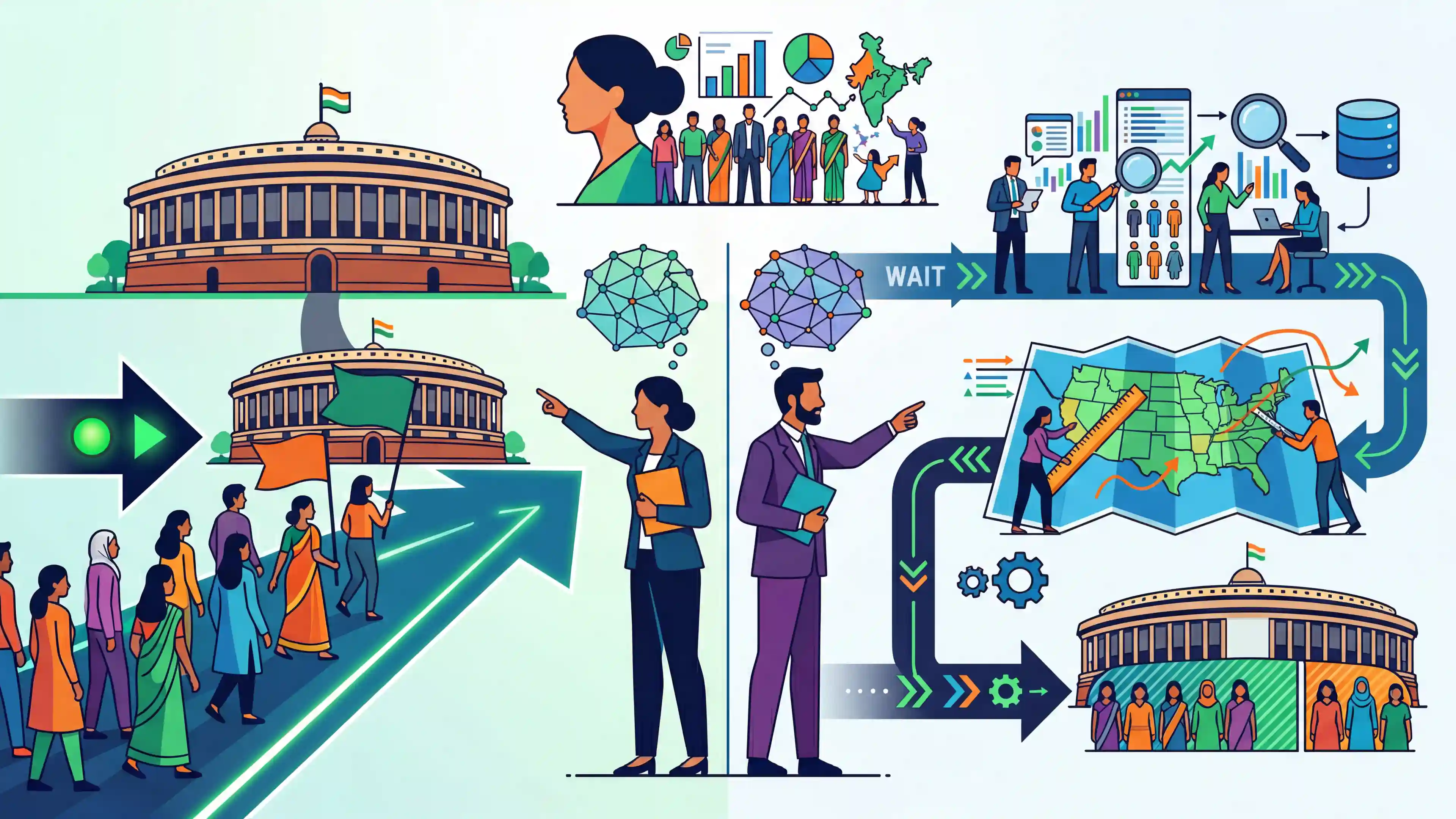
Congress OBC leaders are advocating for a sub-quota for OBC women within the 33% women's reservation for the Lok Sabha and State Assemblies. Crucially, they want this implemented only after a nationwide caste census and delimitation exercise are completed to ascertain the exact OBC population. This stance diverges from the official Congress party line and the All India Mahila Congress's campaign, which demand the immediate implementation of the Women's Reservation Law (Nari Shakti Vandan Adhiniyam). The internal debate highlights the complexities of intersecting identities (gender and caste) in affirmative action policies.
Key Points
- Congress OBC leaders are demanding a sub-quota for OBC women within the overall 33% women's reservation in legislative bodies.
- These leaders insist the women's quota should only be implemented after conducting a nationwide caste census and delimitation exercise.
- This demand contradicts the official Congress party stance and the All India Mahila Congress campaign, which both advocate for the immediate rollout of the women's reservation law.
- Rahul Gandhi has reportedly supported the OBC leaders' perspective, suggesting the position be formalised and presented to the Congress Working Committee.
Important Terms
Nari Shakti Vandan Adhiniyam

Official name of the 106th Constitutional Amendment Act, 2023, reserving 33% of seats for women in the Lok Sabha and State Legislative Assemblies.
UPSC context
GS Paper 2 (Polity/Governance); tests constitutional amendments, political representation, and gender-inclusive legislative reforms.
Caste Census
A nationwide exercise to enumerate individuals based on caste identity to assess socio-economic status, particularly for Other Backward Classes (OBCs).
UPSC context
GS Papers 1 & 2 (Society/Social Justice); tests understanding of affirmative action data and social stratification.
Delimitation
The process of redrawing constituency boundaries to reflect population changes, ensuring the democratic principle of 'One Vote, One Value.'
UPSC context
GS Paper 2 (Polity); central to electoral reforms, Articles 82/170, and the functioning of the Delimitation Commission.
Quota within Quota
The policy of creating targeted sub-categories within a reserved class (SC/ST/OBC) to ensure equitable benefit distribution among most marginalized sub-groups.
UPSC context
GS Paper 2 (Social Justice); involves 'substantive equality' debates and recent Supreme Court rulings on sub-classification.
Congress Working Committee (CWC)
The principal executive and decision-making body of the Indian National Congress (INC), responsible for national policy and organizational strategy.
UPSC context
GS Paper 1 (Freedom Struggle) & Paper 2; relevant for historical organizational evolution and internal party democracy.
Prelims Trap
The Nari Shakti Vandan Adhiniyam mandates a 33% reservation for women in the Lok Sabha, including sub-quotas for SC, ST, and OBC women.
The 106th Amendment creates SC and ST sub-quotas within existing political reservations, but there is NO constitutional provision for an OBC sub-quota in legislatures.
Static Concepts Connected
What are the key constitutional provisions added by the 106th Amendment Act?
- Articles 330A & 332A: Reserves 33% of seats for women in the Lok Sabha and State Legislative Assemblies, including mandatory sub-quotas for SC and ST women.
- Article 239AA: Extends the 33% women's reservation to the Legislative Assembly of the National Capital Territory of Delhi.
- Article 334A: Mandates that the reservation takes effect only after the first census published post-enactment and its subsequent delimitation exercise.
How does the Delimitation Commission function under Article 82?
- Statutory Body: Appointed by the President of India, it works in close collaboration with the Election Commission of India.
- Final Authority: Its orders carry the force of law and cannot be questioned or challenged before any court.
- Current Freeze: State-wise allocation of Lok Sabha seats remains frozen based on the 1971 Census until figures of the first census after 2026 are published.
Cross-Topic Patterns
106th Amendment vs. Local Governance Quotas
Unlike the 106th Amendment (contingent on future delimitation), the 73rd and 74th Amendments immediately granted a baseline 33% reservation to women in Panchayats and Municipalities without waiting for census exercises.
Political vs. Educational/Employment Quotas
Debates on OBC political quotas highlight the difference between Article 15/16 (education/jobs reservations, tested frequently) and Article 330/332 (political reservations in legislatures, which currently lack OBC provisions).

Expect a Prelims statement confusing the 106th Amendment's delimitation condition with immediate Panchayat reservations (73rd Amendment).
Linked PYQs · 3
Linked PYQs · 3
- 2023MainsGS2
Discuss the contribution of civil society groups for women's effective and meaningful participation and representation in state legislatures in India.
- 2019MainsGS2
“The reservation of seats for women in the institutions of local self-government has had a limited impact on the patriarchal character of the Indian Political Process.” Comment.
- 2024PrelimsGS1
How many Delimitation Commissions have been constituted by the Government of India till December 2023?
