Political Discourse and Hindu Majority Sensibilities in India
Source:Indian Express ↗
Why It Matters
This article is crucial for understanding the complex interplay between religion, electoral politics, and secularism in India. It provides analytical fodder for GS-1 (Indian Society, Secularism) and GS-2 (Polity, Role of Political Parties) by exploring how political parties balance majoritarian sensibilities with constitutional secularism.
Summary
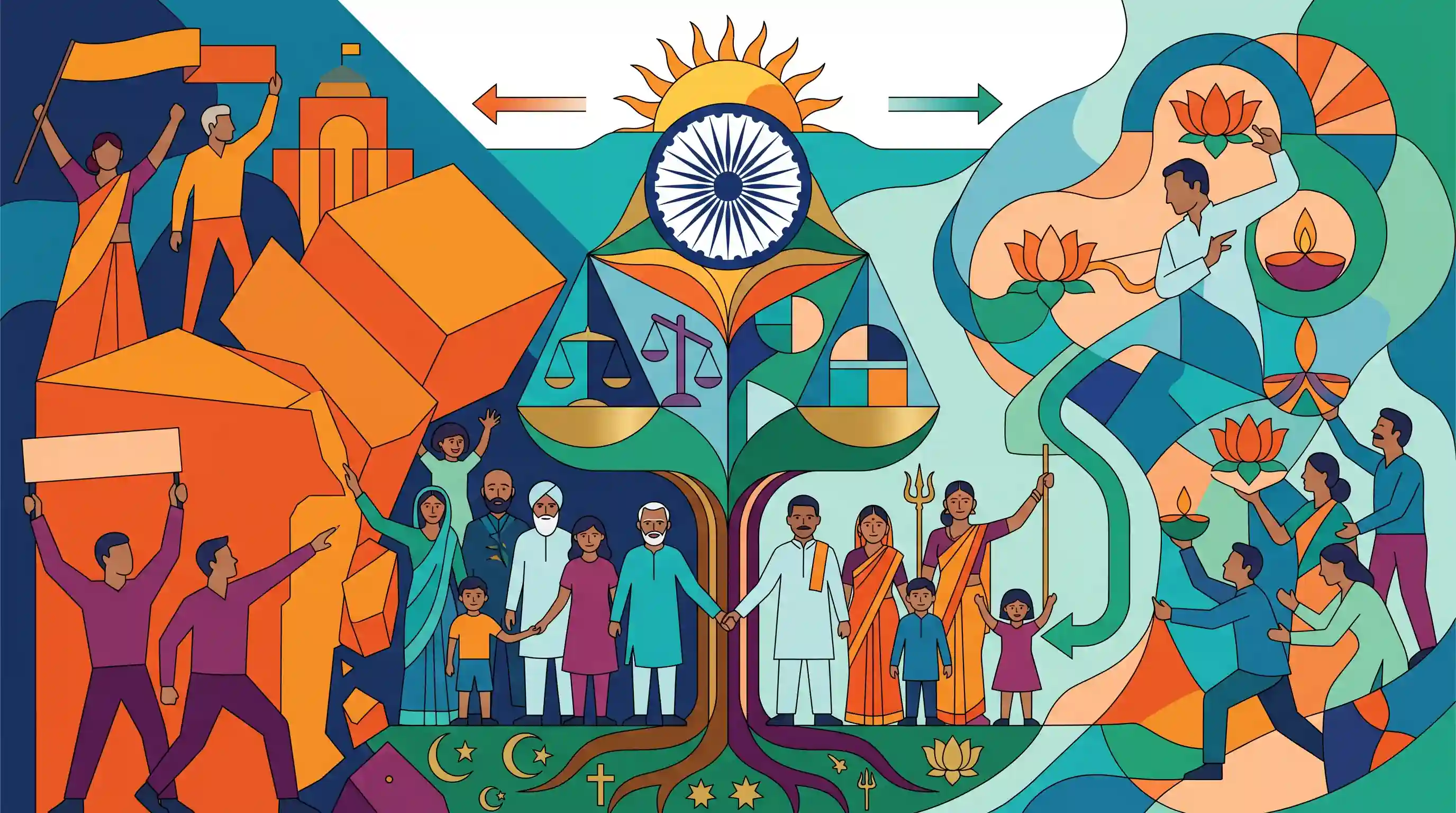
In an opinion piece for The Indian Express, Vandita Mishra argues that the Indian National Congress must actively engage with the 'Hindu' demographic and its cultural sensibilities, rather than conceding this space to the Bharatiya Janata Party's (BJP) majoritarian politics. The author suggests that the Congress needs to articulate a pluralistic and inclusive version of Hinduism that resonates with the majority while staying true to secular values. The article emphasizes that the Indian model of secularism—rooted in equal respect for all religions—allows for acknowledging majority cultural symbols without violating constitutional principles, thereby preventing majoritarian narratives from monopolizing the political discourse.
Key Points
- The Congress party needs to engage directly with the cultural and religious sensibilities of the Hindu majority, rather than ceding this demographic entirely to the BJP's Hindutva narrative.
- Reclaiming the 'Hindu' narrative involves promoting an inclusive, tolerant, and pluralistic version of Hinduism that stands in contrast to majoritarianism.
- In the Indian political context, addressing the majority community's cultural symbols is not antithetical to secularism; it aligns with the 'Sarva Dharma Sambhava' (equal respect for all religions) model.
- A robust political strategy must bridge the gap between secular principles and the lived religious experiences of the majority, avoiding the perception that secularism is solely about minority appeasement.
Important Terms
Indian Secularism

The 'positive' concept of secularism where the state maintains 'principled distance' and equal respect for all religions, rather than the strict Western model of separation.
UPSC context
GS II (Constitution) and GS I (Society); tests distinctions between Indian and Western constitutional models.
Sarva Dharma Sambhava
A Gandhian principle meaning 'equal respect for all religions,' serving as the philosophical bedrock of India's secular fabric and religious coexistence.
UPSC context
GS II (Constitutional Values) and GS IV (Ethics); central to the philosophy of Indian secularism.
Majoritarianism
A political philosophy asserting that a majority (religious, linguistic, or social) is entitled to primacy in society and has the right to make decisions for everyone.
UPSC context
GS II (Polity) and GS I (Social Issues); relates to challenges like communalism and the tyranny of the majority.
Pluralism
The coexistence of diverse ethnic, religious, and linguistic groups within a single society; considered a salient feature of Indian civilization.
UPSC context
GS I (Society); tested under 'Salient features of Indian Society' and 'Unity in Diversity.'
Hindutva
An ideology of cultural nationalism that defines Indian identity through Hindu values and civilizational ethos, often contrasted with Nehruvian secularism.
UPSC context
GS I (Secularism/Communalism) and GS II (Political Ideologies); relevant to debates on national identity.
Indian National Congress (INC)
Founded in 1885, it is India's oldest party; it led the freedom struggle and historically championed a 'big tent' pluralistic and secular nationalism.
UPSC context
GS I (History) and GS II (Political Parties); focuses on its role in democratization and secular governance.
Bharatiya Janata Party (BJP)
A major political party established in 1980 that advocates for cultural nationalism and currently represents the dominant right-wing force in Indian politics.
UPSC context
GS II (Political Parties); tests understanding of party systems and ideological shifts in Indian democracy.
Prelims Trap
"The Indian Constitution mandates a strict wall of separation between the State and religion."
India practices 'positive secularism' and 'principled distance', allowing state intervention in religious affairs (like abolishing untouchability) and providing equal support, unlike the Western strict separation model.
Static Concepts Connected
How does the Indian model of secularism differ from the Western model?
- Western Model: Strict non-interference; the state and religion operate in mutually exclusive spheres without any overlap.
- Indian Model: Based on 'principled distance' and 'Sarva Dharma Sambhava' (equal respect and treatment for all religions).
- State Intervention: Allows positive state intervention in religious affairs to enact social reforms (e.g., abolishing untouchability) or manage religious endowments.
Which fundamental rights explicitly safeguard secularism in the Indian Constitution?
- Non-discrimination: Articles 15 and 16 prohibit state discrimination against any citizen on the grounds of religion, race, caste, sex, or place of birth.
- Religious Freedom: Articles 25 and 26 guarantee freedom of conscience, the right to freely profess, practice, and propagate religion, and manage religious affairs.
- Taxes and Education: Articles 27 and 28 prohibit taxes for promoting a particular religion and restrict religious instruction in wholly state-funded educational institutions.
Cross-Topic Patterns
Electoral appeals & RPA 1951
The political debate around mobilizing religious demographics directly intersects with Section 123(3) of the Representation of the People Act, which defines appealing to voters based on religion as a corrupt practice.
S.R. Bommai & Basic Structure
Secularism's status as a Basic Structure feature was cemented in S.R. Bommai (1994), linking India's model of secularism directly to federalism and the misuse of President's Rule (Article 356).

Expect a Mains GS2 question evaluating India's 'principled distance' vs Western 'strict separation' in the context of recent debates.
Linked PYQs · 4
Linked PYQs · 4
- 2024MainsGS2
Discuss India as a secular state and compare with the secular principles of the US constitution.
- 2022MainsGS1
Are tolerance, assimilation and pluralism the key elements in the making of an Indian form of secularism? Justify your answer.
- 2018MainsGS1
How the Indian concept of secularism is different from the western model of secularism? Discuss.
- 2014MainsGS1
How do the Indian debates on secularism differ from the debates in the West?
