Mullaperiyar Dam Safety Panel Removal Sparks Inter-State Tension
Source:The Hindu ↗
Why It Matters
The controversy illustrates the ongoing complexities in managing inter-state water disputes and shared infrastructure. It highlights the functional challenges and trust deficits between states and central statutory bodies like the NDSA, relevant for understanding federalism and disaster management frameworks.
Summary
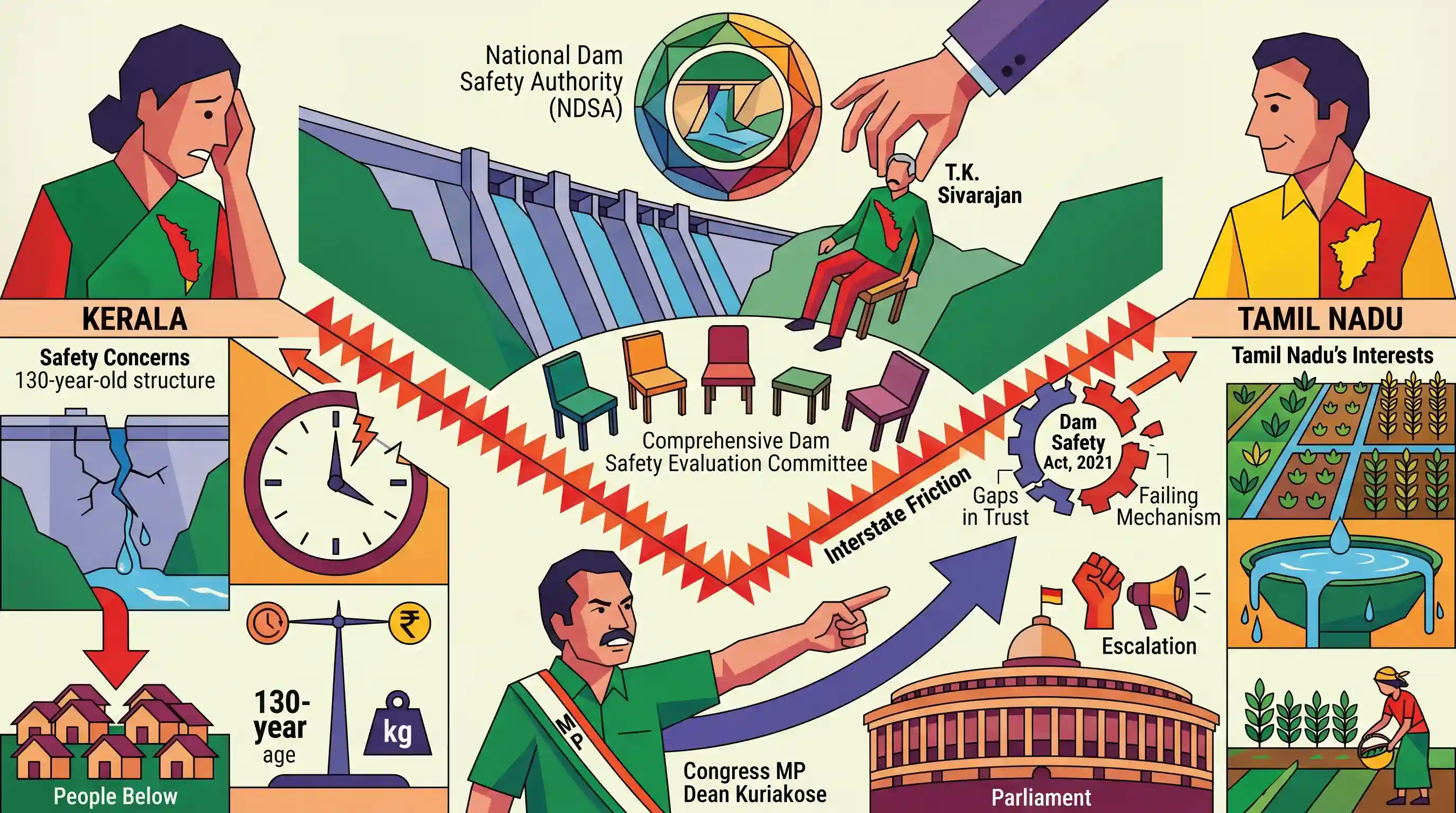
Congress MP Dean Kuriakose has strongly condemned the National Dam Safety Authority's (NDSA) unilateral removal of Kerala's representative, T.K. Sivarajan, from the Comprehensive Dam Safety Evaluation Committee for the Mullaperiyar dam. Kuriakose contends that the move compromises Kerala's safety concerns regarding the 130-year-old structure and appears to favor Tamil Nadu's interests. He has warned of escalating the matter to Parliament, underscoring the enduring interstate friction between Kerala and Tamil Nadu over the dam's management and highlighting potential gaps in trust within statutory dispute and safety mechanisms under the Dam Safety Act, 2021.
Key Points
- Congress MP Dean Kuriakose protested the National Dam Safety Authority's (NDSA) unilateral removal of Kerala's representative, T.K. Sivarajan, from the Mullaperiyar dam safety evaluation panel.
- Kuriakose alleged the removal jeopardizes Kerala's safety concerns regarding the 130-year-old dam and unfairly favors Tamil Nadu's interests.
- The MP threatened to raise the issue in Parliament if the representative is not reinstated, highlighting a breach of federal trust.
- The panel was constituted following Supreme Court directives under the Dam Safety Act to conduct a comprehensive safety review of the contentious Mullaperiyar dam.
Important Terms
Dam Safety Act, 2021

Enacted in 2021, this legislation provides a uniform national framework for the surveillance, inspection, operation, and maintenance of specified dams to prevent failure-related disasters and ensure institutional accountability.
UPSC context
GS Paper II (Statutory Bodies) and GS Paper III (Disaster Management); tests knowledge of regulatory frameworks for infrastructure safety.
National Dam Safety Authority (NDSA)
A statutory body under the Ministry of Jal Shakti established to implement dam safety policies, provide technical assistance, and resolve disputes between state-level safety organizations or dam owners.
UPSC context
GS Paper II (Governance); relevant for understanding the executive's role in inter-state resource management and technical regulation.
Comprehensive Dam Safety Evaluation Committee (CDSEC)
A five-member expert panel formed by the NDSA under the Dam Safety Act, 2021, to conduct detailed technical and structural assessments of the 130-year-old Mullaperiyar dam.
UPSC context
GS Paper III (Infrastructure/Safety); illustrates the application of statutory safety protocols in high-risk, aging infrastructure projects.
Supreme Court of India
As the final arbiter of inter-state disputes, the Court oversees the Mullaperiyar conflict, directing supervisory committees and ensuring safety reviews align with constitutional and statutory mandates.
UPSC context
GS Paper II (Judiciary/Federalism); tests understanding of original jurisdiction in inter-state water and safety disputes.
Mullaperiyar Dam
A 130-year-old masonry gravity dam on the Periyar River in Kerala, operated by Tamil Nadu, which remains a flashpoint for inter-state legal and safety disputes.
UPSC context
GS Paper I (Geography) and Paper II (Inter-state Relations); a classic case study for federal friction and water sharing.
Prelims Trap
Under the Dam Safety Act 2021, the host State (Kerala) exercises regulatory jurisdiction over the Mullaperiyar Dam.
False. For dams located in one State but owned/operated by another, the National Dam Safety Authority (NDSA) assumes the role of the State authority.
Static Concepts Connected
How is legislative jurisdiction over 'Water' divided between the Centre and States?
- State List: Entry 17 covers water supplies, irrigation, canals, drainage, and water storage, but is strictly subject to the provisions of Entry 56 of the Union List.
- Union List: Entry 56 empowers Parliament to regulate and develop inter-State rivers and river valleys to the extent declared expedient in the public interest.
- Article 262: Article 262 allows Parliament to provide for the adjudication of any dispute or complaint with respect to the use, distribution or control of inter-State rivers.
What is the institutional framework established by the Dam Safety Act, 2021?
- National Bodies: The National Committee on Dam Safety (NCDS) evolves policy, while the National Dam Safety Authority (NDSA) implements it and resolves inter-state safety disputes.
- State Bodies: State Committees on Dam Safety and State Dam Safety Organisations manage surveillance, inspection, and operation of dams strictly within their state boundaries.
Cross-Topic Patterns
Aging Dams & Extreme Weather Risks
The 130-year-old Mullaperiyar's structural integrity overlaps with GS3 Disaster Management, as climate-induced extreme rainfall in the Western Ghats exacerbates catastrophic downstream flooding vulnerabilities.
Centralizing Water Governance
The Dam Safety Act's invocation of Entry 56 to bypass State jurisdiction (Entry 17) mirrors GS2 Centre-State tensions seen in recent Central legislation overriding traditional State subjects.

Expect a prelims pair-matching question on inter-state dams (Mullaperiyar, Almatti) alongside NDSA's statutory powers over host states.
Linked PYQs · 2
Linked PYQs · 2
- 2023MainsGS3
Dam failures are always catastrophic, especially on the downstream side, resulting in a colossal loss of life and property. Analyze the various causes of dam failures. Give two examples of large dam failures.
- 2024MainsGS2
What changes has the Union Government recently introduced in the domain of Centre-State relations ? Suggest measures to be adopted to build the trust between the Centre and the States and for strengthening federalism.
