Election Commission Voter Fraud Data and Transparency Issues
Source:The Hindu ↗
Why It Matters
This highlights emerging vulnerabilities in the electoral process, specifically cyber-related electoral malpractices like forged online deletion requests. It brings the Election Commission's accountability, transparency, and role in ensuring free and fair elections under scrutiny, which is highly relevant for GS-2 (Constitutional Bodies, RPA 1951, Electoral Reforms).
Summary
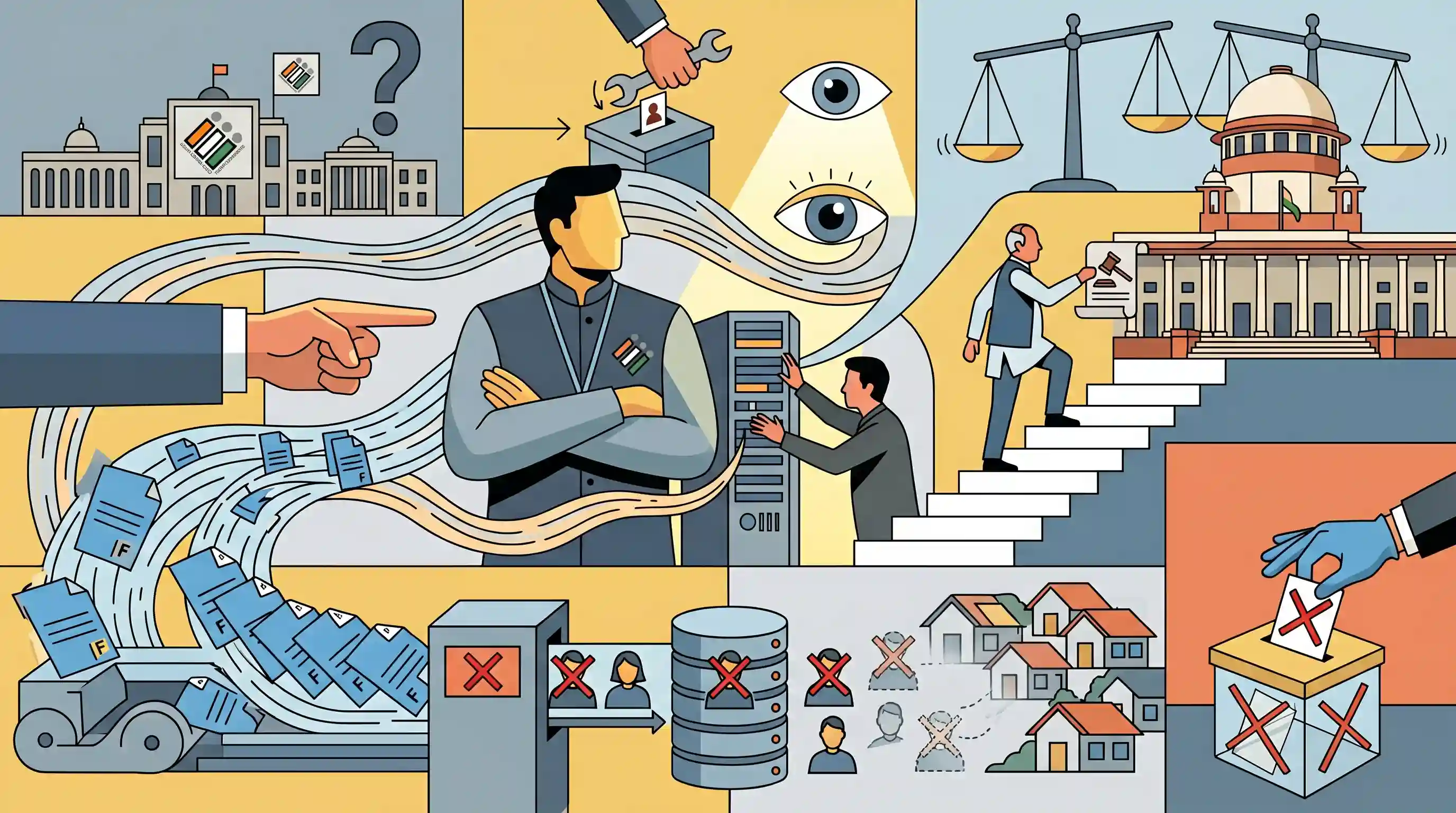
A political controversy has erupted in Karnataka over alleged mass-scale voter fraud involving forged Form 7 applications intended to delete legitimate voters in the Aland constituency before the 2023 elections. Congress MLA B.R. Patil plans to approach the Supreme Court, accusing the Election Commission of India (ECI) of failing to provide the Karnataka CID with essential technical data to unmask the perpetrators. Congress leaders have criticized the ECI for allegedly shielding culprits and compromising its constitutional mandate for transparency and free and fair elections.
Key Points
- Congress MLA B.R. Patil is considering moving the Supreme Court to direct the Election Commission of India (ECI) to share technical data on alleged voter fraud in Karnataka's Aland constituency.
- In the 2023 Karnataka Assembly elections, nearly 5,994 out of 6,018 Form 7s filed in the constituency were forged in an attempt to delete voters' names without their knowledge.
- The Karnataka CID is investigating the case but has not received destination IPs and ports from the ECI despite multiple requests.
- Congress leaders accused the ECI of stonewalling the probe, questioning its transparency and failure to uphold its constitutional responsibility of ensuring free and fair elections.
Important Terms
Election Commission of India (ECI)

An autonomous constitutional authority established under Article 324 to administer election processes for the Lok Sabha, Rajya Sabha, State Legislative Assemblies, and the offices of President and Vice President.
UPSC context
GS Paper II (Constitutional Bodies). Tests knowledge of institutional independence and the mandate for conducting free and fair elections.
Form 7
An official statutory document under the Registration of Electors Rules, 1960, used for objecting to a name's inclusion or requesting the deletion of an existing entry from the electoral roll.
UPSC context
GS Paper II (Electoral Reforms/RPA). Relevant for understanding procedural safeguards against electoral malpractices like mass voter deletion and disenfranchisement.
Representation of the People Act (RPA), 1950
The primary legislation governing the registration of electors, preparation of electoral rolls, and qualifications for voting, providing the legal framework for voter lists and penalties for fraudulent declarations.
UPSC context
GS Paper II (Salient features of the RPA). A core topic regarding the legal administration of India’s representative democracy.
Supreme Court
The highest judicial forum in India, possessing original, appellate, and writ jurisdiction (Article 32) to protect fundamental rights and oversee the actions of constitutional and executive bodies.
UPSC context
GS Paper II (Judiciary). Tests understanding of judicial review, writ jurisdiction, and the court's role in ensuring constitutional compliance.
Criminal Investigation Department (CID)
A specialized branch of the State Police responsible for investigating high-profile, sensitive, or complex crimes like forgery and fraud, often at the direction of the State Government or High Court.
UPSC context
GS Paper II/III (Statutory Bodies/Federalism). Examines the role of state-level investigative agencies in maintaining law and order and federal cooperation.
Prelims Trap
Form 7 under the Registration of Electors Rules is used by NRIs for the inclusion of their names in the electoral roll.
Form 7 is strictly for objecting to a proposed inclusion or seeking the deletion of an existing name from the electoral roll. NRIs must use Form 6A for inclusion.
Static Concepts Connected
What are the key statutory forms for electoral roll management in India?
- Form 6: Used for the registration of new, first-time voters and shifting from one constituency to another.
- Form 6A: Used specifically for the registration of Overseas Indian Electors (NRIs).
- Form 7: Used for objecting to a proposed inclusion or seeking the deletion of an existing name.
- Form 8: Used for the correction of entries, shifting of residence, or requesting a replacement EPIC.
How does the Constitution restrict judicial intervention in the electoral process?
- Article 329(b): Bars courts from interfering in elections; challenges can only be made via an Election Petition to the prescribed authority (High Court).
- Article 329(a): The validity of laws relating to the delimitation of constituencies or allotment of seats cannot be questioned in any court.
Cross-Topic Patterns
Cyber-fraud in Electoral Rolls
Mass forgery of Form 7 via digital portals introduces cyber-investigation (IP logs, ports) into the election domain, bridging the IT Act and the Representation of the People Act.
Article 324 vs State Law Enforcement
The ECI's reluctance to share technical data with the State CID highlights federal friction, questioning the boundaries of ECI's absolute superintendence versus state police jurisdiction over general criminal offenses.

Expect a nuanced Prelims statement distinguishing the scope of RPA 1950 (electoral rolls/Form 7) from RPA 1951 (corrupt election practices).
Linked PYQs · 4
Linked PYQs · 4
- 2022MainsGS2
Discuss the role of the Election Commission of India in the light of the evolution of the Model Code of Conduct.
- 2024MainsGS2
Examine the need for electoral reforms as suggested by various committees with particular reference to "one nation one election" principle.
- 2020MainsGS2
There is a need for simplification of procedure for disqualification of persons found guilty of corrupt practices under the Representation of Peoples Act". Comment.
- 2022MainsGS2
Discuss the procedures to decide the disputes arising out of the election of a Member of the Parliament or State Legislature under The Representation of the People Act, 1951. What are the grounds on which the election of any returned candidate may be declared void ? What remedy is available to the aggrieved party against the decision ? Refer to the case laws.
