India Foreign Policy Tradition Opposes Regime Change by Force
Source:Indian Express ↗
Why It Matters
Understanding the tension between historical non-alignment/non-interventionist principles and modern, pragmatic diplomatic engagements (like closer ties with Israel) is crucial for analyzing India's evolving role in the volatile Middle East.
Summary
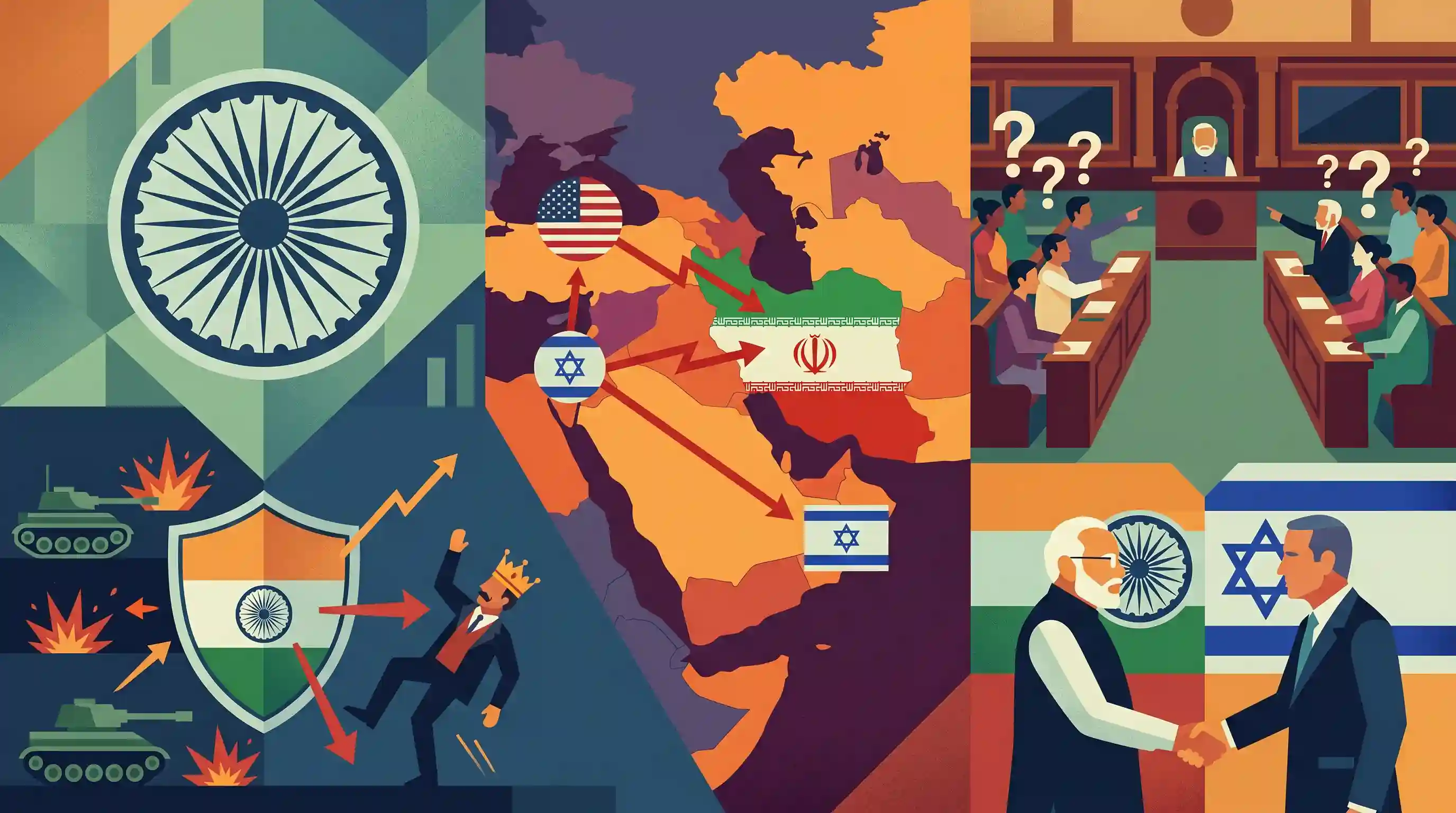
Congress leader Manish Tewari emphasized that India's historical foreign policy doctrine has never supported regime change by force, contextualizing his remarks against the backdrop of the escalating US-Iran-Israel conflict. He defended the opposition's questioning of Prime Minister Narendra Modi's diplomatic engagements, specifically his visit to Israel, arguing that robust domestic debate on foreign policy is a legitimate democratic process. The remarks highlight the tension between India's traditional non-interventionist stance and its evolving strategic partnerships in the Middle East.
Key Points
- Congress leader Manish Tewari articulated that non-intervention and opposition to forced regime change remain core, historical principles of India's foreign policy.
- The Congress party characterized questions surrounding PM Modi's diplomatic visit to Israel as legitimate, reflecting opposition concerns over India's balancing act in West Asia.
- The statements reflect the ongoing domestic political discourse regarding how India navigates the volatile geopolitical situation involving the US, Iran, and Israel.
- The assertion underscores the domestic debate on maintaining historical continuity in Indian diplomacy versus pursuing pragmatic partnerships during global crises.
Important Terms
De-hyphenation Policy

A diplomatic strategy where India maintains independent bilateral relations with Israel and Palestine, ensuring growth in one relationship is not constrained by the status of the other.
UPSC context
GS Paper 2: International Relations. Tests understanding of India’s pragmatic shift from ideological balancing to interest-based diplomacy in West Asia.
Strategic Autonomy
India's foreign policy doctrine of maintaining independence in decision-making and resisting alignment with any power bloc to protect its own national interests.
UPSC context
GS Paper 2: Foreign Policy. A cornerstone concept testing how India navigates conflicting global interests (e.g., US vs. Iran).
Non-interference
One of the five principles of Panchsheel (1954), stating that nations should not intervene in the internal affairs of other sovereign states.
UPSC context
GS Paper 2: International Relations. Foundational principle of Indian diplomacy; relevant for debates on 'regime change' and sovereignty.
Two-State Solution
A proposed diplomatic resolution to the Israeli-Palestinian conflict that advocates for two independent states, Israel and Palestine, living side-by-side in peace.
UPSC context
GS Paper 2: West Asia Relations. Tests knowledge of India’s long-standing support for Palestinian statehood despite growing Israel ties.
I2U2 Grouping
A strategic partnership between India, Israel, the UAE, and the USA focused on joint investments in water, energy, transportation, space, health, and food security.
UPSC context
GS Paper 2: Bilateral/Multilateral Groupings. Key for discussing India’s 'Look West' policy and economic integration in West Asia.
Energy Security
The assurance of reliable and affordable access to energy resources, critical for India which imports roughly 90% of its oil and gas needs from regions like West Asia.
UPSC context
GS Paper 3: Infrastructure and Energy. Highlights why stability in the Strait of Hormuz is a core Indian national interest.
Indian National Congress
Founded in 1885, it is one of India's two major political parties; historically shaped India's early non-aligned and pro-Palestine foreign policy stances.
UPSC context
GS Paper 1: Modern History / GS Paper 2: Polity. Relevant for understanding the historical continuity and ideological shifts in Indian diplomacy.
Prelims Trap
India's transition to a de-hyphenation policy formally ended its historical support for the two-state solution.
De-hyphenation means treating relations with Israel and Palestine independently, not as a zero-sum game. India still officially supports a sovereign, independent Palestinian state (two-state solution).
Static Concepts Connected
What are the core tenets of the Panchsheel Agreement guiding India's non-interventionist stance?
- Mutual respect: Strict adherence to and mutual respect for each other's territorial integrity and national sovereignty.
- Non-interference: A foundational commitment to mutual non-interference in each other's internal affairs, effectively opposing forced regime changes.
- Peaceful co-existence: Commitment to mutual non-aggression, equality, mutual benefit, and peaceful co-existence, which later became the bedrock of the Non-Aligned Movement (NAM).
How do domestic factors act as determinants of India's foreign policy?
- Parliamentary scrutiny: Legislative debates, parliamentary committees, and opposition questioning hold the executive accountable, ensuring foreign policy aligns with a broader national consensus.
- Diaspora & Demographics: The presence of massive diaspora populations (e.g., in the Gulf) forces the government to balance diplomatic ties to ensure civilian safety and economic remittances.
- Coalition dynamics: Regional political parties and coalition dynamics often constrain or push the central government on specific bilateral issues (e.g., historically with Sri Lanka or Bangladesh).
Cross-Topic Patterns
Energy Security & Diaspora Dynamics
India's diplomatic tightrope between Israel and Iran is driven by GS-3 economic realities: securing critical energy imports and safeguarding livelihoods and remittances from the 8-million-strong Indian diaspora in the Gulf.
Parliamentary Scrutiny in Foreign Policy
Connects GS-2 polity (legislative control over executive) with IR. Debates over prime ministerial visits highlight how domestic opposition shapes the boundaries of India's strategic autonomy and non-alignment legacy.

Expect a GS-2 mains question analyzing how domestic political pressures constrain or influence India’s multi-alignment policy in West Asia.
Linked PYQs · 3
Linked PYQs · 3
- 2018MainsGS2
“India’s relations with Israel have, of late, acquired a depth and diversity, which cannot be rolled back.” Discuss.
- 2018PrelimsGS1
The term "two-state solution" is sometimes mentioned in the news in the context of the affairs of
- 2023PrelimsGS1
Consider the following statements: Statement-I: Israel has established diplomatic relations with some Arab States. Statement-II: The 'Arab Peace Initiative' mediated by Saudi Arabia was signed by Israel and Arab League. Which one of the following is correct in respect of the above statements?
