Political Fallout Over Failed Women Reservation Legislation
Source:Indian Express ↗
Why It Matters
This political clash highlights fundamental UPSC GS2 themes such as the structural challenges to securing women's political representation, the constitutional implications of tying legislative quotas to delimitation, and the evolving role of the Election Commission in enforcing the Model Code of Conduct.
Summary
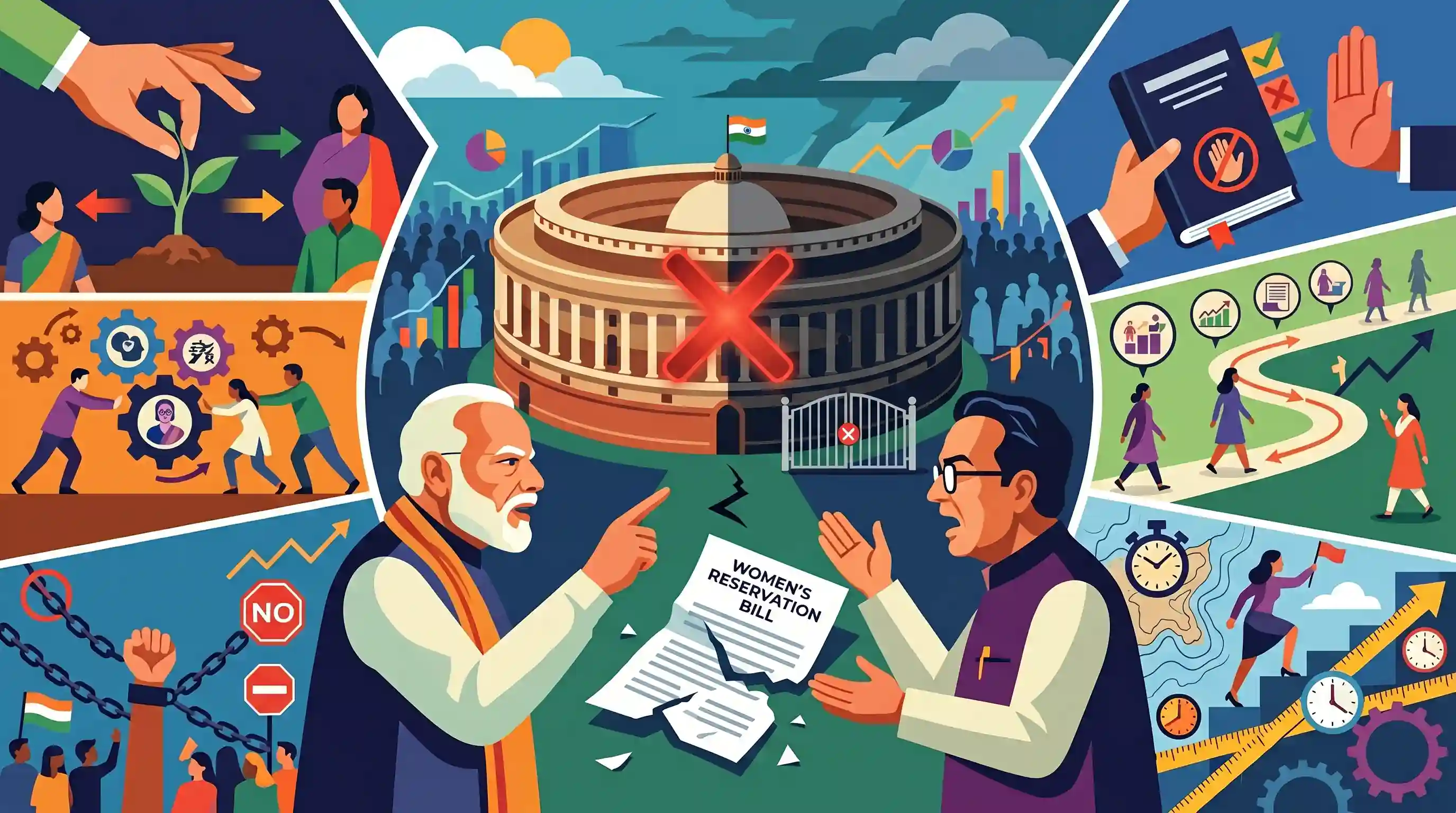
The failure of a Women's Reservation Bill in the Lok Sabha has triggered a major political confrontation. Prime Minister Narendra Modi accused Opposition parties of deliberately defeating the measure, drawing analogies to 'female foeticide' and labeling the Congress anti-reform. In response, Congress President Mallikarjun Kharge accused the Prime Minister of desperation and violating the Model Code of Conduct. Kharge defended his party's legacy of advancing women's empowerment through historical legislations like the Hindu Code Bills and the 2010 Rajya Sabha bill. Furthermore, the Opposition argued that tying the new reservation bill to a future delimitation exercise delayed actual representation, criticizing the move as politically motivated. The debate underscored ongoing challenges surrounding women's political representation and electoral reforms in India.
Key Points
- A newly introduced Women's Reservation Bill failed to pass in the Lok Sabha, sparking a fierce political clash between the ruling BJP and the Opposition.
- Prime Minister Narendra Modi strongly criticized the Opposition, comparing the defeat of the bill to "female foeticide" and calling Congress an anti-reform party.
- Congress President Mallikarjun Kharge retaliated by accusing the PM of political desperation and misusing the Election Commission's Model Code of Conduct for campaigning.
- Kharge highlighted the Congress party's historical contribution to women's rights, including the Hindu Code Bills, workplace harassment laws, and the 2010 passage of a women's reservation bill in the Rajya Sabha.
- The Opposition criticized the current government's bill for its linkage to future delimitation exercises, arguing it functions more as an electoral boundary redrawing tool than an immediate empowerment measure.
- Kharge also invoked NCRB statistics to point out the high rate of crimes against women in BJP-ruled states, challenging the government's commitment to women's safety.
Important Terms
Women's Reservation Bill

A landmark legislation (such as the Nari Shakti Vandan Adhiniyam, 2023) that reserves 33% of seats for women in the Lok Sabha and State Legislative Assemblies.
UPSC context
GS Paper II (Governance/Polity); key for topics on gender representation and constitutional amendments.
Model Code of Conduct
A set of guidelines issued by the Election Commission of India to regulate the conduct of political parties and candidates during elections to ensure free and fair polls.
UPSC context
GS Paper II (Elections); essential for understanding electoral integrity and Article 324.
Hindu Code Bills
A series of laws enacted in the 1950s to codify and reform Hindu personal law, granting women significant rights in inheritance, marriage, and divorce.
UPSC context
GS Paper I (Social Issues/Post-Independence History); tests knowledge of social reform and legislative history.
Delimitation
The act of redrawing boundaries of Lok Sabha and State Assembly seats based on the latest census to reflect population changes, often linked to the implementation of reservation.
UPSC context
GS Paper II (Elections); critical for understanding federalism and political representation.
Election Commission of India
An autonomous constitutional body established under Article 324 responsible for administering union and state election processes in India.
UPSC context
GS Paper II (Constitutional Bodies); fundamental to the study of Indian democracy and electoral governance.
Prelims Trap
The 106th Constitutional Amendment Act immediately implements a 33% women's quota in the Lok Sabha.
Implementation is constitutionally tied to the completion of a delimitation exercise based on the first Census published after the Act's passage, not immediately upon enactment.
Static Concepts Connected
What are the constitutional powers and limitations of the Delimitation Commission?
- Absolute Finality: Its orders have the force of law and cannot be challenged or questioned in any court under Article 329(a).
- No Legislative Veto: When its orders are laid before the Lok Sabha or State Legislative Assembly, they cannot effect any modifications to them.
- Appointment & Collaboration: It is appointed by the President of India and works in close collaboration with the Election Commission of India.
How is the Model Code of Conduct (MCC) legally enforced in India?
- No Direct Statute: The MCC lacks direct statutory backing but derives its broad constitutional authority from Article 324 (superintendence of elections).
- Indirect Enforcement: Certain provisions are enforceable through corresponding clauses in the Representation of the People Act, 1951, the IPC, and CrPC.
- Immediate Application: The Code comes into force immediately when the Election Commission announces the election schedule and remains till results are out.
Cross-Topic Patterns
Women's Quota + 2026 Seat Freeze
Southern states' demographic concerns regarding the lifting of the 2026 Lok Sabha seat freeze intersect directly with the delimitation precondition for implementing the women's reservation mandate.
Ambedkar + Post-Independence Social Reforms
Modern polity debates frequently resurrect post-independence history. Ambedkar's resignation over the Hindu Code Bills remains a critical case study for UPSC on social reform vs. political consensus.

Expect a 2026 polity question linking the 106th CAA's delimitation clause to the constitutional freeze on Lok Sabha seats.
Linked PYQs · 4
Linked PYQs · 4
- 2023MainsGS2
Discuss the contribution of civil society groups for women's effective and meaningful participation and representation in state legislatures in India.
- 2022MainsGS2
Discuss the role of the Election Commission of India in the light of the evolution of the Model Code of Conduct.
- 2024MainsGS2
Examine the need for electoral reforms as suggested by various committees with particular reference to "one nation one election" principle.
- 2019MainsGS1
“Empowering women is the key to control population growth.” Discuss.
