Opposition Scrutiny of Trade Agreements During Budget Session
Source:The Hindu ↗
Why It Matters
The article highlights the intersection of foreign policy, international trade, and domestic economic interests, illustrating the role of parliamentary oversight in questioning bilateral agreements that affect strategic autonomy (like energy security vis-a-vis Russia) and agricultural livelihoods.
Summary
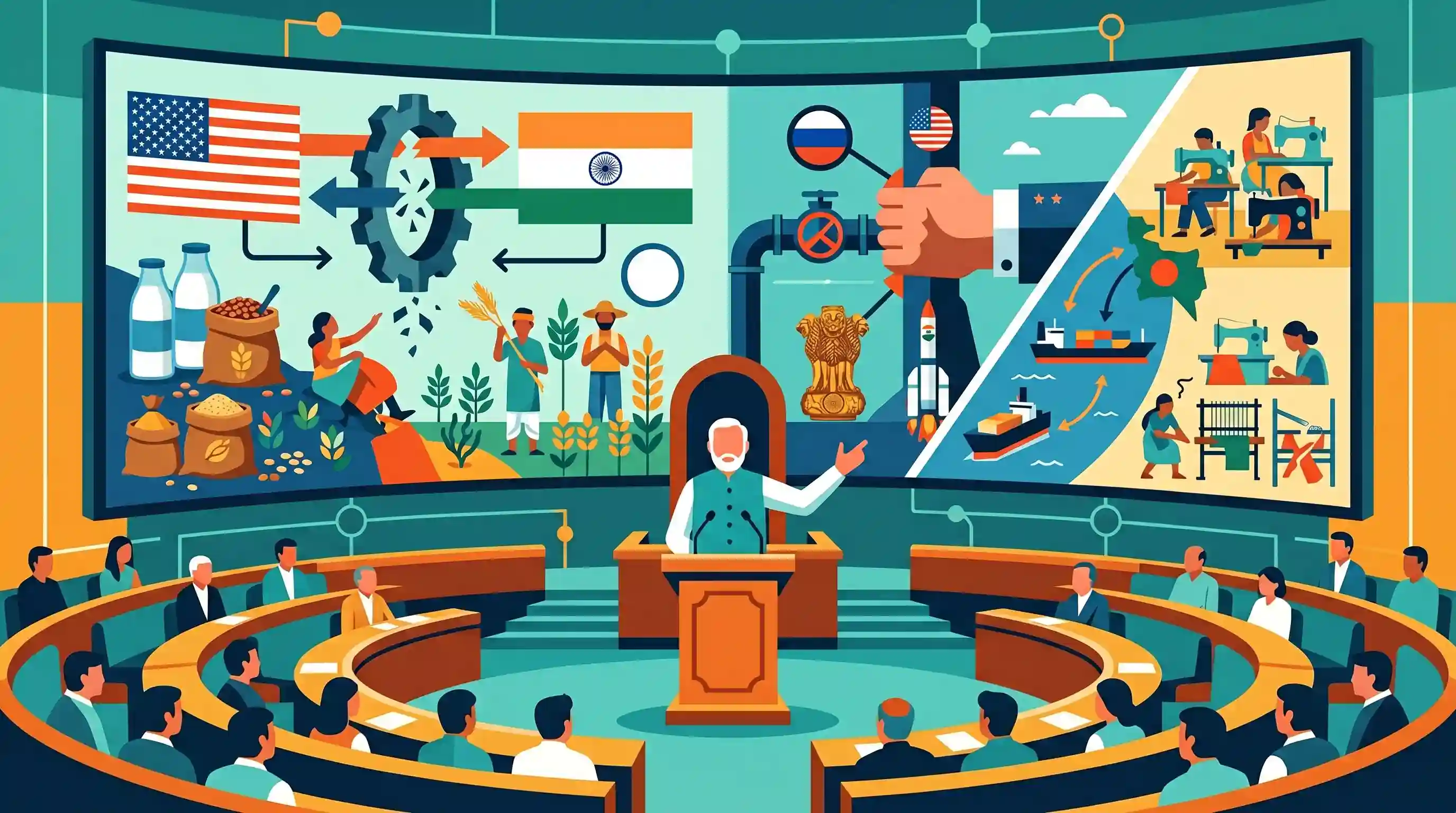
The Congress party is set to highlight the potential adverse effects of the Indo-US trade deal during the Union Budget discussion in the Lok Sabha. Key concerns include the threat to domestic agriculture, specifically the dairy and pulses sectors, due to tariff reductions on U.S. imports. Additionally, the Opposition is criticizing the deal's geopolitical implications, particularly a clause requiring India to halt Russian oil imports to avoid U.S. tariffs, arguing this undermines India's strategic autonomy. The Opposition also intends to raise issues regarding trade concessions granted to Bangladesh and their impact on the Indian apparel sector.
Key Points
- The Congress party plans to focus its Union Budget discussion on the proposed Indo-US trade deal, arguing it undermines India's economic and strategic interests.
- Opposition leaders have expressed concern that the deal will negatively impact Indian dairy farmers and pulse growers due to duty reductions on U.S. agricultural products like dried distillers' grains and sorghum.
- The trade deal includes a provision that restricts India from purchasing Russian Federation oil in exchange for the U.S. removing a 25% tariff, which the Opposition claims compromises India's strategic autonomy.
- The Congress also criticized the government for allegedly making trade concessions to Bangladesh that could harm the domestic apparel sector.
Important Terms
India-US Trade Deal (2026)

A 2026 interim agreement reducing US tariffs on Indian goods from 50% to 18% in exchange for India curbing Russian oil imports and lowering trade barriers.
UPSC context
GS Paper II: Bilateral agreements; GS Paper III: International trade and energy security. Tests understanding of transactional diplomacy.
Strategic Autonomy
A nation's ability to pursue its own foreign policy and national interests without being unduly constrained by other states or international obligations.
UPSC context
GS Paper II: International Relations. Core concept for India's foreign policy and its balancing act between major powers.
Reciprocal Tariff
A trade policy where two nations grant each other similar tariff reductions or market access, often used to de-escalate trade tensions or balance trade deficits.
UPSC context
GS Paper III: Indian Economy and issues relating to planning, mobilization of resources, and growth. Tests knowledge of trade instruments.
Union Budget
The annual financial statement of the Indian government, outlining estimated receipts and expenditures, presented before Parliament for approval under Article 112.
UPSC context
GS Paper II: Polity (Parliamentary proceedings); GS Paper III: Economic Development. Tests legislative process and fiscal policy.
Rules of Origin
Criteria used to determine the national source of a product, essential for applying trade preferences, quotas, or anti-dumping duties in bilateral agreements.
UPSC context
GS Paper III: International Trade and Economy. Crucial for understanding how trade deals like the US-Bangladesh "Cotton for Zero-Tariff" impact India.
Lok Sabha
The lower house of India's bicameral Parliament, directly elected by the people; it holds primary power over money bills and the Union Budget.
UPSC context
GS Paper II: Indian Polity (Structure and functioning of Parliament). Essential for understanding the legislative and budgetary process.
Prelims Trap
Parliamentary ratification is constitutionally mandatory for all international trade agreements signed by India.
In India, treaty-making is an executive function (Article 73). Parliament lacks a mandatory ratification role for treaties unless they require new domestic laws (Article 253).
Static Concepts Connected
How does the Lok Sabha exercise control during the Budget process?
- General Discussion: A broad debate on macroeconomic policy where the Opposition scrutinizes government actions and treaty impacts, without any voting.
- Committee Scrutiny: Departmental Standing Committees examine specific demands for grants in detail during the Parliamentary recess.
- Cut Motions: During voting on demands for grants, MPs can move policy, economy, or token cut motions to reduce requested amounts, enforcing accountability.
Why does discounted Russian crude matter to India's macroeconomy?
- CAD Management: Cheaper oil significantly reduces the national import bill, helping contain the Current Account Deficit (CAD) and stabilizing the Rupee's exchange rate.
- Inflation Control: Lower fuel import costs act as a macroeconomic stabilizer, preventing severe cost-push inflation in domestic transport, agriculture, and manufacturing.
Cross-Topic Patterns
Geoeconomics vs Strategic Autonomy
U.S. efforts to link tariff relief to Russian oil boycotts highlights the shift from WTO-based multilateralism to the 'weaponization of trade' for geopolitical compliance.
Agri-vulnerability in Free Trade Deals
Just as with India's exit from RCEP, the threat of subsidized U.S. dairy highlights the clash between global trade integration and protecting marginal farmers' livelihoods.

Expect a 2026 Mains GS-2 question on how FTAs are increasingly used as tools of geopolitical coercion, challenging strategic autonomy.
Linked PYQs · 3
Linked PYQs · 3
- 2025MainsGS3
What are the challenges before the Indian economy when the world is moving away from free trade and multilateralism to protectionism and bilateralism? How can these challenges be met?
- 2025MainsGS2
"Energy security constitutes the dominant kingpin of India's foreign policy, and is linked with India's overarching influence in Middle Eastern countries.” How would you integrate energy security with India's foreign policy trajectories in the coming years?
- 2018MainsGS3
How would the recent phenomena of protectionism and currency manipulations in world trade affect macroeconomic stability of India?
