Operation Blue Star and historical security decisions spark debate
Source:The Hindu ↗
Why It Matters
The article touches upon two watershed events in India's internal security history: the Khalistan militancy (Operation Blue Star) and cross-border terrorism (26/11 Mumbai attacks). Understanding state responses, policy formulation, and the strategic rationale behind historical military and counter-terrorism decisions is crucial for the Internal Security section of GS Paper 3.
Summary
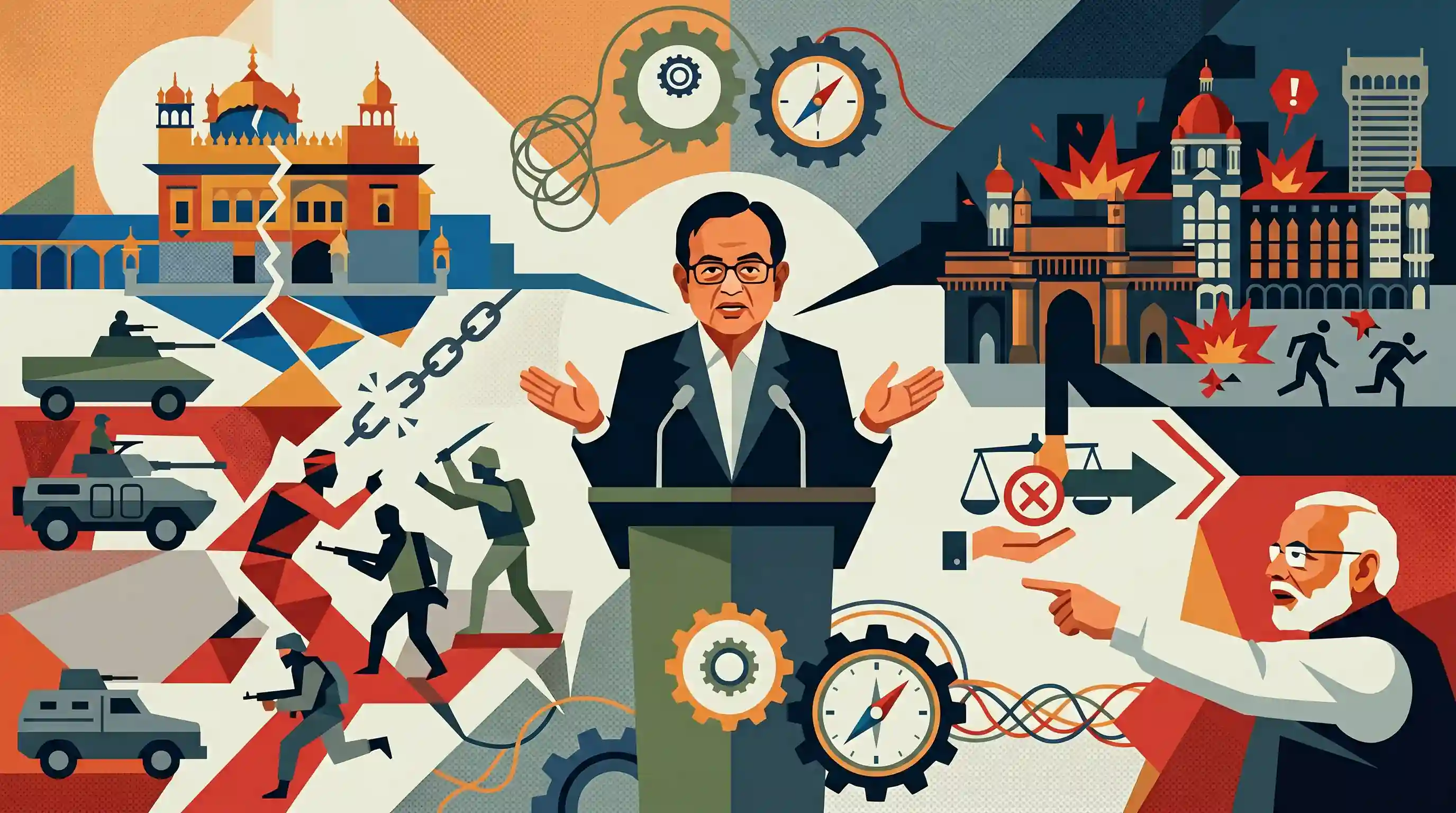
Congress leadership expressed displeasure with senior leader P. Chidambaram over his public remarks concerning Operation Blue Star and the 26/11 Mumbai terror attacks. Chidambaram claimed that Operation Blue Star was the wrong approach to flushing out militants and was a collective failure of various security agencies. Additionally, his admission that the UPA government considered but rejected military retribution after the 26/11 attacks invited criticism from Prime Minister Narendra Modi, highlighting debates over India's historical internal security decisions and counter-terrorism strategies.
Key Points
- Senior Congress leader P. Chidambaram faced backlash from his party leadership over public remarks criticizing the 1984 Operation Blue Star and commenting on the 26/11 Mumbai attacks.
- Chidambaram stated that Operation Blue Star was the wrong way to capture militants in the Golden Temple and called it a cumulative mistake of the Army, intelligence, and police.
- He further revealed that following the 26/11 Mumbai terror attacks, he had contemplated military retribution, but the UPA government ultimately decided against it.
- The statements led to political controversy, with PM Narendra Modi demanding the Congress explain who prevented military retaliation against cross-border terrorism after 26/11.
Important Terms
Operation Blue Star

A 1984 Indian military operation ordered by PM Indira Gandhi to remove Sikh militants, led by Jarnail Singh Bhindranwale, from the Golden Temple complex in Amritsar.
UPSC context
GS Paper I (Post-Independence History) and GS III (Internal Security); tests knowledge of state responses to secessionist movements.
26/11 Mumbai Terror Attacks
A series of coordinated terrorist attacks across Mumbai in November 2008 by Pakistan-based Lashkar-e-Taiba, resulting in major overhauls of India's maritime security and intelligence architecture.
UPSC context
GS Paper III (Internal Security); tests understanding of cross-border terrorism and institutional reforms like the NIA and NATGRID.
Internal Security
The maintenance of peace, sovereignty, and law and order within a nation's borders, primarily managed by the Ministry of Home Affairs against domestic threats.
UPSC context
A core GS Paper III pillar; evaluates comprehension of challenges like insurgency, extremism, and border management.
Counter-terrorism
Political, legal, and military measures designed to prevent and respond to terrorism, involving intelligence coordination, special forces, and legislative frameworks like the UAPA.
UPSC context
GS Paper III (Security); examines India's evolving doctrine from 'strategic restraint' to proactive retaliation and 'zero tolerance'.
Khalistan Movement
A separatist movement seeking to establish a sovereign Sikh state, called Khalistan, in the Punjab region. It peaked in the 1980s but remains a contemporary security concern.
UPSC context
GS Paper III (Internal Security); relevant for studying threats to national integrity and the role of external state actors.
Strategic Restraint
A long-standing Indian security policy of avoiding military escalation despite provocations, notably practiced by the UPA government following the 2008 Mumbai attacks.
UPSC context
GS Paper III (Internal Security/International Relations); tests analysis of India's shift toward a 'Deterrence by Punishment' posture.
Prelims Trap
The NIA was established as India's premier federal counter-terrorism body prior to the 26/11 Mumbai attacks.
The NIA was established via the NIA Act 2008 explicitly in the aftermath of the 26/11 Mumbai attacks to fix systemic intelligence coordination failures.
Static Concepts Connected
What is India's 3-tier coastal security architecture created post-26/11?
- Marine Police: Patrols shallow territorial waters up to 12 nautical miles from the coastline.
- Coast Guard: Secures the maritime zone between 12 and 200 nautical miles, covering the Exclusive Economic Zone (EEZ).
- Indian Navy: Holds overall responsibility for maritime security, patrolling deep seas beyond 200 nautical miles.
How does the doctrine of 'Strategic Restraint' apply to India's security?
- Core Philosophy: Avoiding immediate kinetic military retaliation to prevent nuclear escalation and severe economic disruption.
- Diplomatic Isolation: Prioritizing global forums (like FATF or UN) to diplomatically isolate state-sponsors of terror, as seen post-26/11.
Cross-Topic Patterns
Diaspora extremism & IR
Operation Blue Star's legacy connects directly to GS2 International Relations, specifically concerning the radicalization of sections of the diaspora and recent diplomatic friction with Canada over extremism.
Federalism vs NIA jurisdiction
The NIA's creation post-26/11 frequently triggers GS2 Centre-State disputes. States argue federal terror investigations encroach upon 'Public Order' and 'Police', which are constitutionally State subjects.

Expect GS3 Mains questions linking India's evolution from 'strategic restraint' (26/11) to 'proactive deterrence' (Balakot) in state policy.
Linked PYQs · 4
Linked PYQs · 4
- 2021MainsGS3
Analyse the multidimensional challenges posed by external state and non-state actors, to the internal security of India. Also discuss measures required to be taken to combat these threats.
- 2025MainsGS3
Terrorism is a global scourge. How has it manifested in India? Elaborate with contemporary examples. What are the counter measures adopted by the State? Explain.
- 2020MainsGS3
For effective border area management, discuss the steps required to be taken to deny local support to militants and also suggest ways to manage favourable perception among locals.
- 2019MainsGS3
Cross-border movement of insurgents is only one of the several security challenges facing the policing of the border in North-East India. Examine the various challenges currently emanating across the India-Myanmar border. Also, discuss the steps to counter the challenges.
