Coalition Dynamics in Kerala Government Formation
Source:Indian Express ↗
Why It Matters
The article serves as a practical case study for GS2 Polity topics, demonstrating the complexities of government formation, the role of internal party democracy, and the ongoing influence of regional parties over national alliances.
Summary
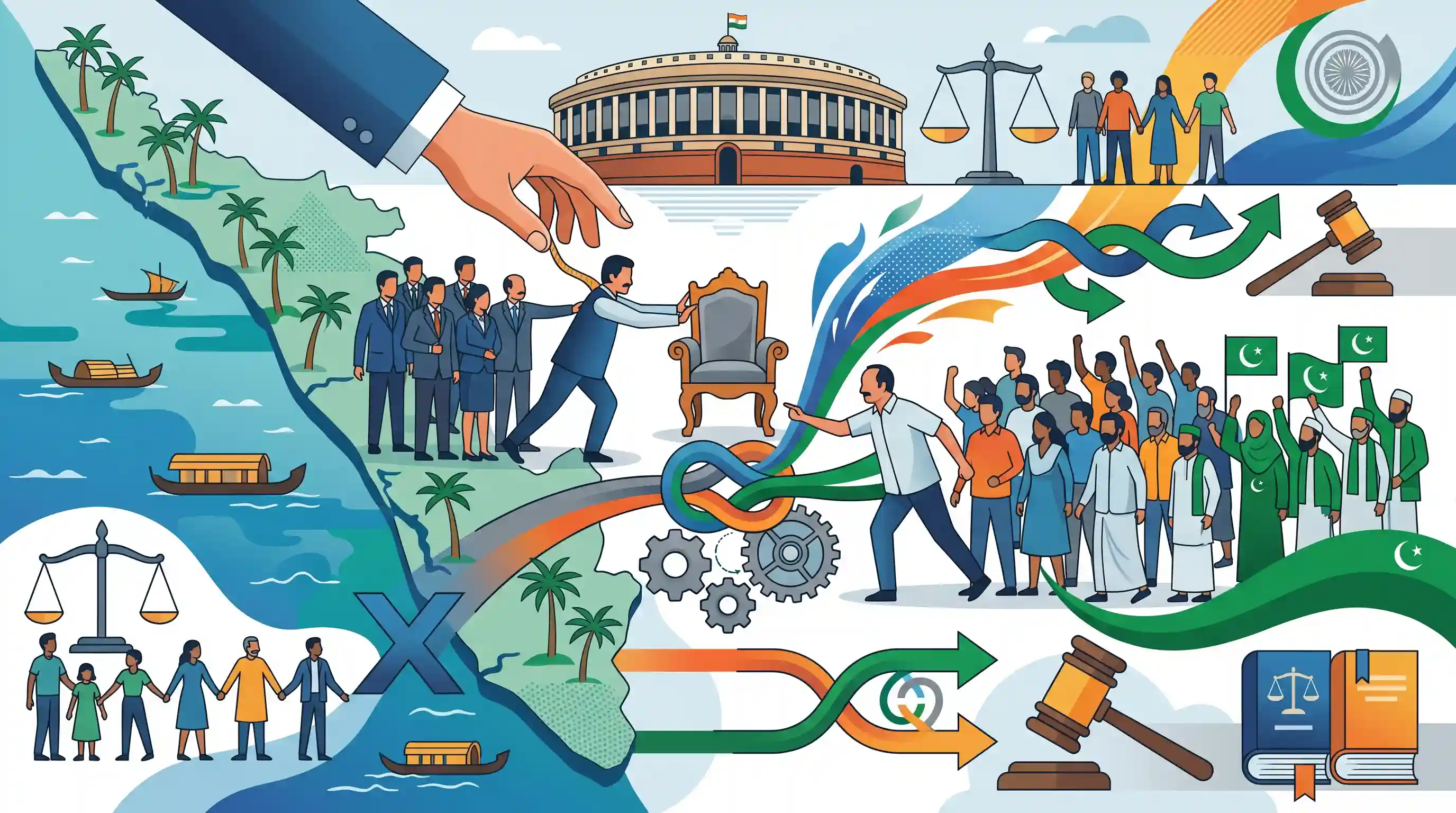
The Congress party's inability to swiftly select a Chief Minister for Kerala following the UDF's election victory underscores complex internal and coalition dynamics. While national general secretary K C Venugopal enjoys the backing of most MLAs, V D Satheesan is favored by party workers, civil society, and key coalition partners like the IUML. The deadlock has forced the party's central high command to intervene, highlighting structural challenges in national political parties. This scenario offers a live example of the tension between internal party democracy, centralized leadership, and the critical influence of regional allies on state-level government formation.
Key Points
- The Congress party and its United Democratic Front (UDF) alliance are facing a prolonged stalemate over selecting Kerala's next Chief Minister following their electoral victory.
- K C Venugopal has the support of a majority of the newly elected Congress MLAs, but V D Satheesan is heavily backed by party workers, civil society, and UDF allies.
- Regional allies, particularly the Indian Union Muslim League (IUML), are exerting significant pressure on the Congress high command to choose a leader acceptable to the broader coalition base rather than just the legislative party.
- The situation illustrates the structural tensions between the central party leadership (high command), internal democracy among MLAs, and the imperatives of coalition politics.
Important Terms
United Democratic Front (UDF)

A Kerala-based political alliance led by the Indian National Congress. It represents a center to center-right platform, drawing significant support from religious minorities and secular voters to alternate power with the LDF.
UPSC context
GS-II: Political parties, coalition dynamics, and regionalism in Indian states.
Indian Union Muslim League (IUML)
A major Kerala-based political party and the second-largest constituent of the UDF. It represents Muslim community interests through a secular-constitutional framework, often playing a decisive role in state government formation.
UPSC context
GS-II: Secularism, role of regional/communal parties, and pressure groups.
Left Democratic Front (LDF)
A Kerala political alliance led by the Communist Party of India (Marxist). It promotes left-wing ideologies, social welfare, and grassroots decentralization, serving as the primary ideological rival to the UDF.
UPSC context
GS-II: Multi-party systems, federalism, and alternate governance models.
Coalition Politics
A governing arrangement where no single party holds a majority, requiring multiple parties to share power. It involves consensus-building through mechanisms like a Common Minimum Programme (CMP) and portfolio allocation.
UPSC context
GS-II: Federal structure, parliamentary democracy, and political stability/challenges.
Article 164
Constitutional provision stating that the Governor appoints the Chief Minister (CM) and other ministers on the CM's advice. It enshrines the principle of collective responsibility to the state's Legislative Assembly.
UPSC context
GS-II: Executive powers, state legislature, and parliamentary conventions.
Congress High Command
Refers to the centralized leadership of the Indian National Congress (AICC). It typically mediates internal party disputes, selects state-level leadership, and negotiates with regional coalition partners during government formation.
UPSC context
GS-II: Internal party democracy and centralization in political parties.
Prelims Trap
"The Election Commission can deregister a political party for failing to hold internal leadership elections."
While Section 29A of the RPA 1951 requires parties to swear allegiance to democratic principles, the ECI lacks statutory power to deregister them for failing to hold internal elections.
Static Concepts Connected
What distinguishes the "Political Party" from the "Legislature Party" under the Tenth Schedule?
- Political Party: The broader organizational structure (high command, workers, members) that sets the ideology, tickets, and official directives.
- Legislature Party: The specific, limited group of elected MPs or MLAs belonging to that political party within the legislature.
- Judicial Precedent: In the 2023 Subhash Desai case, the SC clarified that the 'political party' holds authority to appoint the whip and legislature leader, not just the MLAs.
Does the Constitution regulate how a Chief Minister is selected by a winning party?
- Article 164: Merely states the CM shall be appointed by the Governor. It prescribes no internal democratic mechanism for how a party chooses its leader.
- Parliamentary Convention: The Governor invites the leader of the majority coalition. The internal selection process (MLAs voting vs. High Command fiat) is entirely non-statutory and informal.
Cross-Topic Patterns
Inner-Party Democracy & RPA 1951
The Kerala stalemate highlights the lack of statutory enforcement for intra-party democracy, connecting to the 170th Law Commission's demand for regulatory frameworks over opaque 'High Command' cultures.
Tenth Schedule limits on MLA autonomy
MLAs cannot freely back a factional leader against the official party line without risking defection, subordinating individual legislative agency to central party mandates under the Tenth Schedule.

Expect a GS2 question evaluating the statutory void in regulating intra-party democracy, linking RPA 1951 Section 29A and ECI's limits.
Linked PYQs · 1
Linked PYQs · 1
- 2022MainsGS2
“While the national political parties in India favour centralisation, the regional parties are in favour of State autonomy.” Comment.
