INDIA bloc MPs protest exam paper leaks and BNSS restrictions
Source:The Hindu ↗
ఇది ఎందుకు ముఖ్యం
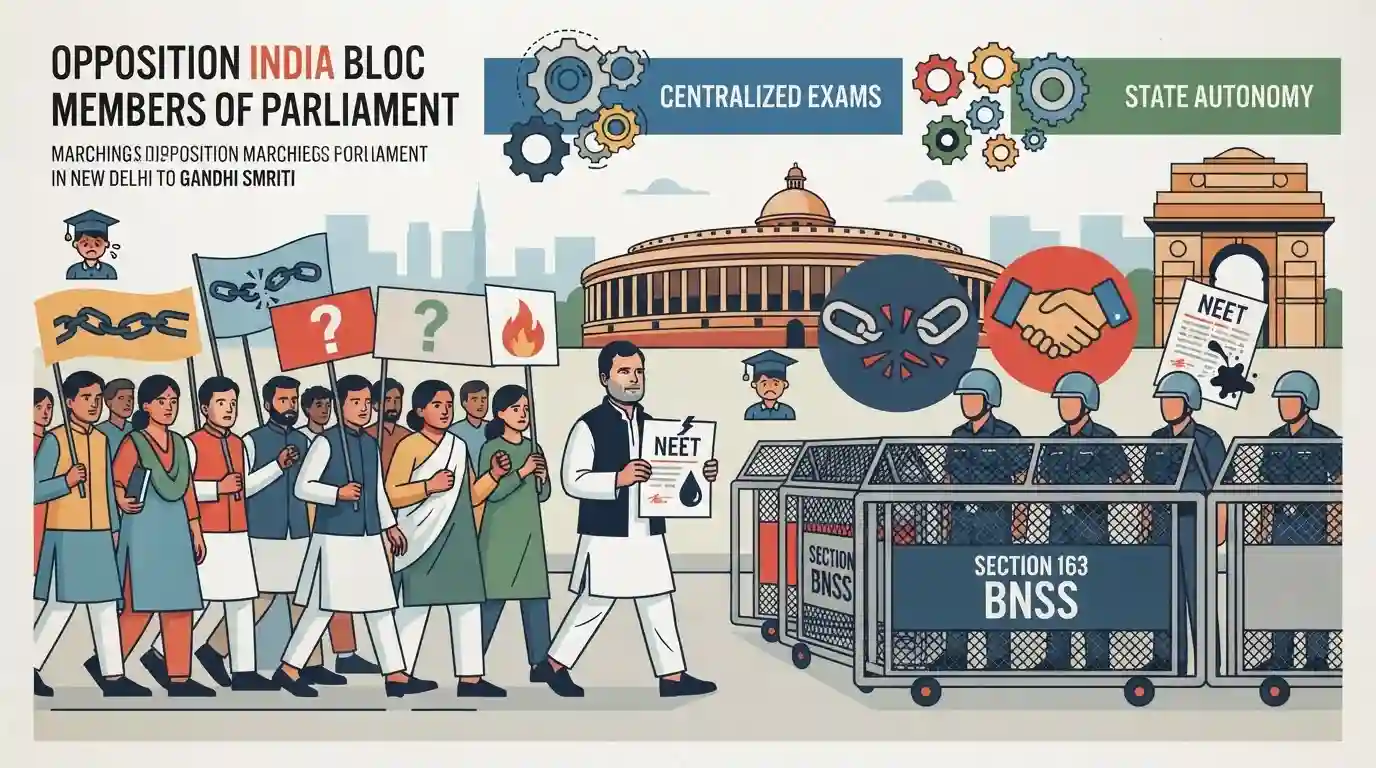
This article highlights the convergence of student mental health issues, systemic vulnerabilities in India's national examination architecture (such as NEET), the newly implemented BNSS provisions on assembly, and federal friction regarding the centralization of education.
సారాంశం
Members of Parliament from the Opposition INDIA bloc, led by Leader of the Opposition Rahul Gandhi, marched from Sunehri Bagh Road to Gandhi Smriti in New Delhi to pay tribute to students who ended their lives due to the NEET paper leak crisis. The march faced police barricades invoking Section 163 of the Bharatiya Nagarik Suraksha Sanhita (BNSS), prompting debates on civil liberties, examination malpractices, and federal demands to replace centralized examinations.
ముఖ్య అంశాలు
- Opposition leaders from the INDIA bloc, led by Rahul Gandhi, marched to Gandhi Smriti to pay homage to students who committed suicide following systemic paper leaks in high-stakes exams like NEET.
- The protest highlights a grave mental health and socio-economic crisis among youth due to the high-pressure examination system and the integrity failures of conducting bodies.
- Police barricaded the march citing Section 163 of the newly enforced Bharatiya Nagarik Suraksha Sanhita (BNSS), 2023 (which replaced Section 144 of the CrPC), highlighting ongoing tensions surrounding civil liberties and the right to peaceful protest.
- The incident mirrors growing federal friction over centralized national examinations, with states like Karnataka formally writing to the Prime Minister to request the replacement of centralized NEET with State Common Entrance Tests (CETs).
- The demonstration underscores the role of the Opposition in utilizing public space and symbolic protests (carrying the Constitution) to demand transparency, accountability, and systemic reforms in the public examination system.
ముఖ్యమైన పదాలు
National Eligibility cum Entrance Test (NEET)

A nationwide, standardized entrance examination conducted by the National Testing Agency (NTA) for undergraduate medical (MBBS), dental (BDS), and AYUSH admissions in India.
UPSC context
GS Paper II (Education/Governance); tests centralized examinations, administrative accountability, and educational reforms.
Bharatiya Nagarik Suraksha Sanhita (BNSS), 2023
India's modernized criminal procedure code that replaced the CrPC, 1973, regulating police investigations, public order maintenance, and preventive powers like Section 163.
UPSC context
GS Paper II (Polity/Governance); tests criminal justice reforms, police powers, and citizen civil liberties.
Public Examinations (Prevention of Unfair Means) Act, 2024
A central law designed to deter, prevent, and penalize paper leaks, organized cheating, and systemic malpractices in public exams to restore system credibility.
UPSC context
GS Paper II (Governance/Education); tests legislative frameworks targeting corruption and systemic examination reforms.
INDIA bloc
A prominent multi-party national political coalition of Indian opposition parties formed to coordinate electorally and safeguard federal principles.
UPSC context
GS Paper II (Polity/Federalism); tests dynamics of coalition politics and multi-party coordination.
ప్రిలిమ్స్ ఉచ్చు
The Public Examinations (Prevention of Unfair Means) Act, 2024 automatically applies to all state-level public service commission and school board examinations.
The Act strictly covers designated central recruitment and entrance bodies (like UPSC, NTA, SSC). States must enact their own laws or formally adopt the central law for state-run exams.
అనుసంధానమైన స్థిర భావనలు
What is the constitutional remedy under Article 254 for legislative conflicts in the Concurrent List?
- Central Supremacy: Article 254(1) mandates that if a state law conflicts with a central law on a Concurrent subject, the central law prevails.
- Presidential Assent: Under Article 254(2), a state law can prevail locally if it receives assent from the President of India.
- Parliamentary Override: Even after presidential assent, Parliament retains the power to enact subsequent legislation that can override or amend the state law.
How does Section 163 of the BNSS, 2023 restrict public assemblies?
- Executive Authority: It empowers District Magistrates, Sub-Divisional Magistrates, or specially empowered Executive Magistrates to issue orders preventing public disorder.
- Duration Limit: Orders generally remain valid for a maximum of two months, extendable up to six months by state government approval.
- Judicial Safeguards: Despite being an executive power, the Supreme Court has ruled such orders are subject to judicial review and cannot violate Article 19 arbitrarily.
అంతర-అంశ నమూనాలు
Centralised Exams vs Cooperative Federalism
Standardised national entrance tests clash with regional healthcare needs, testing the limits of federal accommodation under the Concurrent List of the Seventh Schedule.
Public Exams & Article 21
Systemic administrative lapses in high-stakes testing directly impact youth mental health, elevating examination integrity to a basic right-to-life issue under Article 21.

A 2026 Prelims question will likely test BNSS Section 163 limits alongside Article 254 repugnancy on education-sector disputes.
అనుసంధాన PYQలు · 2
అనుసంధాన PYQలు · 2
- 2024MainsGS2
What are the aims and objects of recently passed and enforced, The Public Examination (Prevention of Unfair Means) Act, 2024? Whether University/State Education Board examinations, too, are covered under the Act ?
- 2021MainsGS2
To what extent, in your view, the Parliament is able to ensure accountability of the executive in India?
