Congress Retains Datia Assembly Seat in Madhya Pradesh
Source:newindianexpress ↗
Why It Matters
The Datia by-election provides critical insights into the electoral dynamics of Madhya Pradesh, specifically illustrating how regional factions, caste equations, and shifting voting patterns (such as differential gender turnout) can influence state politics. Understanding these factors is important for analyzing the broader political landscape of the Gwalior-Chambal region.
Summary
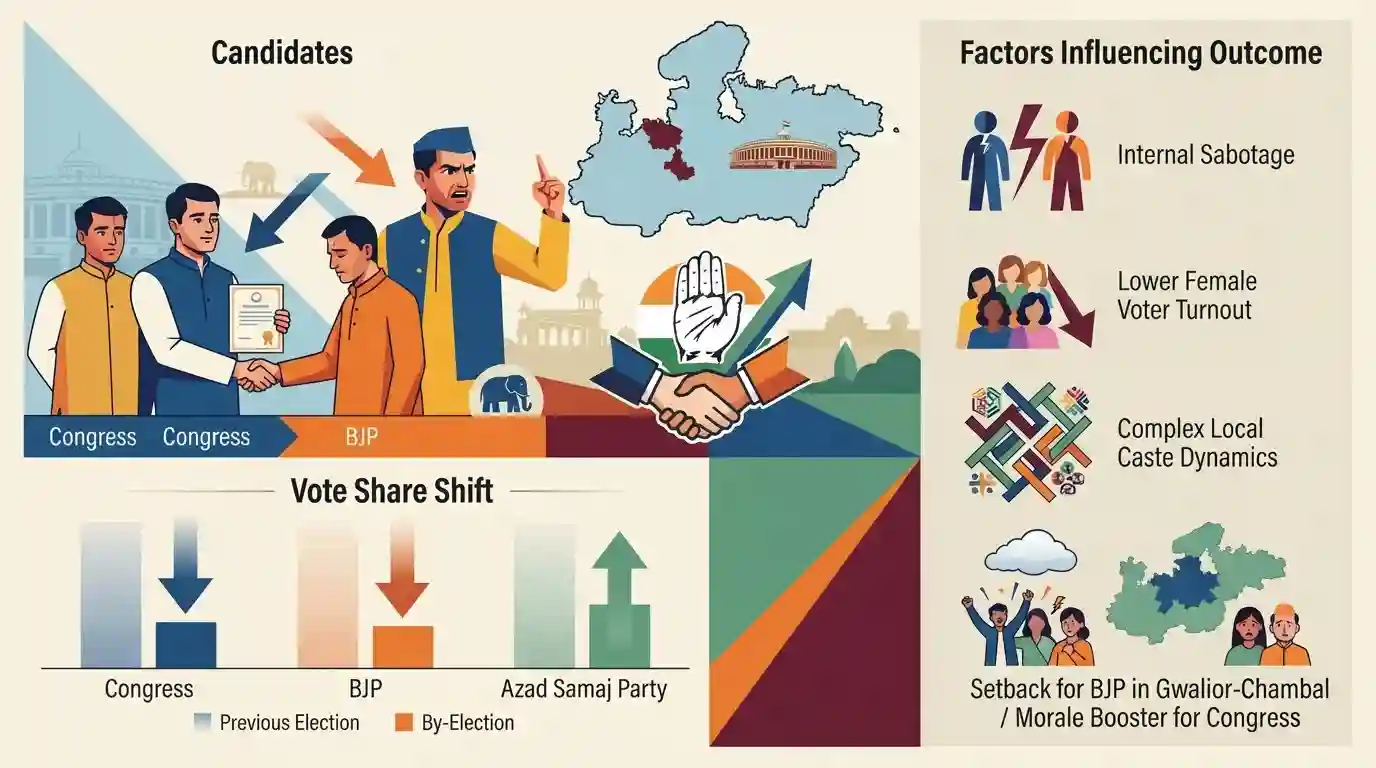
The Congress party retained the Datia Assembly seat in Madhya Pradesh after its candidate, Kunwar Ghanshyam Singh, secured a victory over the BJP's Ashutosh Tiwari in a closely contested by-election. The election saw a significant drop in the vote shares of both major parties, largely attributed to the strong performance of Azad Samaj Party (Kanshi Ram) candidate Damodar Singh Yadav. The outcome was shaped by internal sabotage within both camps, lower female voter turnout, and complex local caste dynamics. The result is seen as a setback for the ruling BJP in the Gwalior-Chambal region and a morale booster for the state Congress leadership.
Key Points
- Congress candidate Kunwar Ghanshyam Singh defeated BJP's Ashutosh Tiwari in the Datia Assembly by-election by a margin of 6,016 votes.
- The entry of Azad Samaj Party (Kanshi Ram) candidate Damodar Singh Yadav severely affected the vote share of both dominant parties by securing 14.3% of the total votes.
- Internal sabotage and factions influenced the election; Congress suspended its 2023 winning candidate Rajendra Bharti, while BJP struggled with the inaction of Narottam Mishra's loyalists.
- A relatively lower voter turnout among women (68.48%) compared to men (74.09%) is cited as a contributing factor to the BJP's defeat.
- The result marks a political boost for MP Congress president Jitu Patwari and highlights regional challenges for the BJP in the Gwalior-Chambal belt.
Important Terms
Indian National Congress (INC)

The Indian National Congress, founded in 1885, is one of India's two major political parties. A center-left party advocating secularism and democratic socialism, it led India's independence movement and dominated post-independence politics for decades.
UPSC context
Relevant for GS Paper 2 (Polity), covering India's party system, historical evolution of democratic institutions, and national electoral dynamics.
Bharatiya Janata Party (BJP)
Founded in 1980, the BJP is a major Indian political party. It represents right-wing politics, advocating for cultural nationalism (Hindutva), social conservatism, strong national defense, and economic liberalization.
UPSC context
Vital for GS Paper 2 (Indian Polity), particularly in topics covering the national party system, ideological shifts, and electoral behavior.
Azad Samaj Party (Kanshi Ram)
Founded in 2020 by Chandrashekhar Azad, the Azad Samaj Party is a political party originating from the Bhim Army. It advocates for the rights of Dalits and marginalized communities, focusing on social justice and Ambedkarite ideology.
UPSC context
Important for GS Paper 2 (Social Justice/Polity) regarding caste-based political mobilization, regional parties, and the empowerment of vulnerable sections.
Prelims Trap
The Election Commission must mandatorily conduct a by-election within six months of any legislative vacancy, without exceptions.
Under Section 151A of the RPA 1951, exceptions exist if the remaining term of the vacant seat is less than one year, or if ECI certifies difficulty in holding the poll.
Static Concepts Connected
What are the rules and exceptions for legislative by-elections in India?
- Statutory Mandate: Section 151A of the Representation of the People Act, 1951, mandates filling vacancies within six months from occurrence.
- Term Exception: No by-election is required if the remainder of the term of the vacant seat is less than one year.
- Administrative Deferral: The ECI can defer if it certifies, in consultation with the Central Government, that holding the poll is difficult.
What defines Registered Unrecognised Political Parties (RUPPs) in India?
- Legal Status: Parties registered under Section 29A of the RPA 1951 that fail to meet performance thresholds for State or National party recognition.
- Symbol Allotment: Unlike recognized parties, they do not possess a permanent symbol and must apply for free symbols under the Symbols Order.
- Compliance Demands: They must file regular audited annual accounts and contribution reports with the ECI to maintain their income tax exemptions.
Cross-Topic Patterns
FPTP outcomes and electoral reforms
By-election vote-splitting highlights how plurality wins in the First-Past-The-Post system can bypass true majoritarian preference, linking to Law Commission debates on hybrid electoral systems.
Gender-segmented electoral dynamics
Disparities in male-female voter turnout rates directly impact the efficacy of targeted state-level welfare programs, connecting political science to developmental sociology.

Statutory timelines of RPA 1951, specifically Section 151A and ECI's powers over RUPPs, are high-probability areas for 2026 Prelims.
Linked PYQs · 2
Linked PYQs · 2
- 2018MPPSC_PRELIMSGS1
How many women were elected in Madhya Pradesh Assembly Election, 2013?
- 2021MPPSC_PRELIMSGS1
Atal Pragati Path is related to
