Political Clash Erupts Over Freedom Struggle History and Vande Mataram
Source:The Hindu ↗
Why It Matters
This article underscores the intense political debate surrounding the narrative of India's freedom struggle, specifically regarding 'Vande Mataram', the Muslim League, and the partition era. It provides crucial context on historical figures like Nehru, Bose, Tagore, Jinnah, and Mookerjee, making it highly relevant for UPSC GS Paper 1 topics on Modern History, Personalities, and Communalism.
Summary
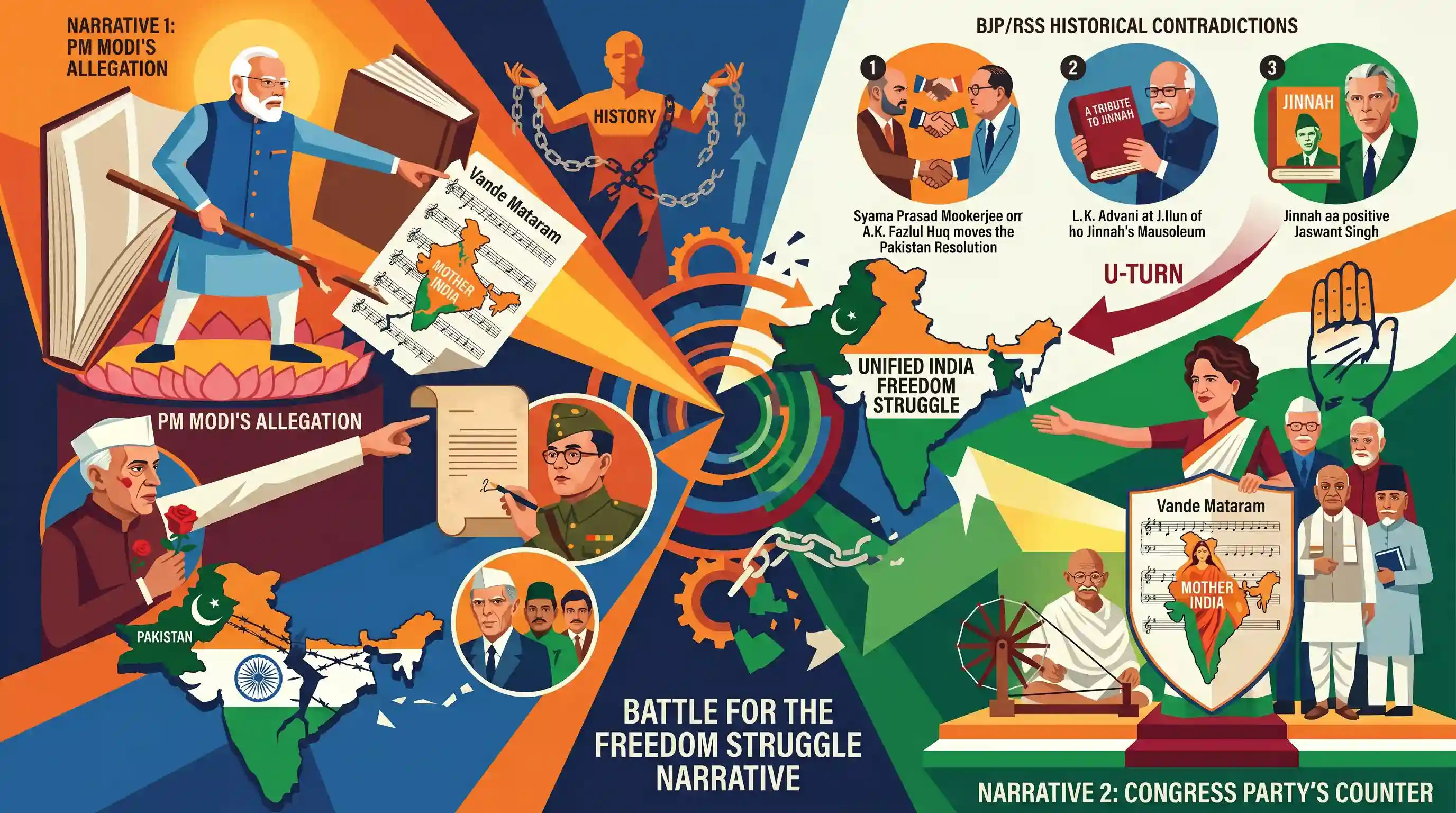
The Congress party strongly criticized PM Narendra Modi, calling him a 'master distorian' following his allegations that Congress historically compromised on the national song 'Vande Mataram' to appease the Muslim League. Modi had referenced a letter from Jawaharlal Nehru to Subhas Chandra Bose suggesting the song might antagonize Muslims. Congress leaders retaliated by highlighting the BJP and RSS's own historical contradictions, such as Syama Prasad Mookerjee's alliance with the politician who moved the Pakistan Resolution, and praises of M.A. Jinnah by BJP stalwarts L.K. Advani and Jaswant Singh. The political clash highlights the ongoing ideological battle over India's freedom struggle narrative and historical figures.
Key Points
- PM Modi alleged that the Congress party historically compromised on the national song Vande Mataram to appease the Muslim League, citing a letter from Jawaharlal Nehru to Subhas Chandra Bose.
- Congress responded by branding PM Modi a 'master distorian', accusing him of distorting history to spread communal discord.
- Congress highlighted historical alliances, noting that Hindu Mahasabha leader Syama Prasad Mookerjee formed a coalition government with A.K. Fazlul Huq, the mover of the Pakistan Resolution.
- Congress also pointed out past instances of BJP stalwarts L.K. Advani and Jaswant Singh praising Mohammad Ali Jinnah.
- The debate contextualizes contemporary political conflicts over nationalism and historical narratives amidst the 150th anniversary of Vande Mataram.
Important Terms
Indian National Congress (INC)

Founded in 1885, it led India's struggle for independence. It advocated for inclusive nationalism and secularism, evolving into a dominant political force in both pre- and post-independence India.
UPSC context
GS Paper I (Modern Indian History). Key to questions on the nationalist movement and evolution of political thought.
All-India Muslim League
Established in 1906 in Dhaka to protect Muslim interests. Under M.A. Jinnah, it spearheaded the demand for a separate nation, leading to the partition of India in 1947.
UPSC context
GS Paper I (Modern History). Tests understanding of communalism, the two-nation theory, and the partition of India.
Hindu Mahasabha
A Hindu nationalist organization formed in 1915 to protect Hindu rights. It promoted 'Hindutva' and was often critical of the Indian National Congress's secular approach during the freedom struggle.
UPSC context
GS Paper I (Modern History). Tests knowledge of communal organizations and ideological shifts in the early 20th century.
Vande Mataram
A patriotic poem by Bankim Chandra Chattopadhyay (1882) that became a rallying cry against British rule. Adopted as India's National Song in 1950, holding equal status to the National Anthem.
UPSC context
GS Paper I (Modern History/Culture). Tests symbols of the freedom struggle and communal-political sensitivities.
Lahore Resolution (1940)
A landmark statement adopted by the Muslim League in 1940 formally demanding independent 'states' for Muslims in India. It is considered the foundation for the eventual creation of Pakistan.
UPSC context
GS Paper I. Critical for understanding the inevitability of Partition and the role of regional majoritarianism.
Syama Prasad Mookerjee
A prominent leader of the Hindu Mahasabha and the founder of the Bharatiya Jana Sangh (1951). He is a key figure in the history of right-wing political thought in India.
UPSC context
GS Paper I (Personalities). Tests contributions of significant figures to political discourse and post-independence consolidation.
Rashtriya Swayamsevak Sangh (RSS)
A Hindu nationalist volunteer organization founded in 1925 by K.B. Hedgewar. It focuses on character-building and promoting Hindu cultural identity, serving as the ideological fountainhead for various Hindu organizations.
UPSC context
GS Paper I (Modern History/Communalism). Tests socio-religious movements and ideological narratives in 20th-century India.
Prelims Trap
Vande Mataram was formally adopted as India's National Anthem on August 15, 1947.
Vande Mataram is the National Song, not Anthem. Both the National Anthem and Song were adopted by the Constituent Assembly on January 24, 1950.
Static Concepts Connected
What is the historical context of Vande Mataram and Anandamath?
- Authorship & Origin: Composed by Bankim Chandra Chattopadhyay in 1875 in Sanskritised Bengali, it was later published in his 1882 novel Anandamath.
- Rebellion Backdrop: The novel Anandamath is famously set against the backdrop of the Sannyasi Rebellion in Bengal during the late 18th century.
- Political Debut: Rabindranath Tagore was the first to sing the song publicly at a political event during the 1896 Calcutta session of the INC.
What were the key developments regarding provincial ministries between 1937 and 1940?
- Congress Resignations: Congress formed ministries in most provinces after the 1937 elections but resigned en masse in 1939 to protest India's unilateral inclusion in WWII.
- Alternate Coalitions: Following the Congress exit, the Hindu Mahasabha formed coalition governments with the Muslim League and regional parties in Sindh, NWFP, and Bengal.
- Lahore Resolution Link: A.K. Fazlul Huq, the Krishak Praja Party leader who formed the Bengal coalition, moved the historic 1940 Lahore Resolution demanding independent Muslim states.
Cross-Topic Patterns
Literature driving mass political movements
The transition of "Vande Mataram" from a novel's verse (Anandamath) to the battle cry of the 1905 Swadeshi movement frequently links cultural literature to active political resistance in UPSC questions.
Pragmatic alliances vs Pre-independence ideology
The coalition between the Hindu Mahasabha and the Krishak Praja Party/Muslim League highlights the complex, non-linear nature of pre-partition provincial politics that UPSC often tests via timeline questions.

Expect a chronological or multi-statement Prelims question linking Anandamath's publication, the 1896 INC session, and 1937 ministries.
Linked PYQs · 4
Linked PYQs · 4
- 2003PrelimsGS1
Which one of the following statements is correct?
- 2023MainsGS1
What was the difference between Mahatma Gandhi and Rabindranath Tagore in their approach towards education and nationalism?
- 2019MainsGS1
Many voices had strengthened and enriched the nationalist movement during the Gandhian phase. Elaborate.
- 2017MainsGS1
Distinguish between religiousness/religiosity and communalism giving one example of how the former has got transformed into the latter in independent India.
