Political Discourse on Left Wing Extremism and Urban Support Networks
Source:Indian Express ↗
Why It Matters
Understanding the concept of 'Urban Naxals' or ideological sympathizers is crucial for the Internal Security syllabus. Aspirants must be able to critically analyze the balance between national security imperatives (dismantling LWE support structures) and the protection of democratic rights and freedom of expression.
Summary
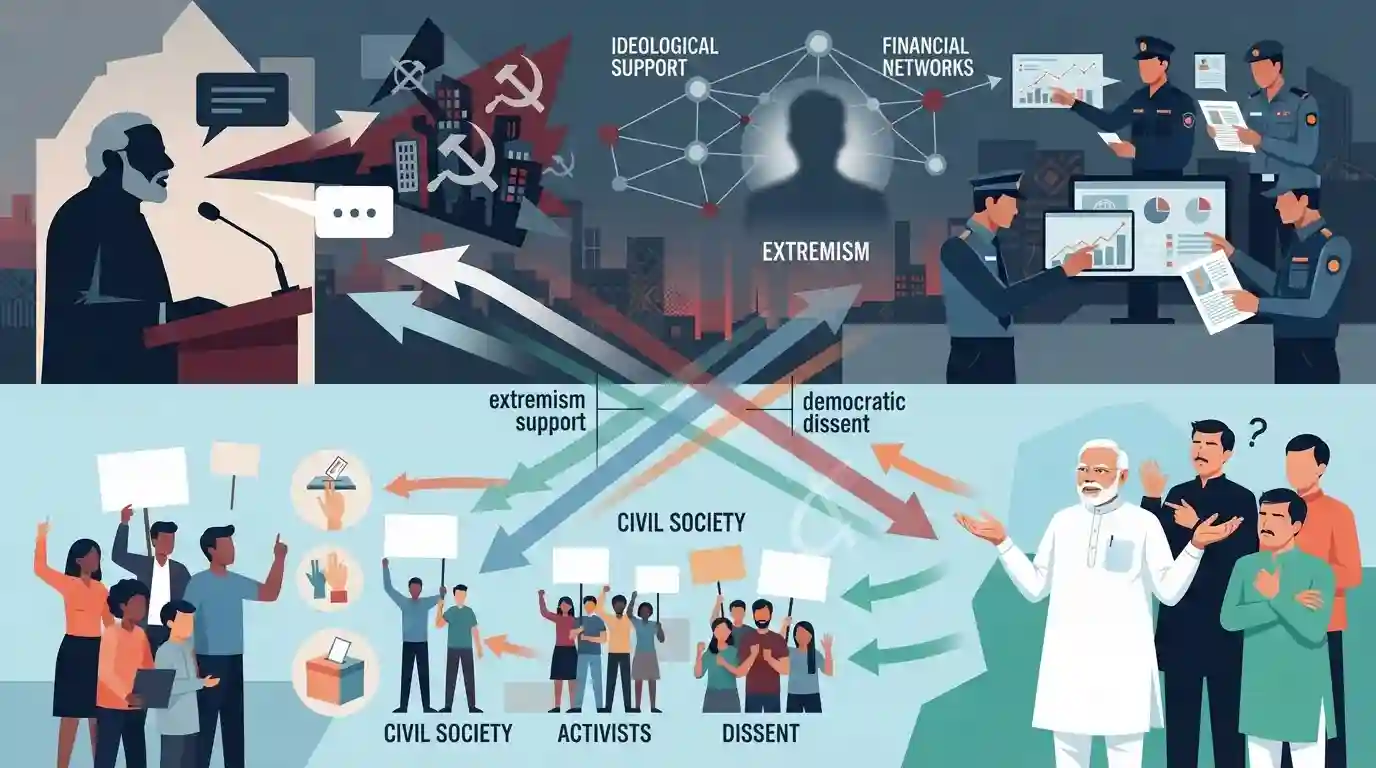
The Congress party has hit back at the Prime Minister's recent remarks concerning 'dimaagi naxals' (ideological or urban naxals), dismissing the rhetoric as a sign of desperation. The political spat highlights the ongoing debate over the definition and framing of 'Urban Naxalism'. While security agencies emphasize the need to dismantle the ideological and financial support networks of Left Wing Extremism (LWE) operating in cities, critics and opposition parties argue that such terms are frequently weaponized to suppress democratic dissent, target civil society activists, and polarize the electorate.
Key Points
- The Congress party has strongly criticized Prime Minister Narendra Modi's use of the term 'dimaagi naxals' (intellectual or urban naxals), terming it a reflection of political desperation.
- The term refers to individuals or groups who allegedly provide intellectual, ideological, and logistical support to Left Wing Extremism (LWE) from urban centers.
- The political opposition argues that such labels are often used to stifle dissent and target intellectuals, human rights activists, and critics of the government.
- From a security standpoint, tackling the ideological and urban support network of Naxalism remains a complex challenge for law enforcement agencies.
Important Terms
Left-Wing Extremism (LWE)

A violent, Maoist-inspired insurgency in India aiming to overthrow the democratic government, historically active in tribal and underdeveloped regions of the "Red Corridor".
UPSC context
GS Paper 3 (Internal Security); tests understanding of security challenges, LWE origins, and government counter-strategies.
Urban Naxalism
A term describing individuals or front organizations in cities who use intellectual, legal, and financial positions to ideologically or logistically support rural Maoist insurgencies.
UPSC context
GS Paper 3 (Internal Security); tests evolving internal security threats, urban-rural linkages, and civil liberty debates.
Democratic Dissent
The constitutional right of citizens, civil society, and opposition parties to disagree with, critique, and peacefully protest against government policies and state actions.
UPSC context
GS Paper 2 (Polity); tests understanding of fundamental rights, Article 19, and the balance with national security.
Indian National Congress (INC)
A major national political party in India, founded in 1885, which led the freedom struggle and represents a centre-left political ideology today.
UPSC context
GS Paper 1 (Modern History) and GS Paper 2 (Polity); tests political history and political party frameworks.
Bharatiya Janata Party (BJP)
A major national political party in India, founded in 1980, representing a right-wing, nationalist ideology (Hindutva) and leading the current Union government.
UPSC context
GS Paper 2 (Polity and Governance); tests the party system, federalism, and political ideologies.
Prelims Trap
"Currently, over 30 districts in India are categorized as 'LWE Affected' by the MHA."
As of the April 2026 MHA revision, only two districts are designated as "LWE Affected," while the other 35 are categorized as "Legacy & Thrust."
Static Concepts Connected
What is the SAMADHAN doctrine for tackling Left-Wing Extremism?
- Strategy & Leadership: Smart leadership, Aggressive strategy, Motivation and training.
- Intelligence & Tech: Actionable intelligence, Dashboard-based KPIs, and Harnessing technology.
- Execution & Finance: Action plan for each theatre and No access to financing.
What is the MHA's definition of 'frontal organizations' in the context of LWE?
- Ideological Support: They are off-shoots that provide intellectual justification to violent ideology, raise funds, and handle legal work.
- Camouflage: They often operate under the guise of human rights NGOs or civil society groups to recruit educated youth.
- MHA Stance: In 2013, the MHA stated in a Supreme Court affidavit that these organizations are "more dangerous than armed cadres."
Cross-Topic Patterns
LWE financing + PMLA overlap
The 'No access to financing' pillar of the SAMADHAN doctrine links internal security to economic offenses, leveraging the PMLA and UAPA to choke the urban network's funds.
Fundamental Rights vs. State Security
The debate over 'urban naxals' frequently tests the boundaries between Article 19(1)(a) (free speech) and reasonable restrictions under 19(2), highlighting friction between civil liberties and state security.

The 2026 MHA reclassification reducing "LWE Affected" to just two districts is highly likely to appear as a Prelims statement trap.
Linked PYQs · 3
Linked PYQs · 3
- 2022MainsGS3
Naxalism is a social, economic and developmental issue manifesting as a violent internal security threat. In this context, discuss the emerging issues and suggest a multilayered strategy to tackle the menace of Naxalism.
- 2018MainsGS3
Left Wing Extremism (LWE) is showing a downward trend, but still affects many parts of the country. Briefly explain the Government of India's approach to counter the challenges posed by LWE.
- 2025MainsGS3
The Government of India recently stated that Left Wing Extremism (LWE) will be eliminated by 2026. What do you understand by LWE and how are the people affected by it? What measures have been taken by the government to eliminate LWE?
