Congress challenges election rules amendment in Supreme Court
Source:The Hindu ↗
Why It Matters
Public access to electoral records such as Form 17-C is heavily debated as part of electoral reforms. The balance between preventing misinformation and ensuring transparency in the democratic process directly concerns the statutory framework (Representation of the People Act, 1951 / Conduct of Election Rules, 1961) and the constitutional mandate of the ECI.
Summary
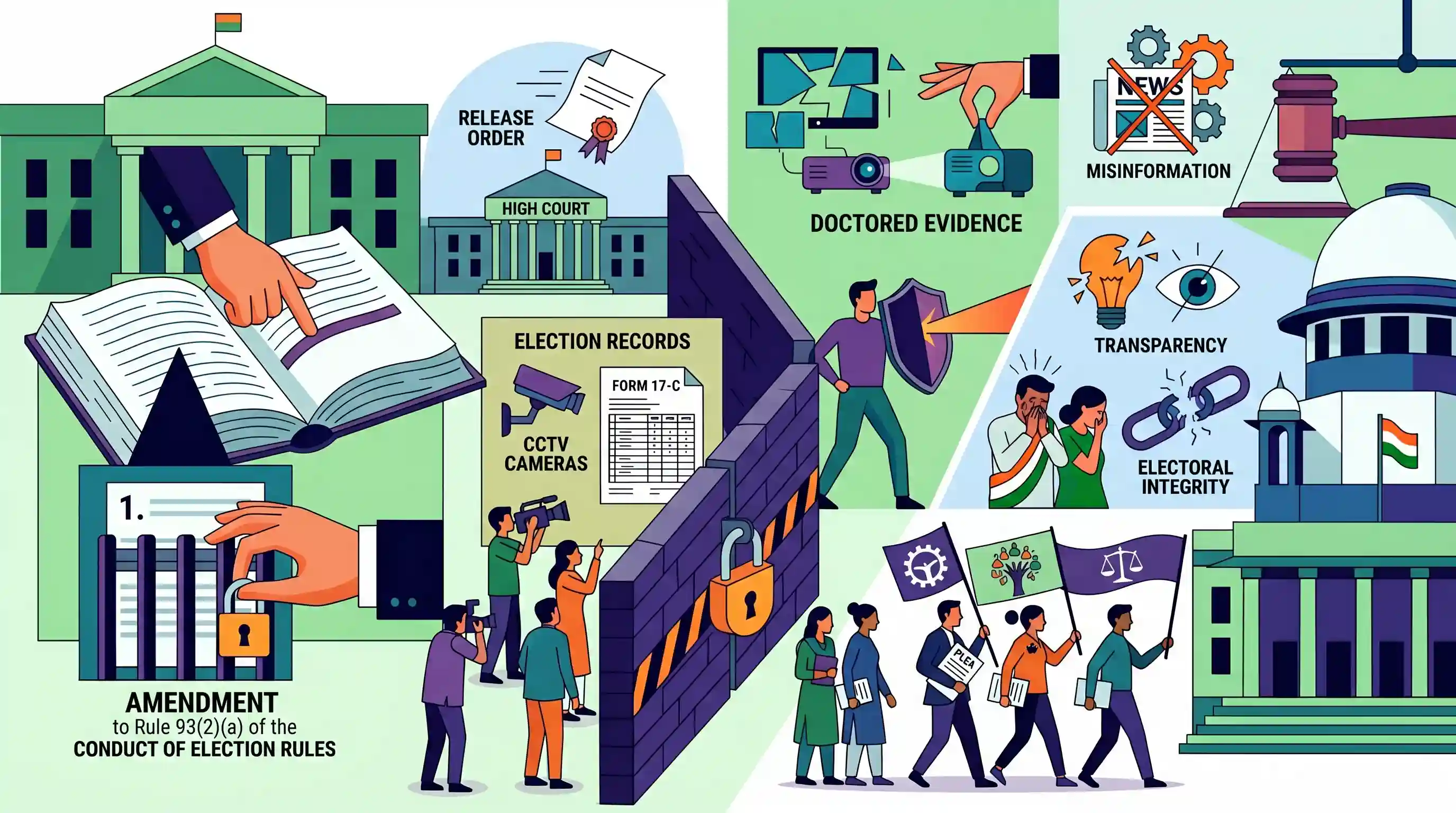
The Congress party has filed a plea in the Supreme Court challenging the Union Law Ministry's recent amendments to Rule 93(2)(a) of the Conduct of Election Rules, 1961. The amendment significantly limits the public's right to inspect election records, such as polling booth CCTV footage and copies of Form 17-C, which details the number of votes recorded. While officials claim the restriction will prevent the spread of false narratives through doctored evidence, the opposition contends it severely erodes the transparency and integrity of the electoral process. The amendment came shortly after the Punjab and Haryana High Court ordered the Election Commission to furnish these exact records to a petitioner concerning the Haryana Assembly elections.
Key Points
- The Congress party has approached the Supreme Court to challenge a recent amendment to Rule 93 of the Conduct of Election Rules, 1961, notified by the Ministry of Law and Justice.
- The amendment restricts public access to election-related records, including CCTV footage from polling booths, video recordings of candidates, and copies of Forms 17-C (Parts I and II).
- The government justifies the restriction as necessary to protect the polling process from false narratives stemming from the misuse or doctoring of electronic records.
- Critics argue the move was taken unilaterally without public consultation and undermines the transparency, accountability, and overall integrity of the electoral process.
- The rule change notably followed a Punjab and Haryana High Court directive ordering the Election Commission to provide such records regarding the recent Haryana Assembly elections.
Important Terms
Conduct of Election Rules, 1961

Statutory rules framed under the Representation of the People Act, 1951, detailing procedural aspects of elections such as nominations, polling, and counting. Recent amendments to Rule 93(2)(a) restrict public access to certain records.
UPSC context
GS Paper II (Polity/Elections); tests understanding of the legal framework governing the electoral process and transparency in democratic procedures.
Form 17-C
A mandatory document recording the 'Account of Votes' at each polling station. It details the number of electors, votes recorded in EVMs, and is used by candidates to verify turnout against final counting results.
UPSC context
GS Paper II (Electoral Reforms); critical for assessing measures that ensure accountability and prevent discrepancies during the counting of votes.
Election Commission of India (ECI)
An autonomous constitutional authority established under Article 324, responsible for the superintendence, direction, and control of elections to Parliament, State Legislatures, and the offices of President and Vice-President.
UPSC context
GS Paper II (Constitutional Bodies); central to topics involving electoral integrity, independence of institutions, and the conduct of fair polls.
Representation of the People Act, 1951 (RPA)
The principal Act of Parliament governing the actual conduct of elections in India. it covers candidate qualifications, election machinery, corrupt practices, and the legal framework for adjudicating election disputes.
UPSC context
GS Paper II (Salient features of RPA); a foundational topic for questions on electoral law and legislative reforms in India.
Union Ministry of Law and Justice
The nodal central ministry responsible for drafting and notifying changes to election laws and rules. It acts as the executive authority that implements electoral reforms in consultation with the ECI.
UPSC context
GS Paper II (Executive/Governance); tests understanding of the government's role in framing secondary legislation that impacts fundamental democratic rights.
Supreme Court of India
The apex judicial body in India with powers of judicial review. It adjudicates on the constitutional validity of election laws and often intervenes to protect the voter's 'Right to Know.'
UPSC context
GS Paper II (Judiciary); significant for its role in interpreting constitutional provisions and ensuring executive accountability in the electoral process.
Punjab and Haryana High Court
A constitutional court whose recent directive to the ECI to share election records with a petitioner is cited as the trigger for the subsequent central rule change restricting such access.
UPSC context
GS Paper II (Judiciary); illustrates the power of high courts in upholding transparency before legislative or executive pushback.
Prelims Trap
"The Conduct of Election Rules, 1961 are framed and amended directly by the Election Commission of India."
The Central Government (Ministry of Law and Justice) has the power to amend these rules under Section 169 of the RPA 1951, only in consultation with the ECI.
Static Concepts Connected
What is the significance of Forms 17A and 17C in India's election process?
- Form 17A: Serves as the statutory register of electors, logging the details and signatures of every voter who physically enters the booth and casts a vote.
- Form 17C (Part I): The 'Account of votes recorded' given to polling agents at the close of polls, detailing the absolute number of votes cast via EVMs.
- Form 17C (Part II): Completed on counting day by the supervisor; records the final result and requires signatures of candidates or their representatives to authenticate the tally.
Who holds rule-making powers under the Representation of the People Act, 1951?
- Central Government: Empowered under Section 169 to make rules (like the Conduct of Election Rules, 1961) for carrying out the Act's purposes.
- Consultation Mandate: The Central Government cannot unilaterally make rules; it is legally bound to do so in consultation with the Election Commission of India.
- Parliamentary Scrutiny: Any new rule or amendment made under this provision must be laid before both Houses of Parliament for scrutiny.
Cross-Topic Patterns
RTI vs. Election Misinformation narratives
The tension between restricting access to prevent "doctored evidence" (misinformation) and ensuring democratic transparency through public scrutiny of EVM/VVPAT data and Form 17-C records.
Judicial review of Subordinate Legislation
The Supreme Court plea highlights how delegated legislation (executive rules under the RPA) can be challenged for allegedly violating the basic structure mandate of free and fair elections.

Expect a specific prelims question distinguishing Form 17A (voter register) from Form 17C (vote account) and rule-making powers under RPA.
Linked PYQs · 4
Linked PYQs · 4
- 2022MainsGS2
Discuss the procedures to decide the disputes arising out of the election of a Member of the Parliament or State Legislature under The Representation of the People Act, 1951. What are the grounds on which the election of any returned candidate may be declared void ? What remedy is available to the aggrieved party against the decision ? Refer to the case laws.
- 2022MainsGS2
Discuss the role of the Election Commission of India in the light of the evolution of the Model Code of Conduct.
- 2004PrelimsGS1
Consider the following tasks: 1. Superintendence, direction and conduct of free and fair elections. 2. Preparation of electoral rolls for all elections to the Parliament, State Legislatures and the Office of the President and the Vice-president. 3. Giving recognition to political parties and allotting election symbols to political parties and individuals contesting the election. 4. Proclamation of final verdict in the case of election disputes. Which of the above are the functions of the Election Commission of India?
- 2017PrelimsGS1
Consider the following statements: 1. The Election Commission of India is a five-member body. 2. Union Ministry of Home Affairs decides the election schedule for the conduct of both general elections and bye-elections. 3. Election Commission resolves the disputes relating to splits/mergers of recognised political parties. Which of the statements given above is/are correct?
