Political Debate over Reservation and Constitutional Governance
Source:The Hindu ↗
Why It Matters
The political debate over religion-based reservation versus caste-based affirmative action touches upon fundamental constitutional principles and Dr. B.R. Ambedkar's vision of social justice. The discourse on the Uniform Civil Code and Waqf property laws highlights ongoing friction in Indian polity regarding secularism, minority rights, and legal uniformity.
Summary
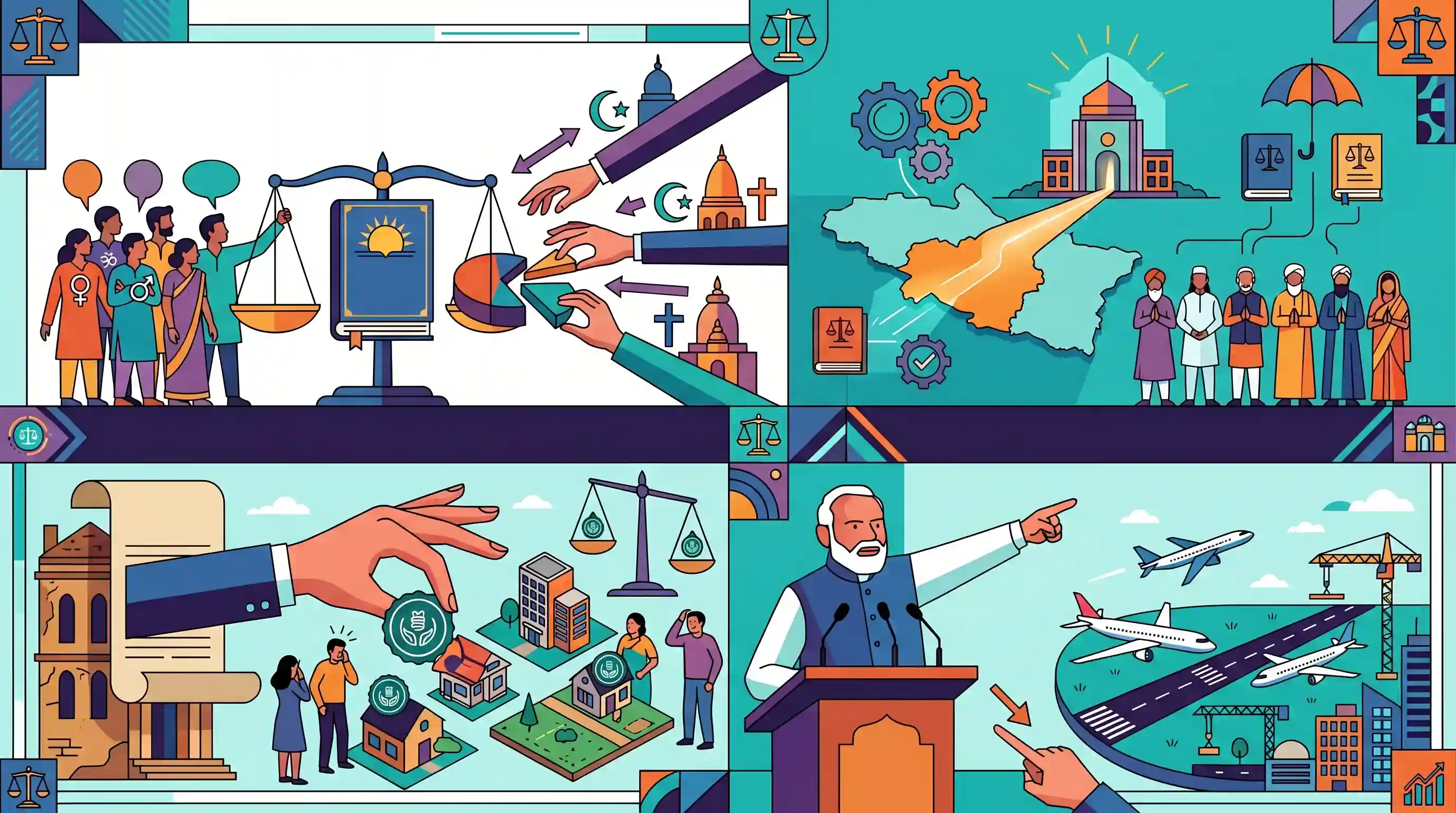
In a rally in Hisar, Haryana, PM Narendra Modi criticized the Congress party for allegedly using the Constitution for political gain and practicing appeasement politics. He claimed that Congress's push for religion-based reservations, citing their actions in Karnataka, directly opposes Dr. B.R. Ambedkar's vision of social justice and encroaches on the rights of SC/ST/OBC communities. Modi praised the enactment of the Uniform Civil Code in Uttarakhand as a step toward secular governance. Furthermore, he condemned the 2013 Waqf law amendments for empowering Waqf Boards to arbitrarily claim property. Alongside political critiques, he highlighted regional infrastructure progress, including the expansion of the Maharaja Agrasen airport in Hisar.
Key Points
- PM Modi accused the Congress party of pushing for religion-based reservations, arguing it undermines the constitutionally mandated rights of Scheduled Castes, Scheduled Tribes, and Other Backward Classes (SC/ST/OBC).
- He contrasted the Congress's alleged appeasement politics with the implementation of a Secular Civil Code (Uniform Civil Code) in Uttarakhand, presenting it as a move toward genuine constitutional equality.
- The PM criticized a 2013 amendment to the Waqf law, alleging it granted Waqf Boards unchecked power to claim lands, including properties belonging to vulnerable sections.
- Infrastructure development was highlighted with the foundation laying for a new terminal at Maharaja Agrasen airport in Hisar and the flagging off of a Hisar-Ayodhya flight.
Important Terms
Uniform Civil Code (UCC)

A proposed common set of personal laws for all citizens regardless of religion, covering marriage, divorce, inheritance, and adoption to replace fragmented religious codes.
UPSC context
GS Paper II (Polity); tests secularism, gender justice, and the constitutional mandate for legal uniformity.
Article 44
A Directive Principle of State Policy (Part IV) that mandates the State to endeavor to secure a Uniform Civil Code for all citizens.
UPSC context
GS Paper II (Constitution); essential for analyzing the non-justiciable goals and evolution of personal law reform.
Waqf Board
A statutory body responsible for managing and protecting properties dedicated for religious or charitable purposes under Islamic law.
UPSC context
GS Paper II (Statutory Bodies); focuses on governance, management of religious endowments, and minority affairs.
Waqf Act
The primary legislation regulating Islamic endowments. Significant amendments in 2013 and proposed 2025 reforms address board powers, transparency, and property claims.
UPSC context
GS Paper II (Legislation); involves analyzing legislative shifts in managing religious property and minority rights.
Personal Laws
Legal codes derived from religious traditions governing marriage, divorce, and inheritance, currently separate for different communities in India.
UPSC context
GS Paper II (Social Justice); relevant for evaluating Article 14 (equality) vs. Article 25 (religious freedom).
Prelims Trap
The Constitution completely prohibits reservations for religious minorities in public employment and education.
The Constitution prohibits reservation based *solely* on religion (Art 16(2)). However, religious minorities can be granted reservations if they are classified as Socially and Educationally Backward Classes (SEBC).
Static Concepts Connected
How does the Constitution regulate reservations concerning religious minorities?
- Solely on religion: Articles 15(1) and 16(2) prohibit discrimination or reservation on grounds "only" of religion, race, caste, sex, or place of birth.
- OBC classification route: Religious minorities can receive quotas under Articles 15(4) and 16(4) if identified as Socially and Educationally Backward Classes (SEBC).
- Scheduled Caste restriction: The Constitution (Scheduled Castes) Order, 1950, limits SC status exclusively to individuals professing Hinduism, Sikhism, and Buddhism. Dalit Muslims/Christians are excluded.
What is the statutory and administrative framework governing Waqf properties?
- Nature of Waqf: A permanent, irrevocable dedication of property for Islamic charitable purposes. Once established, it cannot revert to private ownership.
- Statutory Management: Managed under the Waqf Act, 1995, which establishes the Central Waqf Council (advisory) and State Waqf Boards (management).
- Dispute Resolution: Currently, specialized Waqf Tribunals hold civil court powers to adjudicate disputes over Waqf properties.
Cross-Topic Patterns
UCC vs. Tribal Autonomy (Article 371)
The Uttarakhand UCC explicitly exempts Scheduled Tribes. Future national UCC debates will inevitably clash with cultural autonomy protections under the Fifth/Sixth Schedules and Article 371.
Waqf amendments and executive centralization
The proposed 2024 Waqf Amendment shifts property determination powers from Waqf Boards to District Collectors, reflecting a broader trend of centralizing quasi-judicial land authority back to civil administration.

Expect a Prelims statement testing Waqf Tribunal jurisdiction vs District Collector powers, or the specific ST exemptions in the state UCC.
Linked PYQs · 4
Linked PYQs · 4
- 2015MainsGS2
Discuss the possible factors that inhibit India from enacting for its citizens a uniform civil code as provided for in the Directive Principles of State Policy.
- 2018MainsGS2
Whether National Commission for Scheduled Castes (NCSC) can enforce the implementation of constitutional reservation for the Scheduled Castes in the religious minority institutions? Examine.
- 2020PrelimsGS1
Which part of the Constitution of India declares the ideal of Welfare State?
- 2024MainsGS2
Public charitable trusts have the potential to make India's development more inclusive as they relate to certain vital public issues. Comment.
