Political party funding trends and donation declines in India
Source:The Hindu ↗
Why It Matters
Understanding the patterns of political party donations and funding transparency is vital for evaluating governance, electoral reforms, and the health of democratic institutions in India.
Summary
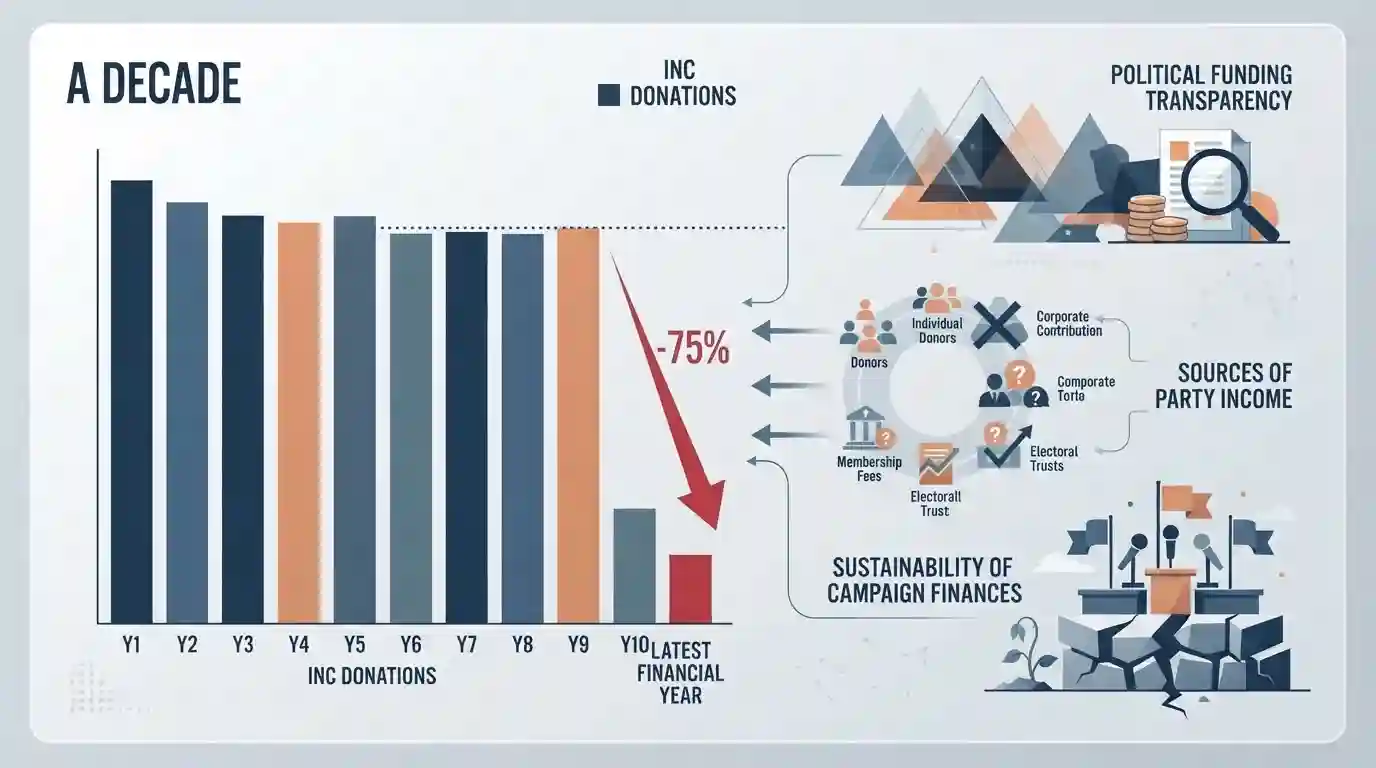
The Indian National Congress experienced a dramatic drop of nearly 75% in donations during the latest financial year, representing the sharpest decline over a decade. This drop highlights wider issues regarding political funding transparency, sources of party income, and the sustainability of campaign finances in Indian elections.
Key Points
- The Indian National Congress (INC) reported a sharp decline of nearly 75% in its donations during the financial year, marking its steepest drop in a decade.
- Political party funding transparency and the methods of political donations remain a critical debate in Indian democracy.
- Declining institutional and formal donations affect political campaign financing and electoral level playing field.
Important Terms
Representation of the People Act

A key legislation governing elections in India, containing provisions under Section 29C that require political parties to declare donations exceeding twenty thousand rupees to the Election Commission.
UPSC context
GS Paper II (Polity and Governance) - Important aspects of governance, transparency, and representation of people in elections.
Election Commission of India
An autonomous constitutional authority responsible for administering election processes in India, ensuring free and fair elections, and monitoring political party funding and expenditure disclosures.
UPSC context
GS Paper II (Polity and Governance) - Appointments, constitutional bodies, and their roles in democratic processes.
Prelims Trap
Section 29C of the RP Act mandates that all political donations must be disclosed to the ECI regardless of the amount.
Aspirants often confuse the ₹20,000 disclosure threshold under Section 29C of the RP Act with a blanket ban on cash donations above ₹2,000 (introduced via IT Act amendments), whereas Section 29C specifically mandates reporting individual contributions exceeding ₹20,000.
Static Concepts Connected
What are the statutory disclosure norms for political donations in India under the RP Act and Companies Act?
- RP Act Threshold: Under Section 29C of the RP Act 1951, parties must report contributions exceeding ₹20,000 to the Election Commission of India.
- Companies Act Limits: Under Section 182 of the Companies Act 2013, corporate donations require board resolutions and specific profit-based limits, previously modified by now-defunct electoral bonds.
- Constitutional Ruling: The Supreme Court in 2024 struck down electoral bonds, ruling anonymous funding violates voters' right to information under Article 19(1)(a).
Cross-Topic Patterns
Electoral Funding & Corporate Disclosure Laws
Post-Electoral Bond era, political party funding transparency intersects with Right to Information (Article 19) and corporate governance disclosures under Companies Act Section 182.
Campaign Finance & State Funding of Elections
Fluctuating party revenues directly impact the electoral level playing field, raising questions about state funding of elections and independent expenditure caps.

Expect a multi-statement Prelims question combining RP Act Section 29C disclosure thresholds with the Supreme Court's Electoral Bond judgment.
Linked PYQs · 3
Linked PYQs · 3
- 2025MainsGS2
Discuss the 'corrupt practices' for the purpose of the Representation of the People Act, 1951. Analyze whether the increase in the assets of the legislators and/or their associates, disproportionate to their known sources of income, would constitute 'undue influence' and consequently a corrupt practice.
- 2020MainsGS2
There is a need for simplification of procedure for disqualification of persons found guilty of corrupt practices under the Representation of Peoples Act". Comment.
- 2022MainsGS2
Discuss the procedures to decide the disputes arising out of the election of a Member of the Parliament or State Legislature under The Representation of the People Act, 1951. What are the grounds on which the election of any returned candidate may be declared void ? What remedy is available to the aggrieved party against the decision ? Refer to the case laws.
