Women reservation implementation and parliamentary delimitation debate
Source:Indian Express ↗
Why It Matters
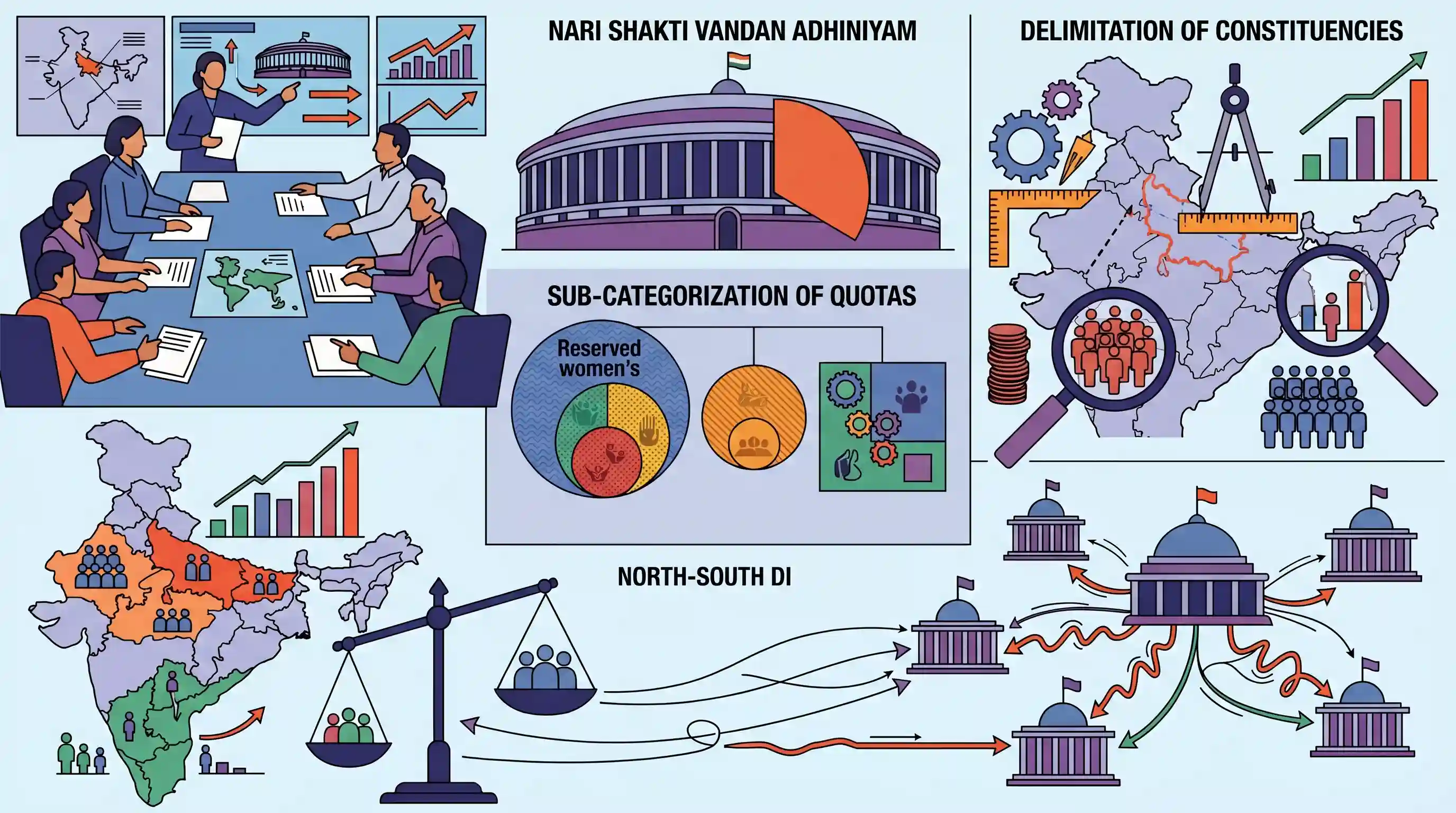
The implementation of the Nari Shakti Vandan Adhiniyam is a critical step for gender equity in legislatures, but issues like sub-categorization highlight the complexities of intersectional representation. Furthermore, the upcoming delimitation exercise poses one of the most severe challenges to Indian federalism: balancing the democratic ideal of proportional representation against the need to protect the political weight of states that have successfully adhered to national population control objectives.
Summary
The Congress Working Committee has convened to strategize on the Nari Shakti Vandan Adhiniyam and the impending Delimitation Bill. The government plans to implement the 33% women's reservation using 2011 Census data, a move Congress supports in principle while demanding sub-categorization for SC, ST, and OBC women. A major point of contention is the proposed delimitation of parliamentary constituencies. Congress leaders warn that allocating Lok Sabha seats strictly based on current population figures will penalize Southern states that have successfully controlled population growth, thereby disproportionately increasing the political representation and influence of populous Northern states like Uttar Pradesh and straining India's federal structure.
Key Points
- The Congress Working Committee (CWC) met to finalize its strategy regarding the Nari Shakti Vandan Adhiniyam (Women's Reservation Bill) and a proposed Delimitation Bill.
- The government intends to implement the 33% women's reservation using 2011 Census data, delinking it from the completion of the pending decadal Census.
- While supporting women's reservation, the Congress party is demanding sub-categorization to secure specific quotas for SC, ST, and OBC women within the 33% framework.
- Congress leaders raised strong concerns over the impending delimitation exercise, arguing that it will disproportionately benefit populous Northern states like Uttar Pradesh.
- Southern states (such as Kerala and Tamil Nadu) that successfully stabilized their populations risk a relative decline in their political representation in Parliament, widening the North-South political divide.
Important Terms
Nari Shakti Vandan Adhiniyam

The 106th Constitutional Amendment Act, 2023, reserving one-third (33%) of seats for women in the Lok Sabha, State Legislative Assemblies, and the Delhi Assembly for 15 years.
UPSC context
GS-II (Polity/Governance); tests knowledge of affirmative action for women and legislative hurdles like the census-linkage clause.
Delimitation Commission
A high-power statutory body (Articles 82 and 170) that redraws electoral boundaries to ensure equal population-based representation. Its decisions are final and cannot be challenged in court.
UPSC context
GS-II (Elections/Federalism); crucial for analyzing the North-South representation divide and the 2026 freeze on seat allocation.
Sub-categorization
Dividing a reserved category (e.g., OBCs or SCs) into smaller groups to ensure equitable distribution of benefits, preventing dominant castes from cornering reservation advantages.
UPSC context
GS-II (Social Justice); relevant for debates on the G. Rohini Commission and inclusive affirmative action policies.
Congress Working Committee (CWC)
The highest executive and decision-making organ of the Indian National Congress, responsible for shaping party strategy, interpreting its constitution, and guiding organizational policies.
UPSC context
GS-II (Political Parties/Pressure Groups); tests understanding of the internal governance of major political parties in a parliamentary democracy.
Federalism
The constitutional division of power between the Centre and States. Current tensions involve demographic shifts where population-based seat allocation may penalize states with successful population control.
UPSC context
GS-II (Federal Structure); tests the ability to analyze regional parity and the political impact of demographic changes.
Prelims Trap
The 106th Constitutional Amendment Act provides a specific sub-quota for OBC women alongside SC/ST women.
The Nari Shakti Vandan Adhiniyam only provides intersecting sub-quotas for SC and ST women. There is no constitutionally mandated reservation for OBC women in this Act.
Static Concepts Connected
How does the Delimitation Commission function under the Constitution?
- Constitutional mandate: Under Article 82, Parliament enacts a Delimitation Act after every Census to readjust constituency boundaries.
- Absolute authority: The Commission's orders have the force of law and cannot be challenged in any court, ensuring the electoral process is not delayed by litigation.
- Composition: Typically chaired by a retired Supreme Court judge, and includes the Chief Election Commissioner and relevant State Election Commissioners.
What was the objective of the 84th Constitutional Amendment Act regarding seat allocation?
- Seat freeze: It extended the freeze on the total number of Lok Sabha seats allocated to each state until the first Census published after 2026.
- Policy rationale: It aimed to reward, not penalize, states that successfully implemented family planning and population stabilization policies since the 1971 Census.
- Internal adjustments: While freezing total state seats, it allowed for the redrawing of territorial constituency boundaries within a state based on updated demographic data.
Cross-Topic Patterns
Finance Commission parallels in Delimitation
Similar to the 15th Finance Commission using a 'Demographic Performance' criterion to offset 2011 Census usage, delimitation will require novel formulas to balance pure population data against federal equity.
Demographic Dividend vs. Federal Leverage
Connects India's National Population Policy successes in Southern states with constitutional representation. Good governance and replacement-level fertility paradoxically threaten a state's political leverage under Article 81.

GS2 Mains 2026 is highly likely to feature a question connecting the post-2026 Delimitation lifting with federal friction and demography.
Linked PYQs · 4
Linked PYQs · 4
- 2019MainsGS2
“The reservation of seats for women in the institutions of local self-government has had a limited impact on the patriarchal character of the Indian Political Process.” Comment.
- 2023MainsGS2
Discuss the contribution of civil society groups for women's effective and meaningful participation and representation in state legislatures in India.
- 2024MainsGS2
What changes has the Union Government recently introduced in the domain of Centre-State relations ? Suggest measures to be adopted to build the trust between the Centre and the States and for strengthening federalism.
- 2016MainsGS1
What is the basis of regionalism? Is it that unequal distribution of benefits of development on regional basis eventually promotes regionalism? Substantiate your answer.
