Great Nicobar Infrastructure Project and Environmental Concerns
Source:The Hindu ↗
Why It Matters
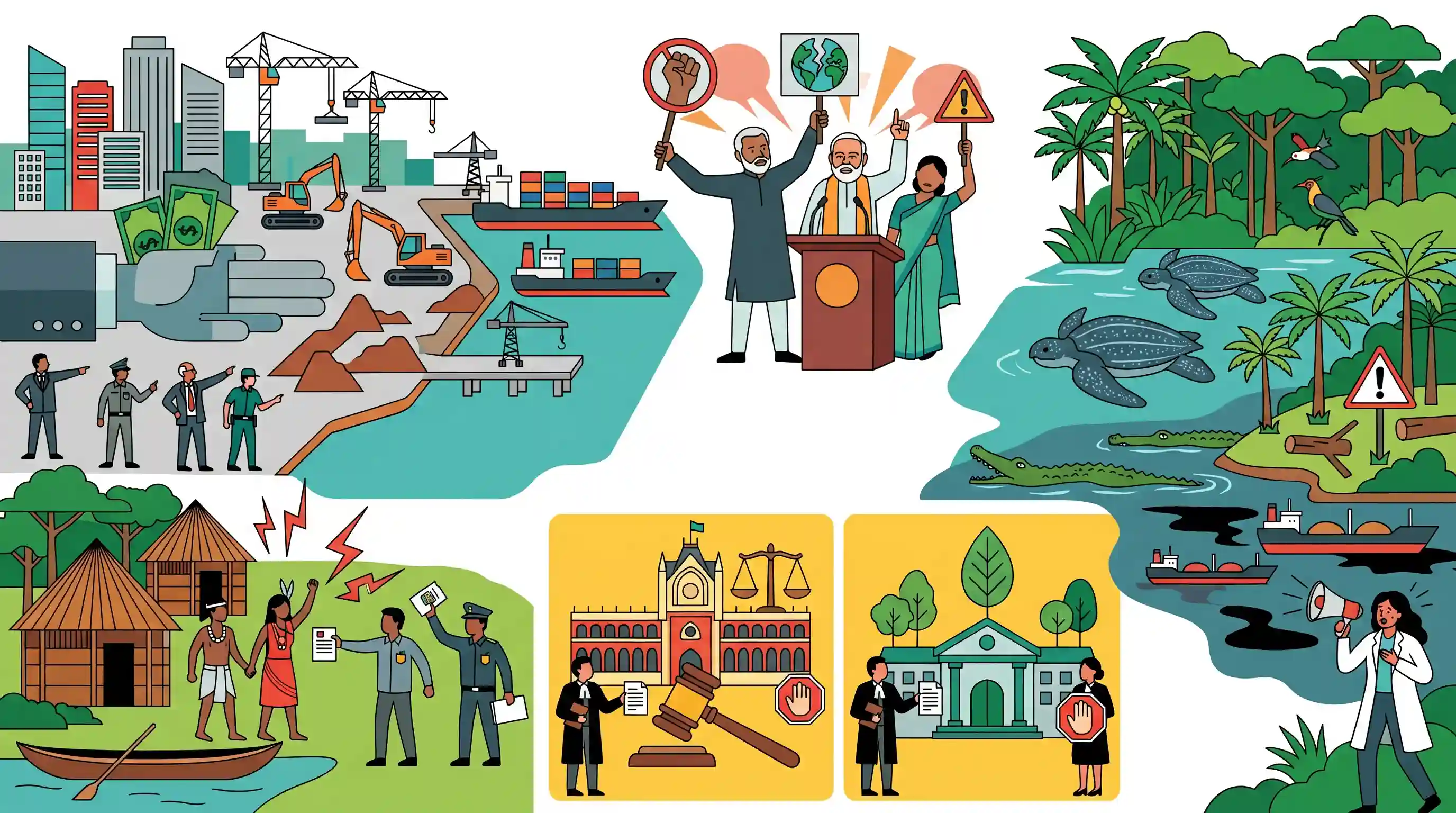
This highlights the inherent conflict between large-scale strategic infrastructure development (Great Nicobar Project) and the protection of fragile island ecosystems and indigenous tribal communities (e.g., Shompen, Nicobarese). It is highly relevant for GS3 questions on Environmental Impact Assessment (EIA), conservation, and GS2 issues pertaining to tribal rights.
Summary
The Congress party has targeted the Union government over the Great Nicobar infrastructure project, citing reports that the local administration is pressuring indigenous communities to surrender their ancestral lands. Prominent opposition leaders described the NITI Aayog-piloted project as an ecological disaster and an existential threat to local tribes, noting that litigation challenging the project is still pending before the Calcutta High Court and the National Green Tribunal.
Key Points
- The Congress party cited a media report alleging the local administration is pressuring the Tribal Council to surrender ancestral lands for the Great Nicobar Project.
- The multi-crore infrastructure project, piloted by NITI Aayog, is being criticized as an 'ecological disaster' that poses an existential threat to vulnerable indigenous communities.
- Petitions challenging the environmental and social clearance of the project are currently pending before the Calcutta High Court and the National Green Tribunal (NGT).
- Opposition leaders assert that the Union government is bulldozing the project despite grave concerns over its impact on biodiversity and tribal rights.
Important Terms
Great Nicobar Project

A ₹72,000–81,000 crore mega-project comprising an International Transshipment Terminal, greenfield airport, power plant, and township on Great Nicobar Island, designed as a strategic maritime and defense hub.
UPSC context
GS III: Infrastructure and Strategic Geography; tests the balance between national security and ecological/tribal conservation.
National Green Tribunal (NGT)
A statutory judicial body (est. 2010) specialized in environmental disputes. It recently cleared the Great Nicobar project, citing its strategic importance while imposing stringent ecological safeguards.
UPSC context
GS III: Environmental Governance; tests knowledge of judicial oversight and statutory bodies in environmental clearances.
NITI Aayog
The premier policy think-tank of the Government of India that conceptualized the Great Nicobar "holistic development" plan to transform the island into a major economic and strategic gateway.
UPSC context
GS II: Executive Bodies; tests the role of national planning bodies in large-scale infrastructure and regional development.
Tribal Council (Andaman & Nicobar)
A statutory body established under 2009 regulations to represent indigenous Nicobarese and Shompen communities. It is central to the project’s controversy regarding the withdrawal of consent for land diversion.
UPSC context
GS II: Tribal Administration; tests understanding of local governance and the legal rights of indigenous groups in Union Territories.
Particularly Vulnerable Tribal Groups (PVTGs)
A sub-classification of Scheduled Tribes (e.g., the Shompen) characterized by extreme vulnerability, geographical isolation, and pre-agricultural technology, requiring specialized constitutional and legal protections.
UPSC context
GS I & II: Social Justice; tests awareness of India's most disadvantaged communities and their existential threats from development.
Forest Rights Act (FRA), 2006
A 2006 law recognizing the rights of forest-dwelling communities. It mandates the "free, prior, and informed consent" of local Gram Sabhas before forest land can be diverted for non-forest projects.
UPSC context
GS II & III: Governance and Environment; tests knowledge of land tenure laws and indigenous rights in conservation contexts.
Prelims Trap
"The Shompen tribe of Great Nicobar belongs to the Negrito racial group."
The Shompen are of Mongoloid descent. The Negrito PVTGs (Jarawa, Onge, Sentinelese, Great Andamanese) reside in the Andaman Islands, not Nicobar.
Static Concepts Connected
What is the demographic profile of PVTGs in the Andaman & Nicobar Islands?
- Negrito groups: Great Andamanese, Onge, Jarawa, and Sentinelese. These tribes reside exclusively in the Andaman Islands.
- Mongoloid groups: The Shompen, residing in Great Nicobar. (Note: The Nicobarese are Scheduled Tribes but do not fall under the PVTG classification).
What is the ecological significance of Galathea Bay?
- Location: Situated on the southern coast of Great Nicobar Island, extremely close to Indira Point and the Six Degree Channel.
- Key species: It is India's most iconic and critical nesting site for the globally endangered Giant Leatherback turtle.
- Recent denotification: It has been controversially denotified (losing its highly protected CRZ-1A status) to facilitate the construction of the International Container Transshipment Terminal.
Cross-Topic Patterns
Strategic exemptions vs. Ecological conservation
The denotification of Galathea Bay mirrors recent Forest Conservation Act amendments that exempt strategic border projects from stringent clearances, highlighting a definitive policy shift prioritizing national security over ecological conservation.
Malacca Strait & Transshipment economics
The Great Nicobar ICTT connects directly to India's 'Maritime India Vision 2030' to capture regional transshipment traffic currently lost to Colombo, countering China's naval presence near the critical Malacca Strait chokepoint.

Expect a multi-statement Prelims question on Great Nicobar combining PVTGs (Shompen), Galathea Bay ecology, and FRA exemptions in 2026.
Linked PYQs · 4
Linked PYQs · 4
- 2024MainsGS3
What role do environmental NGOs and activists play in influencing Environmental Impact Assessment (EIA) outcomes for major projects in India? Cite four examples with all important details.
- 2014MainsGS3
Environmental Impact Assessment studies are increasingly undertaken before a project is cleared by the Government. Discuss the environmental impacts of coal-fired thermal plants located at coal pitheads.
- 1997PrelimsGS1
The tribal population in Andaman and Nicobar Islands belongs to the
- 2014PrelimsGS1
Which of the following have coral reefs? 1. Andaman and Nicobar Islands 2. Gulf of Kachchh 3. Gulf of Mannar 4. Sunderbans Select the correct answer using the code given below.
