Supreme Court Plea on Model Code and Media Telecast
Source:The Hindu ↗
Why It Matters
It highlights critical issues surrounding the enforcement of the Model Code of Conduct, the definition of 'corrupt practices' under the RPA, 1951, and the ECI's constitutional responsibility to maintain a level playing field during active election cycles.
Summary
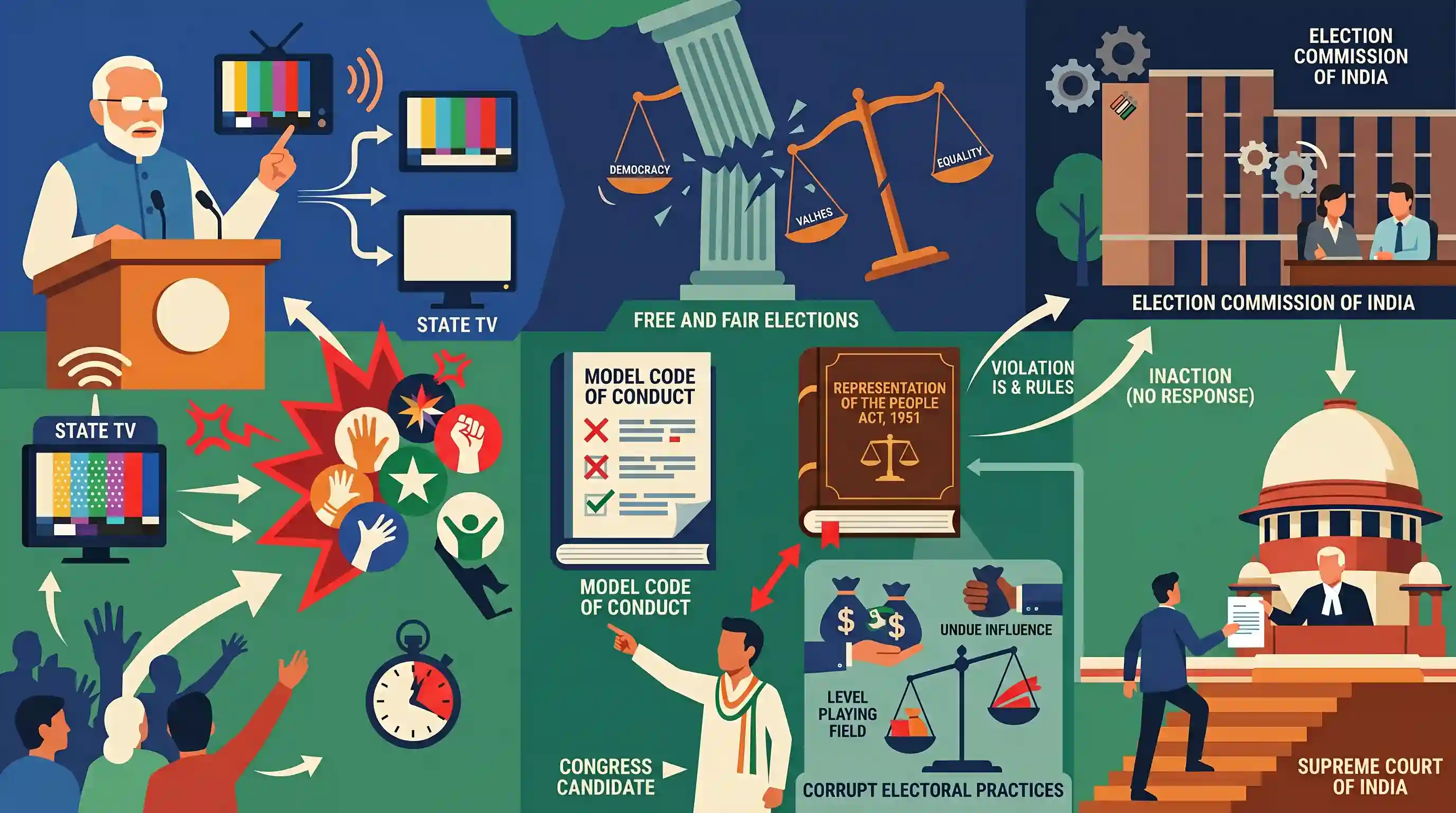
A Congress candidate has approached the Supreme Court alleging inaction by the Election Commission of India (ECI) over a televised national address by Prime Minister Narendra Modi. The petition claims that the broadcast, aired on government-controlled media like Doordarshan and Sansad TV during an active election cycle, overtly targeted Opposition parties. It argues that this violates the Model Code of Conduct (MCC) and constitutes a 'corrupt practice' under Section 123(7) of the Representation of the People Act, 1951. The petitioner asserts that the ECI's failure to intervene compromises the constitutional mandate of ensuring a level playing field and free, fair elections.
Key Points
- Congress MP T.N. Prathapan petitioned the Supreme Court against the Election Commission of India's (ECI) inaction regarding a televised address by PM Narendra Modi on April 18, 2026.
- The petitioner alleges the broadcast on state-controlled media (Doordarshan and Sansad TV) violated the Model Code of Conduct (MCC).
- The plea contends that naming and vilifying Opposition parties using state machinery constitutes a 'corrupt practice' under Section 123(7) of the Representation of the People Act, 1951.
- The ECI's failure to issue a show-cause notice is criticized as an unconstitutional abdication of its duty to ensure a level playing field and free and fair elections.
Important Terms
Representation of the People Act, 1951

The foundational law governing the actual conduct of elections in India, covering candidate qualifications, registration of parties, corrupt practices, and election dispute resolution.
UPSC context
GS II: Salient features of RPA; essential for understanding the legal basis for disqualification and electoral offenses.
Election Commission of India (ECI)
A permanent constitutional body under Article 324 responsible for administering and supervising Union and State elections to ensure they are free, fair, and impartial.
UPSC context
GS II: Constitutional Bodies; tests knowledge of ECI’s mandate to maintain a level playing field.
Model Code of Conduct (MCC)
A set of consensus-based guidelines issued by the ECI to regulate the conduct of political parties and candidates during an election cycle. It lacks statutory backing.
UPSC context
GS II: Electoral Reforms; frequently tested regarding the ECI's enforcement powers and executive accountability.
Section 123(7), RPA 1951
A specific provision of the RPA 1951 that prohibits candidates from obtaining assistance from government servants to further their election prospects, labeled as a 'corrupt practice.'
UPSC context
GS II: Statutory Provisions; critical for analyzing cases involving the misuse of state machinery by incumbents.
Constitution (131st Amendment) Bill
A 2026 legislative proposal aimed at expanding Lok Sabha seats and fast-tracking women's reservation via the 2011 Census; it notably failed to pass in April 2026.
UPSC context
GS II: Amendments and Federalism; tests understanding of special majorities under Article 368 and delimitation challenges.
Article 324
The 'watchdog' article of the Constitution that vests the ECI with the power of 'superintendence, direction, and control' over all Indian elections.
UPSC context
GS II: Constitutional Provisions; the primary source for ECI’s plenary powers and judicial interpretations of election fairness.
Prelims Trap
The Model Code of Conduct (MCC) is a statutory set of rules under the Representation of the People Act, 1951.
The MCC is not a statutory document. It is a consensus-driven code enforced by the ECI under Article 324, though certain violations may independently attract statutory penalties under the RPA.
Static Concepts Connected
What constitutes a 'corrupt practice' under Section 123 of the RPA, 1951?
- Government Assistance: Obtaining or attempting to obtain election assistance from specified government servants (e.g., gazetted officers, police).
- Undue Influence & Bribery: Any direct or indirect interference with the free exercise of electoral rights, alongside offering gratification to voters.
- Identity Appeals: Soliciting votes or promoting enmity on the basis of religion, race, caste, community, or language.
How is broadcast time regulated for political parties on state media during elections?
- Statutory Mandate: Section 39A of the RPA, 1951, mandates the ECI to allocate equitable broadcast time on state-owned media (Doordarshan/AIR).
- Eligible Parties: This time-allocation provision specifically applies only to recognized National and State political parties, not unrecognized ones.
- Core Objective: To prevent the ruling party from monopolizing state machinery and to ensure a level playing field during campaigning.
Cross-Topic Patterns
Basic Structure & Electoral Integrity
The Supreme Court ruled in Indira Nehru Gandhi v. Raj Narain (1975) that 'free and fair elections' are part of the Constitution's Basic Structure, making the ECI's mandate a non-derogable constitutional duty.
Article 324 Powers vs. Judicial Review
The ECI relies on its plenary powers under Article 324 to enforce the non-statutory MCC. The Supreme Court often examines whether inaction under Article 324 compromises the level playing field.

Expect a multi-statement Prelims question testing the exact statutory boundaries of 'corrupt practices' under RPA 1951 vs MCC violations.
Linked PYQs · 4
Linked PYQs · 4
- 2022MainsGS2
Discuss the role of the Election Commission of India in the light of the evolution of the Model Code of Conduct.
- 2025MainsGS2
Discuss the 'corrupt practices' for the purpose of the Representation of the People Act, 1951. Analyze whether the increase in the assets of the legislators and/or their associates, disproportionate to their known sources of income, would constitute 'undue influence' and consequently a corrupt practice.
- 2020MainsGS2
There is a need for simplification of procedure for disqualification of persons found guilty of corrupt practices under the Representation of Peoples Act". Comment.
- 2019MainsGS2
On what grounds a people's representative can be disqualified under the Representation of Peoples Act, 1951? Also mention the remedies available to such person against his disqualification.
