Replacement of MGNREGA with Viksit Bharat Rural Employment Bill
Source:Indian Express ↗
Why It Matters
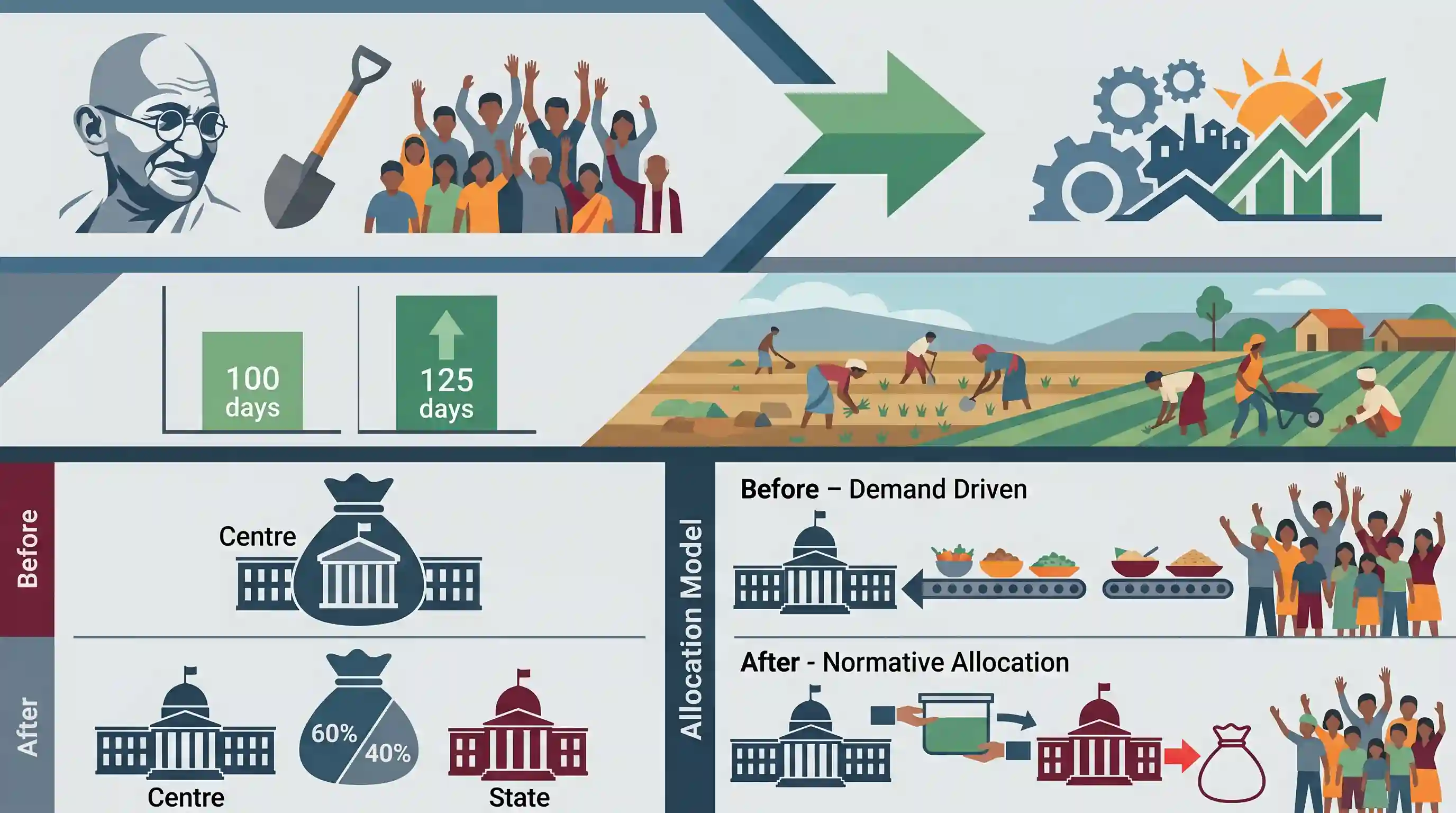
The replacement of MGNREGA represents a major paradigm shift in rural social security. By transitioning from a 100% centrally funded, demand-driven right to an allocation-based model with a 60:40 financial burden on general states, it introduces new dynamics in fiscal federalism and Centre-State relations, fundamentally altering how rural unemployment is addressed.
Summary
The Union government has introduced the Viksit Bharat Guarantee for Rozgar and Ajeevika Mission (Gramin) (VB-GRAM G) Bill, 2025, to replace the flagship MGNREGA scheme. The move drew sharp criticism from the Congress for erasing Mahatma Gandhi's name. While the new bill increases guaranteed employment from 100 to 125 days, it significantly alters the funding and operational mechanism. The financial liability, previously borne 100% by the Centre, will now be shared with states (60:40 for general states). Furthermore, the scheme will shift from a demand-driven approach to a normative allocation model, meaning states will have to cover any costs exceeding the Centre's designated allocation.
Key Points
- The Centre introduced the Viksit Bharat Guarantee for Rozgar and Ajeevika Mission (Gramin) Bill, 2025 in the Lok Sabha to replace MGNREGA, prompting strong opposition criticism over removing Mahatma Gandhi's name.
- The new bill promises 125 days of wage employment per financial year, an increase from MGNREGA's 100 days.
- The funding model shifts from 100% centrally sponsored to a shared structure: 90:10 for North Eastern and Himalayan states, and 60:40 for other states with legislatures.
- The scheme transitions from a purely demand-driven model to a state-wise normative allocation decided by the Centre, with states bearing any excess expenditure.
- The opposition has demanded that the bill be referred to a Parliamentary Standing Committee for closer scrutiny.
Important Terms
VB-GRAM G Bill, 2025

A 2025 legislative proposal to replace MGNREGA, increasing the rural employment guarantee to 125 days while shifting to a 60:40 Centre-State funding split.
UPSC context
GS Paper 2 (Government Policies); tests understanding of rural development reforms and shifts from rights-based to mission-based welfare.
MGNREGA, 2005
A landmark 2005 Act providing a legal guarantee of 100 days of unskilled work to rural households, fundamentally demand-driven with 100% central funding for wages.
UPSC context
GS Paper 2/3 (Welfare Schemes); a foundational topic for social justice, rural poverty, and comparing rights-based employment models.
Normative Allocation Model
A budgetary mechanism where funds are pre-allocated based on fixed parameters rather than actual demand, potentially capping expenditure for welfare schemes like rural employment.
UPSC context
GS Paper 3 (Economy/Budgeting); critical for analyzing fiscal discipline versus the responsiveness of social safety nets during economic distress.
Centrally Sponsored Scheme (CSS)
Programs funded jointly by the Centre and States (e.g., 60:40) but implemented by state governments; the VB-GRAM G Bill reclassifies rural employment into this category.
UPSC context
GS Paper 2 (Polity); essential for understanding fiscal federalism and the changing financial liabilities shared between the Centre and States.
Demand-driven Scheme
A policy framework where the government’s obligation to provide a service is triggered by citizen requests, ensuring the scheme expands automatically during economic downturns.
UPSC context
GS Paper 2 (Social Justice); tests the concept of "rights-based entitlements" and its impact on rural economic stability.
Fiscal Federalism
The financial relationship between the Centre and States; the shift in MGNREGA's funding ratio to 60:40 is a significant development in this area.
UPSC context
GS Paper 2 (Centre-State Relations); evaluates the impact of central policy shifts on state budgets and administrative autonomy.
Prelims Trap
"Under the VB-GRAM G Bill 2025, the Centre legally guarantees and funds 100% of wage costs for 125 days."
This is a trap. The new bill introduces a 60:40 shared model for wages (90:10 for NE/Himalayan) and uses a capped "normative allocation."
Static Concepts Connected
What were the original legal guarantees of MGNREGA 2005?
- Demand-driven nature: It provided a legal right to work within 15 days of demanding it, failing which an unemployment allowance had to be paid by the state.
- Financial liability: The Centre bore 100% of the wage cost for unskilled manual labor and 75% of the material cost.
- Gender quota: The Act mandated that at least one-third of the beneficiaries provided employment must be women.
How do Centrally Sponsored Schemes (CSS) differ from Central Sector Schemes?
- Funding pattern: CSS are jointly funded by the Centre and States (e.g., 60:40, 90:10), whereas Central Sector Schemes are 100% funded by the Union government.
- Implementation mechanism: CSS are implemented by State governments, while Central Sector Schemes are directly implemented by Central government ministries or agencies.
- Subject jurisdiction: CSS generally pertain to subjects in the State List to supplement state efforts, whereas Central Sector Schemes relate to the Union List.
Cross-Topic Patterns
Welfare restructuring and Fiscal Federalism
Moving from 100% central wage funding to a 60:40 split shifts significant financial burden to states, connecting directly to GS2 debates on centralizing revenue but decentralizing welfare expenditure.
Scrutiny deficit by Parliamentary Committees
The opposition's demand reflects a recurring GS2 theme: the declining percentage of legislative bills scrutinized by specialized Department-Related Parliamentary Standing Committees (DRPSCs) over recent Lok Sabhas.

Prelims 2026 will likely test the exact funding shift (60:40) & the end of open-ended demand-driven wages under the new VB-GRAM G scheme.
Linked PYQs · 3
Linked PYQs · 3
- 2011PrelimsGS1
Among the following who are eligible to benefit from the “Mahatma Gandhi National Rural Employment Guarantee Act”?
- 2025MainsGS2
Examine the evolving pattern of Centre-State financial relations in the context of planned development in India. How far have the recent reforms impacted the fiscal federalism in India?
- 2024MainsGS2
What changes has the Union Government recently introduced in the domain of Centre-State relations ? Suggest measures to be adopted to build the trust between the Centre and the States and for strengthening federalism.
