Opposition criticizes India abstaining from UNGA Gaza resolution
Source:The Hindu ↗
Why It Matters
Highlights the ongoing evolution of India's foreign policy on the Israel-Palestine conflict, balancing historical solidarity with the Palestinian cause against deepening strategic ties with Israel. The debate touches on India's role in multilateral forums and its moral standing in international relations.
Summary
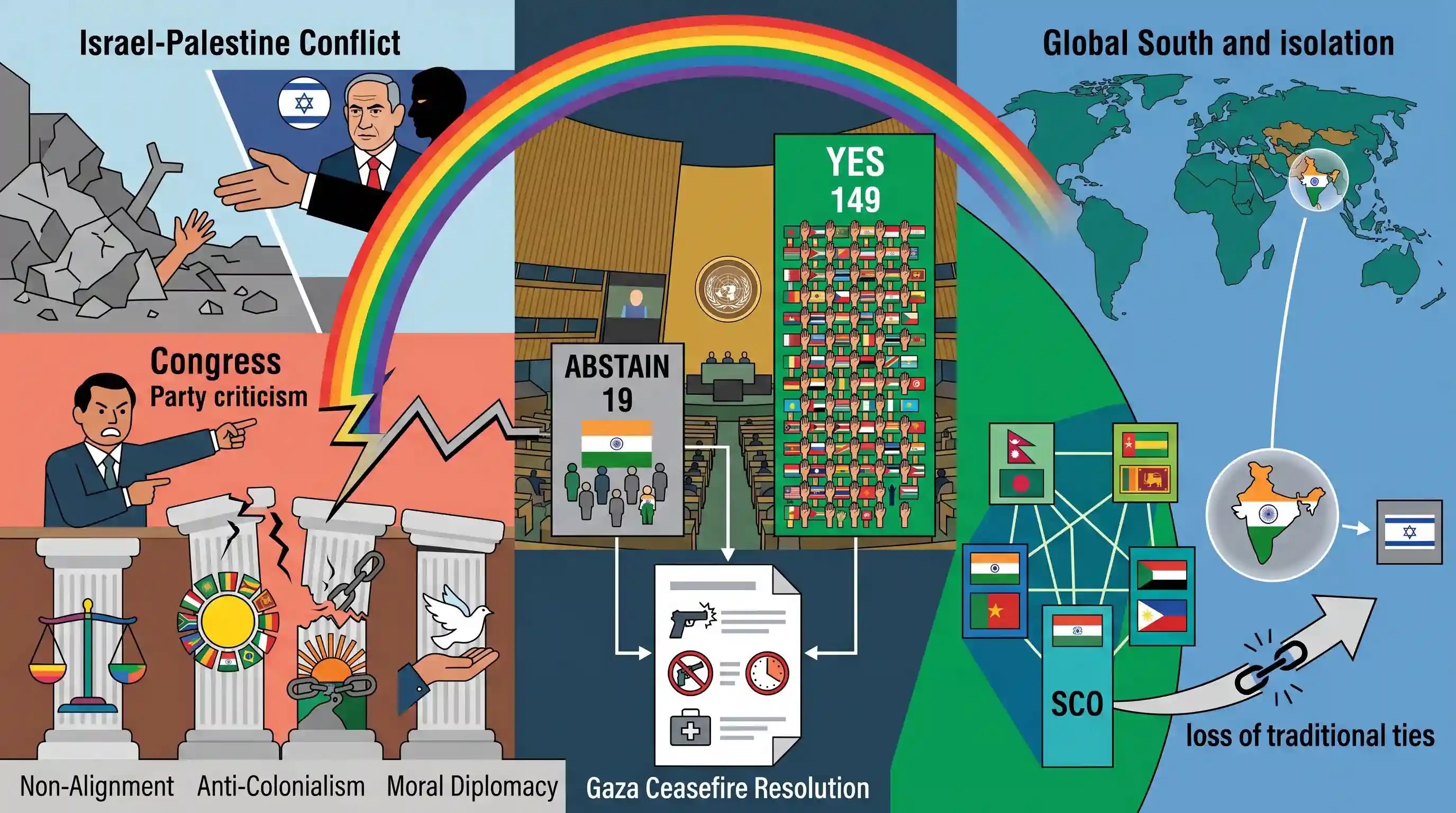
The Congress party strongly condemned the Indian government's decision to abstain from a UN General Assembly (UNGA) resolution demanding an immediate and permanent ceasefire in Gaza. While 149 nations supported the resolution, India was among 19 countries that abstained. Congress leaders argued that this move betrayed India's foundational foreign policy principles, including Non-Alignment, anti-colonialism, and moral diplomacy. The opposition accused the NDA government of effectively condoning a humanitarian catastrophe to appease Israeli Prime Minister Benjamin Netanyahu. Furthermore, they asserted that the abstention isolates India globally, contrasting its stance with neighboring South Asian nations and partners in groupings like BRICS and the SCO.
Key Points
- The UNGA overwhelmingly passed a resolution demanding an immediate, unconditional, and permanent ceasefire in Gaza, with 149 countries in favor and India among the 19 abstentions.
- The Congress party strongly criticized the BJP-led government for abstaining, labeling it a betrayal of India's historical foreign policy grounded in Non-Alignment and moral diplomacy.
- Opposition leaders argued that India's abstention tacitly condones the humanitarian catastrophe in Gaza and serves to appease Israeli Prime Minister Benjamin Netanyahu.
- Congress highlighted that India's stance isolates it regionally in South Asia and globally among its partners in multilateral forums such as BRICS and the SCO.
Important Terms
United Nations General Assembly (UNGA)

The main deliberative and representative organ of the United Nations, where all 193 member states have an equal vote on international issues like peace, security, and human rights.
UPSC context
GS Paper 2: Important International institutions, agencies and fora - their structure, mandate. Tests understanding of multilateral diplomacy.
Non-Aligned Movement (NAM)
A forum of 120+ developing countries not formally aligned with major power blocs, founded in 1961 to promote strategic autonomy, anti-colonialism, and sovereign equality.
UPSC context
GS Paper 2: India's Foreign Policy. Tests knowledge of India's historical diplomatic foundations and the principle of strategic autonomy.
BRICS
An influential grouping of major emerging economies—originally Brazil, Russia, India, China, and South Africa—expanded in 2024/25 to include nations like Iran, Egypt, and Ethiopia.
UPSC context
GS Paper 2: Bilateral, regional and global groupings and agreements involving India. Tests understanding of multipolar global governance.
Shanghai Cooperation Organisation (SCO)
A Eurasian security, political, and economic alliance focused on regional stability, counter-terrorism (via RATS), and cooperation between members including India, China, Russia, and Pakistan.
UPSC context
GS Paper 2: Regional and global groupings. Tests India's strategic engagement in Eurasia and neighborhood security management.
Global South
A collective term for developing and underdeveloped nations in Asia, Africa, and Latin America, often characterized by a shared colonial history and lower economic development.
UPSC context
GS Paper 2: India and its neighborhood- relations. Tests India's role as a representative and leader of developing nations.
Abstention
A diplomatic choice to not vote in favor or against a proposal, often used as a tool of strategic autonomy to maintain neutral ground or express dissatisfaction with resolution language.
UPSC context
GS Paper 2: India's Foreign Policy. Tests nuances of India's voting patterns at the UN and its balancing of strategic interests.
Prelims Trap
UN General Assembly resolutions demanding an immediate ceasefire are legally binding on all UN member states.
UN General Assembly (UNGA) resolutions are politically significant but non-binding recommendations. Only UN Security Council (UNSC) resolutions under Chapter VII are legally binding.
Static Concepts Connected
What is India's 'De-hyphenation' policy regarding Israel and Palestine?
- Independent relations: Treating bilateral ties with Israel and Palestine independently, assessing each on its own merits rather than viewing them through a zero-sum lens.
- Strategic shift: Marks a shift from traditional pro-Palestinian alignment to balancing critical defense and tech ties with Israel alongside developmental support for Palestine.
How do UNGA and UNSC resolutions differ in enforceability?
- UNGA recommendations: UN General Assembly resolutions are politically significant expressions of global consensus but are generally non-binding recommendations on member states.
- UNSC binding mandates: UN Security Council resolutions, particularly those adopted under Chapter VII of the UN Charter, are legally binding on all member states.
Cross-Topic Patterns
UN voting + Strategic Autonomy
India's abstentions on both Ukraine (regarding Russia) and Gaza (regarding Israel) highlight a definitive transition from ideological Non-Alignment to interest-based 'Strategic Autonomy' in multilateral forums.
Global South vs Bilateral ties
India’s push for 'Global South' leadership frequently faces friction when multilateral groupings like BRICS and SCO take consensus stances that conflict with New Delhi's core bilateral strategic partnerships.

India's 'de-hyphenation' policy and UN abstentions (Gaza, Ukraine) are highly likely to anchor a GS-2 IR Mains question in 2026.
Linked PYQs · 1
Linked PYQs · 1
- 2018MainsGS2
“India’s relations with Israel have, of late, acquired a depth and diversity, which cannot be rolled back.” Discuss.
