Political Debate Over Women Reservation and Delimitation
Source:The Hindu ↗
Why It Matters
It connects the constitutional mechanism of the Delimitation Commission with critical contemporary debates on federalism, demographic shifts between North and South India, and the implementation timeline for women's political representation.
Summary
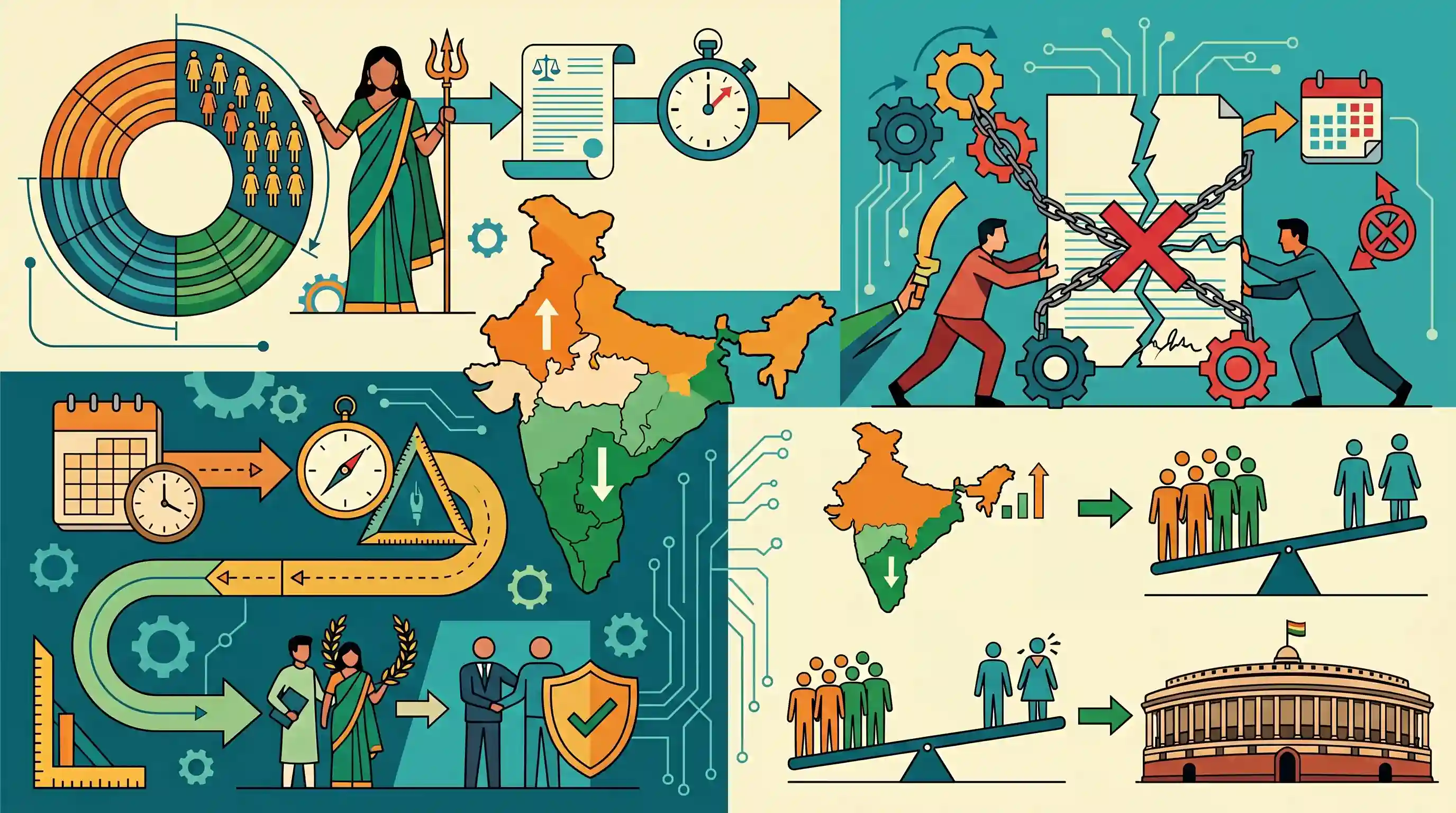
The article highlights a political clash following the defeat of a Constitution Amendment Bill aimed at expediting the 33% women's reservation in Parliament. The BJP criticized Congress for allegedly obstructing women's empowerment. The 2023 Nari Shakti Vandan Adhiniyam linked the quota to a post-amendment census and delimitation exercise. To speed up the process, the government proposed using the 2011 census. However, this sparked federal concerns: Lok Sabha seats have been frozen since 1976 based on the 1971 census to reward Southern states for population control. A new delimitation within the existing 543 seats would reduce Southern political representation compared to Northern states. To solve this North-South demographic imbalance, the defeated bill sought to increase the total number of Lok Sabha seats.
Key Points
- The BJP accused Congress of celebrating the defeat of a Constitution Amendment Bill intended to increase Lok Sabha strength and expedite the 33% women's reservation.
- The 2023 Nari Shakti Vandan Adhiniyam stipulated that women's reservation would commence only after delimitation based on the first census following the Act's passage.
- To bypass census delays, the government proposed using the 2011 census data for delimitation.
- Lok Sabha seats are currently capped at 543 based on the 1971 census to prevent penalizing Southern States for their successful population control measures.
- Implementing the women's quota without increasing total seats would tilt political representation toward Northern States, leading the government to propose expanding the Lok Sabha to maintain the federal balance.
Important Terms
Nari Shakti Vandan Adhiniyam

The 106th Amendment Act reserves 33% of seats in the Lok Sabha and State Legislative Assemblies for women. Its implementation is constitutionally linked to the next census and subsequent delimitation.
UPSC context
GS Paper II: Constitutional Amendments & Social Justice. Tests knowledge of legislative mechanisms for gender-based political empowerment and implementation hurdles.
Delimitation Commission
A statutory body responsible for redrawing the boundaries of parliamentary and assembly constituencies based on the latest census to ensure equitable population-to-representative ratios.
UPSC context
GS Paper II: Elections & Representation of People Act. Focuses on the demographic challenges of maintaining "one person, one vote, one value."
42nd Amendment Act (1976)
Enacted during the Emergency, it froze the allocation of Lok Sabha seats based on the 1971 Census to ensure states' population control efforts did not lead to reduced political representation.
UPSC context
GS Paper II: Federalism & Center-State relations. Relevant for discussing the historical origins of the North-South political and demographic imbalance.
Constitution (131st Amendment) Bill, 2026
A 2026 legislative proposal that sought to expedite women's reservation by using 2011 Census data and expanding the Lok Sabha to 850 seats; it failed to secure a special majority.
UPSC context
GS Paper II: Parliament & Law-making process. Tests understanding of special majorities and the specific political deadlocks surrounding the census-delimitation-reservation nexus.
Constitution (108th Amendment) Bill, 2008
A previous legislative attempt to provide 33% reservation for women. It was passed by the Rajya Sabha in 2010 but lapsed with the dissolution of the 15th Lok Sabha.
UPSC context
GS Paper II: Parliamentary Procedures. Demonstrates the difference between Bills that lapse and Acts that are sustained across sessions.
North-South Demographic Divide
The political tension arising from the fact that a population-based delimitation would increase representation for high-growth Northern states while penalizing Southern states that successfully implemented population control.
UPSC context
GS Paper II: Federalism. A critical issue regarding national unity, fiscal devolution, and equitable political power-sharing in a diverse union.
Prelims Trap
The 106th Amendment immediately implements 33% women's reservation in the Lok Sabha.
The reservation will only come into effect after a delimitation exercise is conducted based on the first census published following the Act's passage.
Static Concepts Connected
How did the 42nd, 84th, and 87th Amendments affect the Delimitation of constituencies?
- 42nd Amendment (1976): Froze the state-wise allocation of Lok Sabha seats based on the 1971 census until 2000 to reward states for successful population control.
- 84th Amendment (2001): Extended the freeze on the total number of Lok Sabha seats per state until 2026, keeping 1971 as the baseline population metric.
- 87th Amendment (2003): Allowed intra-state territorial redrawing of constituency boundaries based on the 2001 census, without altering the total number of seats allocated to the state.
What are the constitutional powers and characteristics of the Delimitation Commission?
- Article 82: Parliament enacts a Delimitation Act after every census to readjust the allocation of seats in the Lok Sabha to the states and divide states into territorial constituencies.
- Final Authority: Its orders have the force of law and cannot be challenged in any court, preventing election delays due to boundary disputes.
- Composition: It is appointed by the President and typically includes a serving/retired Supreme Court Judge, the Chief Election Commissioner, and respective State Election Commissioners.
Cross-Topic Patterns
Finance Commission vs. Delimitation
Both bodies face the North-South demographic dilemma. The 15th Finance Commission used the 2011 census but added demographic performance weights, a balancing mechanism absent in absolute Lok Sabha seat allocations.
PRI Quotas vs. Parliamentary Quotas
Contrast the delayed 106th CAA implementation with the 73rd/74th Amendments, which immediately mandated one-third reservation for women in local bodies without complex delimitation or census prerequisites.

A multi-statement 2026 Prelims question testing the exact Census years (1971 vs 2001) tied to inter- and intra-state delimitation is expected.
Linked PYQs · 4
Linked PYQs · 4
- 2024PrelimsGS1
Consider the following statements regarding 'Nari Shakti Vandan Adhiniyam' : 1. Provisions will come into effect from the 18th Lok Sabha. 2. This will be in force for 15 years after becoming an Act. 3. There are provisions for the reservation of seats for Scheduled Castes Women within the quota reserved for the Scheduled Castes. Which of the statements given above are correct?
- 2024PrelimsGS1
How many Delimitation Commissions have been constituted by the Government of India till December 2023?
- 2012PrelimsGS1
With reference to the Delimitation Commission, consider the following statements: 1. The orders of the Delimitation Commission cannot be challenged in a Court of Law. 2. When the orders of the Delimitation Commission are laid before the Lok Sabha or State Legislative Assembly, they cannot effect any modifications in the orders. Which of the statements given above is/are correct?
- 2023MainsGS2
Discuss the contribution of civil society groups for women's effective and meaningful participation and representation in state legislatures in India.
