Congress Alleges Police Brutality Against Students in Siwan
Source:The Hindu ↗
Why It Matters
The incident highlights the crucial balance between the fundamental right to peaceful protest (Article 19) and the maintenance of law and order. Allegations of police using lethal weapons against students raise significant human rights concerns. Additionally, issues related to high recruitment exam fees and paper leaks reflect systemic governance and employment challenges relevant for civil services aspirants.
Summary
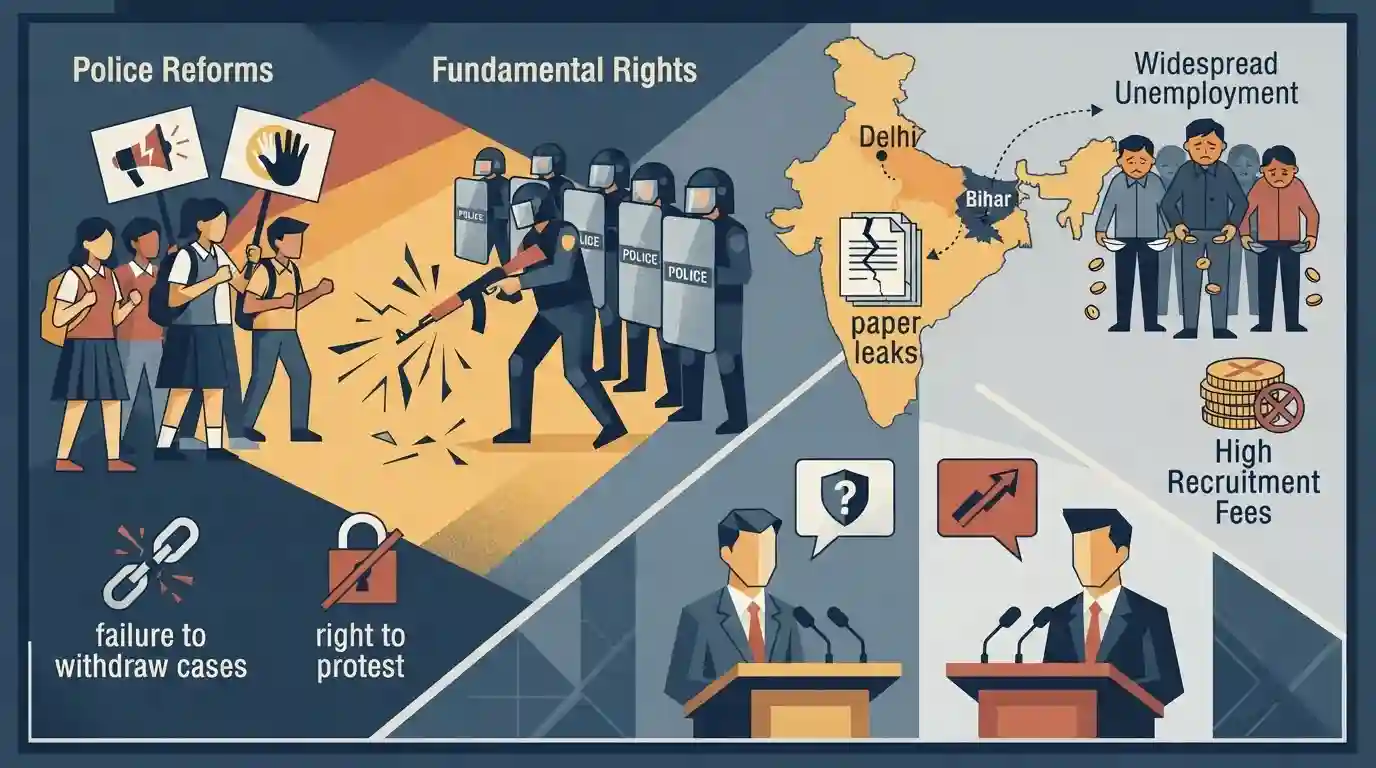
The Indian National Congress has strongly condemned the Bihar Police for alleged brutality against student protesters, citing an incident where police reportedly used AK-47s in Siwan. The students were demonstrating in support of an ongoing agitation at Jantar Mantar. Congress General Secretary Jairam Ramesh targeted Bihar Deputy CM Samrat Choudhary and Union Home Minister Amit Shah, raising concerns over high recruitment examination fees, frequent paper leaks, and widespread unemployment in the state. The party also criticized the government for failing to withdraw cases against previously protesting students. This event underscores ongoing governance challenges regarding youth employment and the tension between public protests and state law enforcement actions.
Key Points
- The Congress accused the Bihar Police of using extreme brutality, including firing AK-47s in Siwan, against students protesting in solidarity with the Jantar Mantar agitation.
- Congress leader Jairam Ramesh criticized the high fees (₹500 to ₹850) charged for recruitment examinations in Bihar compared to cheap land leased to industries.
- The party highlighted systemic issues of unemployment, paper leaks, and the failure of the state government to withdraw cases against protesting students despite previous notifications.
- The incident raises constitutional questions regarding the right to peaceful assembly and the use of disproportionate force by law enforcement agencies.
Important Terms
Right to Protest (Article 19)

A democratic right implicitly guaranteed under Article 19(1)(a) (freedom of speech) and 19(1)(b) (peaceful assembly) of the Constitution, allowing citizens to agitate against state policies, subject to reasonable restrictions for public order.
UPSC context
GS Paper 2 (Fundamental Rights). Evaluates the balance between constitutional liberties, democratic dissent, and maintaining public order.
Police Brutality (Excessive Use of Force)
The unwarranted or disproportionate use of force by law enforcement. Standard crowd-control protocols mandate a graded response (e.g., water cannons, tear gas) rather than lethal weapons like AK-47s against peaceful student assemblies.
UPSC context
GS Paper 2 & 3 (Governance, Security). Tests human rights, internal security standard operating procedures, and police reforms.
Bihar Police
The primary law enforcement agency for the state of Bihar. As "Police" and "Public Order" are State List subjects (Seventh Schedule), state police are responsible for localized law enforcement, crowd management, and internal security.
UPSC context
GS Paper 2 & 3 (Federalism, Internal Security). Relevant for analyzing state-level law enforcement issues and structural police reforms.
Examination Paper Leaks
The unauthorized release of confidential exam materials. This compromises institutional integrity and meritocracy, driving recent massive protests and prompting new legislative measures to curb unfair means in public recruitment testing.
UPSC context
GS Paper 2 (Governance, Transparency). Highlights systemic vulnerabilities in public recruitment, testing anti-corruption and governance reform knowledge.
Youth Unemployment (Demographic Dividend)
The inability of young, able-bodied individuals to find work. Persistently high youth unemployment and costly recruitment exams risk turning India's demographic dividend into a demographic disaster through social unrest and economic stagnation.
UPSC context
GS Paper 3 (Economy, Employment). Key to understanding human resource development, job creation, and macroeconomic planning.
Indian National Congress (INC)
Founded in 1885, it is India's oldest political party. As a principal national opposition force in a parliamentary democracy, it plays a crucial role in scrutinizing government actions and highlighting public grievances.
UPSC context
GS Paper 2 (Political Parties/Democracy). Tests understanding of the Opposition's structural role in holding the executive accountable.
Prelims Trap
"The Right to Protest is explicitly guaranteed as a Fundamental Right under Article 19."
The Constitution does not explicitly use the term 'Right to Protest'. It is a derived right interpreted by the Supreme Court from Articles 19(1)(a) and 19(1)(b).
Static Concepts Connected
What are the Constitutional restrictions on the Right to Protest?
- Derived Right: The right is derived from freedom of speech and peaceful assembly, not explicitly written.
- Reasonable Restrictions: Under Article 19(2) and 19(3), protests can be restricted for sovereignty, integrity, and public order.
- No Indefinite Occupation: The Supreme Court ruled (e.g., Shaheen Bagh case) that public ways and spaces cannot be occupied indefinitely.
What are the key features of the Public Examination (Prevention of Unfair Means) Act, 2024?
- Central Scope: It covers exams conducted by central bodies like UPSC, SSC, RRB, NTA, and IBPS.
- Strict Nature: Offences like leaking question papers or tampering with computer networks are cognizable, non-bailable, and non-compoundable.
- Harsh Penalties: Organised syndicates and institutions face up to 10 years in prison and fines up to ₹1 crore.
Cross-Topic Patterns
Unemployment + Demographic Disaster
The ILO's India Employment Report 2024 showing youths comprise ~83% of the unemployed links this political agitation directly to India's stalling demographic dividend and jobless growth debates.
State Subject + Prakash Singh Directives
Alleged police excesses consistently expose the failure of states to implement the Supreme Court's 2006 Prakash Singh directives, specifically regarding independent Police Complaints Authorities.

The Public Examination Act 2024's provisions (cognizable/non-bailable) and overlap with state policing is prime for a 2026 Prelims MCQ.
Linked PYQs · 2
Linked PYQs · 2
- 2025BPSC_PRELIMSGS1
The constitution of India provides for reasonable restrictions on Fundamental Rights but reasonableness must keep in mind that: 1. The restrictions must be necessary for the protection of the rights of others. 2. The restrictions must be proportionate to the end sought. 3. The restrictions must be reasonable in the light of the circumstances. 4. The restrictions must be in the public interest.
- 2016BPSC_PRELIMSGS1
Choose the fundamental rights available to Indian Citizen but not to aliens: I. Equality before Law II. Freedom of Expression and Speech III. Right of Minorities to conserve their language and culture IV. Protection to life and liberty
