Opposition Criticizes Economic Claims and Financial Policies
Source:The Hindu ↗
কেন এটি গুরুত্বপূর্ণ
The debate highlights the critical intersection of political accountability and economic governance, specifically regarding the transparency of financial inclusion schemes, job creation metrics, and the legal-regulatory architecture (such as the Fugitive Economic Offenders Act and financial intelligence agencies) used to tackle large-scale banking defaults.
সারসংক্ষেপ
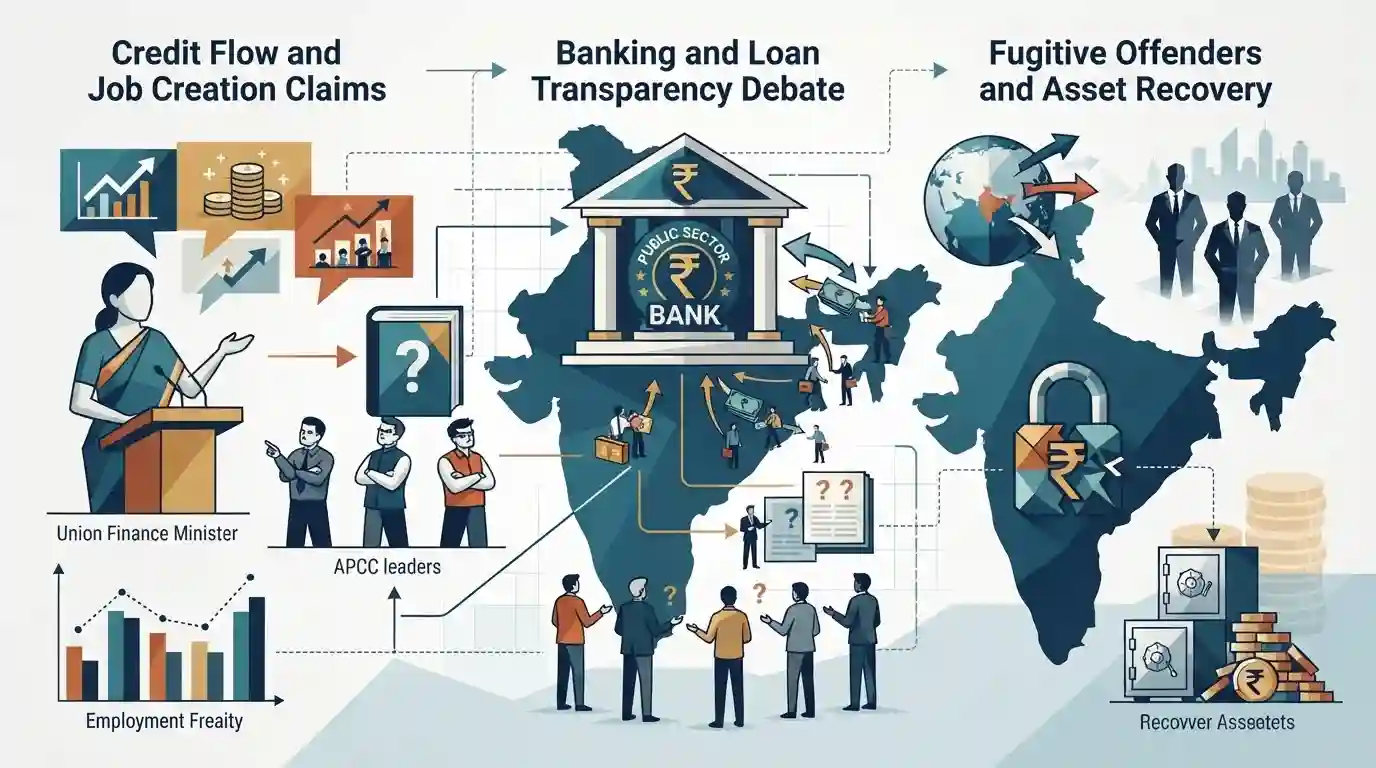
The Andhra Pradesh Congress Committee (APCC) has accused Union Finance Minister Nirmala Sitharaman of making misleading claims about credit flow, job creation, and economic recovery. During a press conference in Vijayawada, APCC leaders challenged the claims of extensive bank credit distribution for self-employment, demanding that the Union Government publish detailed data on loan beneficiaries and disbursements. Additionally, they targeted the administration over its inability to repatriate fugitive economic offenders who defrauded public sector banks of thousands of crores, calling for transparency regarding the total assets recovered. The development underscores the ongoing political-economic debate surrounding financial inclusion, unemployment, and institutional recovery mechanisms for banking frauds.
মূল বিষয়
- The Andhra Pradesh Congress Committee (APCC) accused Union Finance Minister Nirmala Sitharaman of repeating 'false claims' regarding bank loans, employment generation, and economic recovery.
- Opposition leaders demanded the publication of specific data on bank loan disbursements, including names of beneficiaries, physical locations, and exact amounts sanctioned to back the government's self-employment claims.
- The APCC criticized the government for failing to address the problem of fugitive economic offenders who defaulted on massive banking loans and fled the country, demanding a clear account of the total financial assets recovered so far.
- The political row highlights broader policy debates on credit-led jobless growth, non-performing assets (NPAs) management, and the effectiveness of institutional frameworks like the Fugitive Economic Offenders Act, 2018 in recovering public funds.
গুরুত্বপূর্ণ শব্দ
Fugitive Economic Offenders Act, 2018

A law enabling the government to declare individuals who flee India to evade prosecution for economic offences of ₹100 crore or more as "fugitive economic offenders" and confiscate their properties.
UPSC context
GS Paper 3 (Economy & Security); tests knowledge of legal frameworks against economic offences, money laundering, and banking scams.
Pradhan Mantri MUDRA Yojana
A flagship scheme launched in 2015 to provide collateral-free microfinance up to ₹20 lakh (with Shishu, Kishor, Tarun, and Tarun Plus categories) to small and micro-enterprises.
UPSC context
GS Paper 3 (Growth & Employment); tests financial inclusion, self-employment schemes, and credit mobilization.
Serious Fraud Investigation Office
A multi-disciplinary statutory agency under the Ministry of Corporate Affairs established to investigate complex corporate frauds and white-collar crimes in India.
UPSC context
GS Paper 3 (Banking & Institutional Frameworks); tests regulatory mechanisms for corporate governance and financial fraud prevention.
Directorate of Enforcement
A multi-disciplinary financial investigation agency under the Ministry of Finance responsible for enforcing economic laws like PMLA, FEMA, and the Fugitive Economic Offenders Act.
UPSC context
GS Paper 3 (Security & Economy); tests money laundering, financial crime enforcement, and internal security challenges.
Ministry of Finance
An important ministry of the Government of India responsible for taxation, financial legislation, financial institutions, capital markets, federal finance, and the Union Budget.
UPSC context
GS Paper 3 (Government Budgeting & Economic Growth); tests fiscal policy, economic reforms, and financial sector governance.
প্রিলিমস ফাঁদ
Only properties explicitly identified as 'proceeds of crime' can be confiscated under the Fugitive Economic Offenders Act (FEOA), 2018.
Under FEOA 2018, the Special Court can confiscate any property owned by the offender, including benami and corporate assets, regardless of whether they are directly linked to the specific crime.
সংযুক্ত স্থির ধারণা
What are the key provisions and threshold criteria of the Fugitive Economic Offenders Act, 2018?
- Threshold Limit: Applies strictly to scheduled economic offences involving a total value of ₹100 crore or more where the accused has fled India.
- Asset Confiscation: Allows confiscation of any property of the declared FEO (including benami, corporate, and offshore assets), which then vests with the Centre.
- Civil Disentitlement: Disables declared FEOs and associated corporate entities from defending or filing civil claims in Indian courts, preventing legal stalling.
- Enforcing Agency: The Enforcement Directorate (ED) serves as the primary implementation agency, filing applications before the PMLA Special Court.
What are the structural features and loan categories under the Pradhan Mantri MUDRA Yojana (PMMY)?
- Classification Categories: Loans are classified into Shishu (up to ₹50,000), Kishor (above ₹50,000 to ₹5 Lakh), and Tarun (above ₹5 Lakh to ₹10 Lakh).
- Tarun Plus Upgrade: Union Budget 2024-25 introduced 'Tarun Plus', doubling the credit limit to ₹20 lakh for borrowers who have successfully repaid previous Tarun loans.
- Credit Delivery: MUDRA loans are collateral-free and are disbursed by Commercial Banks, RRBs, Small Finance Banks, MFIs, and NBFCs.
আন্তঃবিষয় প্যাটার্ন
Extradition treaties + FEOA 2018
While FEOA allows offshore asset confiscation, actual repatriation of offenders relies heavily on bilateral extradition treaties and MLATs, bridging domestic economic laws with international diplomacy.
Priority Sector Lending + Job Elasticity
Expanding micro-credit via MUDRA aims to drive self-employment, but raising loan limits without formal employment mapping risks compounding retail NPAs and highlighting low job elasticity.

FEOA asset confiscation powers and PMLA Special Court jurisdictions will likely feature as a multi-statement Prelims question in 2026.
সংযুক্ত PYQ · 4
সংযুক্ত PYQ · 4
- 2025PrelimsGS1
With reference to the Government of India, consider the following information: Organization Some of its functions It works under I. Directorate of Enforcement Enforcement of the Fugitive Economic Offenders Act, 2018 Internal Security Division-I, Ministry of Home Affairs II. Directorate of Revenue Intelligence Enforces the Provisions of the Customs Act, 1962 Department of Revenue, Ministry of Finance III. Directorate General of Systems and Data Management Carrying out big data analytics to assist tax officers for better policy and nabbing tax evaders Department of Revenue, Ministry of Finance In how many of the above rows is the information correctly matched?
- 2026PrelimsGS1
With reference to the organisations under the Government of India, consider the following details : | Sl. No. | Organisation | Function | Controlling Union Ministry | | --- | --- | --- | --- | | 1. | Central Economic Intelligence Bureau (CEIB) | To coordinate between various law enforcement agencies | Ministry of Home Affairs | | 2. | Serious Fraud Investigation Office (SFIO) | To investigate complex corporate frauds | Ministry of Finance | | 3. | Central Bureau of Investigation (CBI) | To preserve values in public life and ensure the health of the national economy | Ministry of Personnel, Public Grievances and Pension | In how many of the above rows are the given details correctly matched ?
- 2021MainsGS3
Discuss how emerging technologies and globalisation contribute to money laundering. Elaborate measures to tackle the problem of money laundering both at national and international levels.
- 2022MainsGS3
Economic growth in the recent past has been led by increase in labour productivity." Explain this statement. Suggest the growth pattern that will lead to creation of more jobs without compromising labour productivity.
