Congo and Rwanda sign US-mediated peace deal
Source:The Hindu ↗
Why It Matters
This article is highly relevant for UPSC as it touches upon crucial map-based Prelims topics (like regions in the DRC such as North Kivu/Ituri, which have appeared in past PYQs) and Mains GS2 themes of global geopolitics, major power rivalry (US vs. China) over critical minerals in the Global South, and regional conflict resolution mechanisms.
Summary
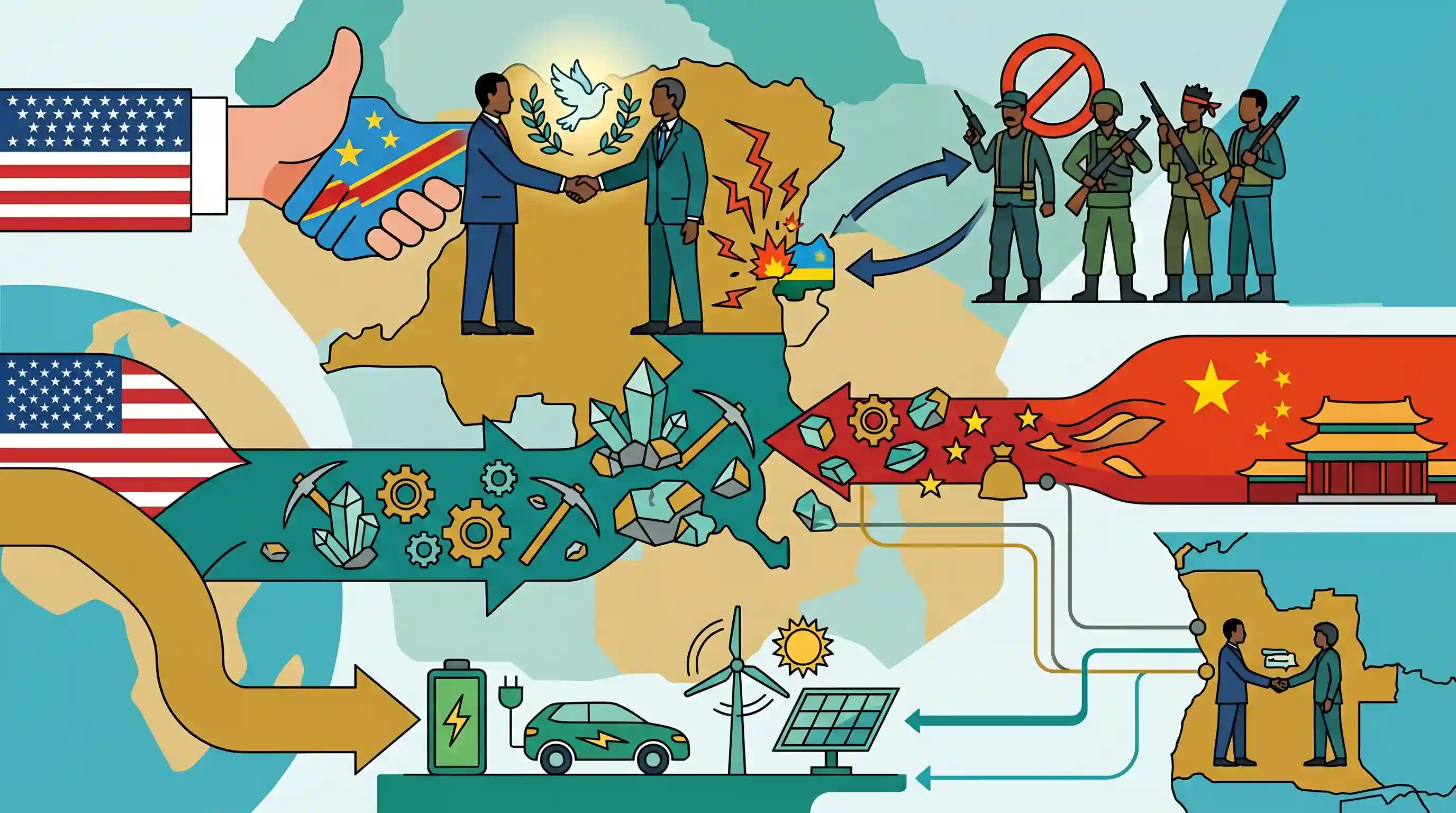
The United States has brokered a historic peace agreement between the Democratic Republic of Congo (DRC) and Rwanda, aiming to resolve decades of violent conflict in eastern Congo. The conflict has been heavily driven by various armed groups, most notably the Rwanda-backed M23 rebels, who have stated they are not bound by this new agreement. The geopolitical significance of the deal extends beyond regional stability; the US is strategically positioning itself to secure access to the DRC's vast reserves of critical minerals—essential for green technologies—thereby countering China's established dominance in the African mining sector. The deal complements ongoing regional mediation efforts like the Angola-led Luanda process.
Key Points
- The US successfully brokered a peace deal between the Democratic Republic of Congo (DRC) and Rwanda to end decades of bloody conflict in eastern Congo.
- The prominent rebel group M23, widely believed to be backed by Rwanda, refused to recognize the deal, stating it was not a signatory.
- The agreement highlights growing US strategic interest in Africa, particularly regarding access to critical minerals like cobalt and copper, aiming to counterbalance Chinese influence.
- The US-mediated talks ran parallel to other regional peace initiatives, including the Angola-led 'Luanda process' and discussions facilitated by Qatar.
Important Terms
Washington Accords (2025)

A 2025 U.S.-mediated peace treaty between the DRC and Rwanda. It mandates Rwandan troop withdrawal, disarmament of rebel groups, and establishes a framework for U.S. investment in the DRC's critical minerals sector.
UPSC context
GS-II: International Relations. Relevant for understanding U.S. mediation in global conflicts and resource diplomacy in Africa.
M23 (March 23 Movement)
A powerful Rwanda-backed, Tutsi-led rebel group operating in eastern Congo. Named after a 2009 peace deal, it has seized key territories (Goma, Bukavu), driving the region's severe humanitarian and security crisis.
UPSC context
GS-II: International Relations (Conflict zones). Tests knowledge of non-state actors impacting global stability and mineral supply chains.
Luanda Process
An Angola-led regional diplomatic initiative established in 2022 to normalize DRC-Rwanda relations. It created the 'Harmonized Plan' for demobilizing rebels, serving as a critical precursor to current U.S.-led peace efforts.
UPSC context
GS-II: International Relations. Important for studying regional mediation mechanisms and African Union-backed peace frameworks.
Congo River Alliance (AFC)
A politico-military coalition formed in 2023 (led by Corneille Nangaa) that includes the M23 rebels. It seeks to overthrow the DRC government and has been sanctioned by the U.S. for destabilizing Central Africa.
UPSC context
GS-II & GS-III: Security and IR. Highlights the role of rebel coalitions in regional instability and the use of international sanctions.
Critical Minerals (DRC context)
Strategic resources (e.g., cobalt, copper, coltan) essential for high-tech and green energy industries. The DRC’s vast reserves are a focal point of U.S.-China geopolitical competition and resource security strategies.
UPSC context
GS-I: Economic Geography; GS-II: IR. Crucial for understanding global supply chains and the 'Scramble for Africa' 2.0.
Prelims Trap
"M23 is an armed rebel group operating in the Sahel region."
M23 operates in the African Great Lakes region (Eastern DRC). UPSC often traps students by swapping African regions (Sahel vs. Great Lakes vs. Horn of Africa).
Static Concepts Connected
What are the key geographical features of the Democratic Republic of Congo (DRC)?
- Great Lakes: Shares eastern borders with the African Great Lakes: Albert, Edward, Kivu, Tanganyika, and Mweru.
- Congo Basin: Contains the world's second-largest rainforest and largest tropical peatlands, acting as a critical global carbon sink.
- Equator: The equator runs directly through the central and northern parts of the country.
Why is Cobalt geopolitically critical for the modern clean energy transition?
- Battery Chemistry: Crucial for stabilizing, preventing overheating, and extending the life of lithium-ion batteries in Electric Vehicles (EVs).
- Supply Concentration: DRC mines ~70% of global cobalt, but China dominates the downstream refining and processing, creating a supply chain choke point.
- India's Strategy: India established KABIL (Khanij Bidesh India Ltd) to secure critical mineral assets in resource-rich nations and reduce import dependencies.
Cross-Topic Patterns
US-led Mineral Security Partnership (MSP)
This US diplomatic push directly aligns with the MSP's goal—which India joined in 2023—to de-risk critical mineral (cobalt/copper) supply chains from Chinese monopolies.
African Solutions to African Problems
The Angola-led Luanda process highlights the African Union's framework for regional conflict resolution, frequently contrasted in Mains with external Western or Chinese diplomatic interventions.

Expect a 'Places in News' matching M23, North Kivu, or Luanda Process, combined with African critical mineral geography in 2026 Prelims.
Linked PYQs · 4
Linked PYQs · 4
- 2023PrelimsGS1
Consider the following pairs: Regions often mentioned in news Reason for being in news 1. North Kivu and Ituri : War between Armenia and Azerbaijan 2. Nagorno-Karabakh : Insurgency in Mozambique 3. Kherson and Zaporizhzhia : Dispute between Israel and Lebanon How many of the above pairs are correctly matched?
- 2024PrelimsGS1
One of the following regions has the world's largest tropical peatland, which holds about three years worth of global carbon emissions from fossil fuels; and the possible destruction of which can exert detrimental effect on the global climate. Which one of the following denotes that region?
- 2023PrelimsGS1
Which one of the following is a part of the Congo Basin?
- 2025MainsGS2
"The reform process in the United Nations remains unresolved, because of the delicate imbalance of East and West and entanglement of the USA vs. Russo-Chinese alliance.” Examine and critically evaluate the East-West policy confrontations in this regard.
