Congress seeks Election Commission intervention on voter deletions
Source:uniindia ↗
Why It Matters
Purification of electoral rolls is critical for conducting free and fair elections, but procedural lapses or misuse of automated systems (like DSE/PSE) and statutory forms (Form-7) can lead to the disenfranchisement of legitimate voters. This highlights ongoing challenges in electoral governance and the functioning of the Election Commission.
Summary
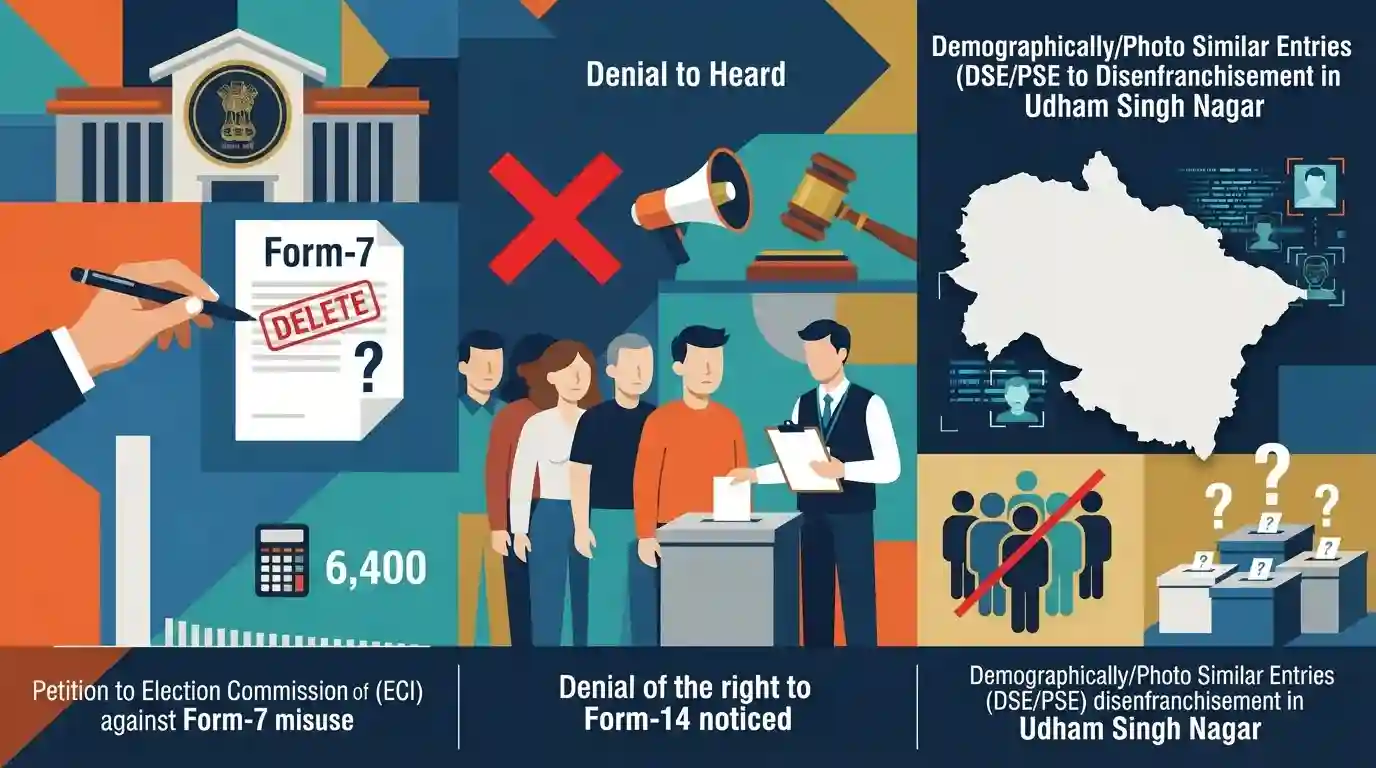
The Congress party in Uttarakhand has petitioned the Election Commission of India (ECI) to halt the processing of disputed Form-7 objections, which are used to delete names from the electoral roll. The party alleges rampant misuse of this mechanism during the ongoing Special Intensive Revision (SIR), highlighting that a small number of individuals have filed thousands of objections—including one person submitting over 6,400 objections in Kichha—without verifiable proof. Furthermore, the party claimed that affected voters were not issued mandatory Form-14 notices, denying them the right to be heard. They also raised concerns over the Demographically/Photo Similar Entries (DSE/PSE) exercise in Udham Singh Nagar district, arguing it could lead to mass disenfranchisement.
Key Points
- The Uttarakhand Congress urged the Election Commission of India (ECI) to suspend actions on disputed Form-7 objections, alleging systematic deletion of genuine voters during the Special Intensive Revision.
- Form-7, used to object to the inclusion of a name in the electoral roll, has allegedly been misused, with instances of single individuals filing thousands of such objections without providing verifiable evidence.
- The party also alleged that mandatory notices (Form-14) were not served to the affected voters, denying them a chance to challenge their deletion.
- Congress opposed the restarting of the Demographically/Photo Similar Entries (DSE/PSE) deduplication exercise in Udham Singh Nagar district, which could affect over 1 lakh electors.
Important Terms
Special Intensive Revision (SIR)

A comprehensive door-to-door exercise by the Election Commission of India to update and verify electoral rolls, removing deceased, shifted, or ineligible voters while adding new eligible citizens.
UPSC context
UKPSC GS Paper 2 (Polity); tests knowledge of electoral reforms, ECI functions, and voter registration processes.
Form-7
The official application form under the Representation of the People Act, 1950, used by citizens to object to a name's inclusion or request a deletion from the electoral roll.
UPSC context
UKPSC GS Paper 2 (Polity); essential for questions on the Representation of the People Act and electoral dispute mechanisms.
Form-14
A mandatory legal notice issued by the Election Commission to a voter whose inclusion in the electoral roll is challenged, granting them the opportunity to be heard before deletion.
UPSC context
UKPSC GS Paper 2; relevant for electoral rights, natural justice principles, and statutory voting safeguards.
Demographically/Photo Similar Entries (DSE/PSE)
An IT-enabled system used by the Election Commission to identify duplicate voter registrations by comparing demographic details and photographs across the electoral roll database.
UPSC context
UKPSC GS Paper 2 & Paper 3; highlights the role of technology in ensuring free, fair, and transparent elections.
Representation of the People Act, 1950
The primary legislation that provides for the allocation of seats, delimitation of constituencies, qualifications of voters, and the preparation of electoral rolls in India.
UPSC context
UKPSC GS Paper 2; forms the core statutory framework for elections and is heavily tested in Mains.
Prelims Trap
Electoral rolls preparation and revision is governed by the Representation of the People Act, 1951.
Preparation and revision of electoral rolls fall strictly under the Representation of the People Act, 1950. RPA 1951 deals with the actual conduct of elections.
Static Concepts Connected
What are the key provisions of the Representation of the People Act, 1950?
- Electoral Rolls: Mandates the preparation, revision, and updating of electoral rolls for Parliamentary and Assembly constituencies.
- Delimitation: Provides for the allocation of seats and delimitation of constituencies for both the Lok Sabha and State Legislative Assemblies.
- Voter Qualifications: Lays down the qualifications of voters, including ordinary residency and age criteria.
Which statutory forms are used for modifying the electoral roll in India?
- Form 6: Used by eligible citizens for registering as a new voter or shifting residence to a different constituency.
- Form 7: Used for objecting to the proposed inclusion of a name or seeking deletion of an existing entry.
- Form 8: Used for correction of particulars, shifting within the constituency, marking PwD status, or replacing an EPIC.
Cross-Topic Patterns
Electoral Rolls & Universal Adult Suffrage
Deletion controversies frequently tie into Article 326 (Universal Adult Suffrage) and the statutory nature of the right to vote in India, a core constitutional debate in recent years.
Digital Governance vs. Algorithmic Exclusion
The ECI's use of DSE/PSE software mirrors debates on Aadhaar-voter ID linkage and algorithmic exclusion, a recurring theme in public administration and e-governance topics.

Expect a statement-based question contrasting RPA 1950 (Electoral Rolls) with RPA 1951 (Conduct of Elections) alongside ECI's DSE tool.
Linked PYQs · 1
Linked PYQs · 1
- 2011UKPSC_PRELIMSGS1
The Chief Election Commissioner of India is appointed by
