Rajasthan Assembly Adjournment Powers and Legislative Speaker Role
Source:theprint ↗
Why It Matters
Incidents of assembly disruptions are pertinent for understanding the practical functioning of state legislatures, the powers of the Speaker to adjourn the House, and the significance of procedural mechanisms like Question Hour and Zero Hour, which are core topics in Indian Polity.
Summary
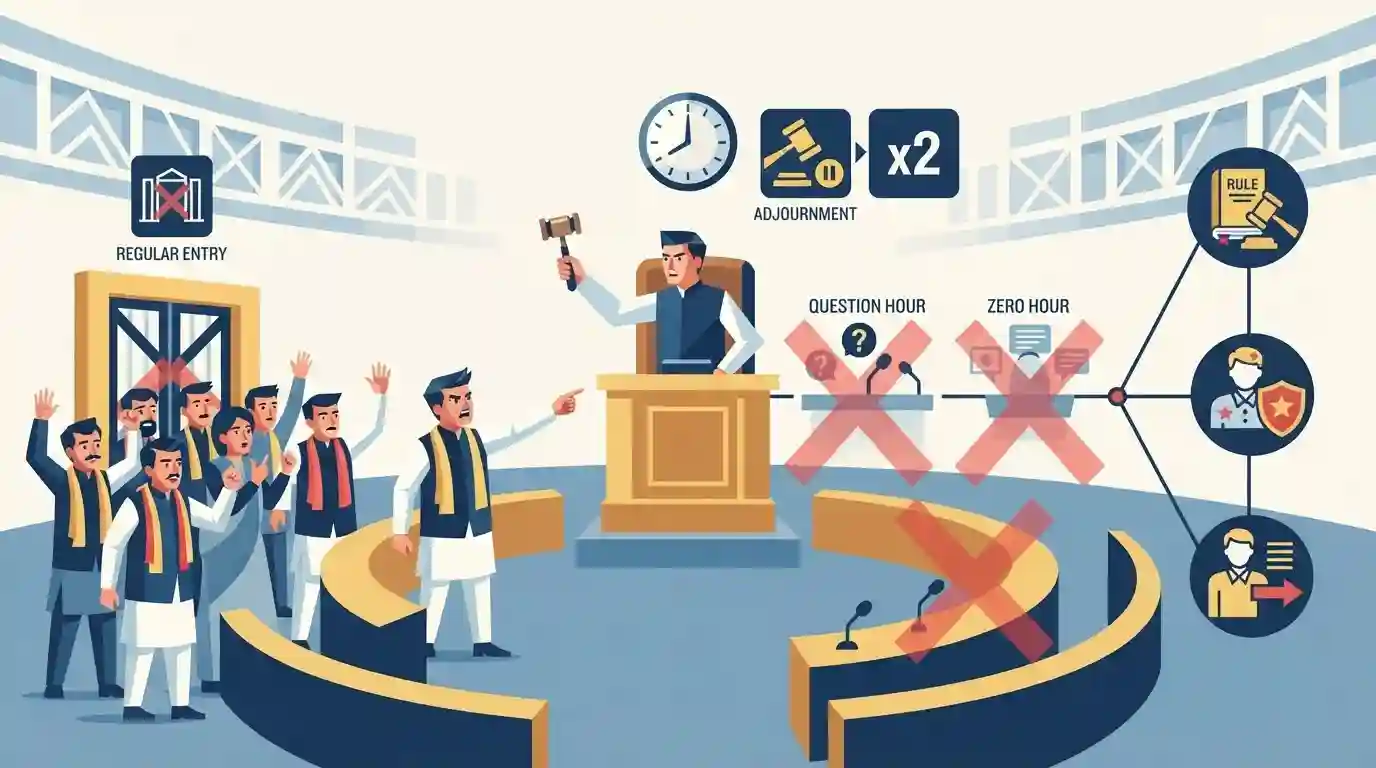
Congress members staged a strong protest in the Rajasthan Assembly over allegedly being denied entry through the regular gate, prompting Speaker Vasudev Devnani to adjourn the House twice. The disruptions impacted significant legislative sessions, including Question Hour and Zero Hour. Leader of the Opposition Tika Ram Jully criticized the restriction as a violation of MLAs' rights, bringing focus to assembly procedures, the rights of legislators, and the disciplinary powers of the Speaker.
Key Points
- Congress MLAs caused disruptions in the Rajasthan Assembly protesting against being denied entry through the regular gate.
- The protest led to the adjournment of the House twice by Speaker Vasudev Devnani, affecting both Question Hour and Zero Hour proceedings.
- Leader of Opposition Tika Ram Jully argued that restricting MLAs' entry through the usual gate was an infringement of their rights.
- The incident underscores the procedural challenges within state legislatures and the role of the Speaker in maintaining order during disruptions.
Important Terms
Question Hour

The designated first hour of a legislative assembly sitting where members ask questions to ministers, serving as a primary procedural tool to hold the executive accountable for its policies and actions.
UPSC context
Crucial for RPSC Paper III (Polity) to understand legislative procedures and how MLAs enforce government accountability.
Zero Hour
An Indian parliamentary innovation immediately following Question Hour, providing legislators a dedicated but informal time slot to raise matters of urgent public importance without requiring standard prior notice.
UPSC context
Frequently tested in RPSC regarding unique Indian legislative conventions and procedural devices used by members.
Adjournment of the House
The suspension of a legislative sitting until a specified time. The Speaker exercises this disciplinary power to maintain order when proceedings are severely disrupted by protests or uproar.
UPSC context
Relevant for RPSC polity sections focusing on the Speaker's role, disciplinary powers, and the conduct of legislative business.
Legislative Privileges (Article 194)
Constitutional immunities under Article 194, including freedom of speech and protection from legal action for assembly proceedings, granted to state legislators to ensure they can function independently without obstruction.
UPSC context
Highly relevant for RPSC Paper III regarding the constitutional rights of MLAs, parliamentary privileges, and institutional autonomy.
Prelims Trap
The Governor has the exclusive power to adjourn the legislative assembly during severe disruptions.
The Speaker adjourns the House to suspend a sitting. The Governor's power is to prorogue the session or dissolve the Assembly, not to manage daily adjournments.
Static Concepts Connected
What differentiates Question Hour from Zero Hour in legislative proceedings?
- Question Hour: The first hour of a sitting, strictly governed by Rules of Procedure, where members ask questions to ministers with prior formal notice.
- Zero Hour: An informal Indian parliamentary innovation not in the rulebook, immediately following Question Hour, used to raise urgent public matters without notice.
How does Article 194 protect the functioning of State Legislatures?
- Constitutional Privileges: It formally defines and guarantees the powers, privileges, and immunities of State Legislatures, their individual members, and legislative committees.
- Legal Immunity: Members are protected from any civil or criminal court proceedings regarding anything said or any vote given on the floor of the legislative assembly.
Cross-Topic Patterns
Speaker's powers + Rules of Procedure
Frequent disruptions tie back to the Speaker's disciplinary powers to suspend members or adjourn proceedings, a recurring theme in RPSC exams regarding assembly decorum.
Legislative Privileges vs. Judicial Review
The LoP's claim of 'infringement of rights' highlights the tension between legislative privileges (Article 194) and internal procedural rules, which are generally immune from judicial scrutiny.

Expect statement-based RPSC questions differentiating the Speaker's power to adjourn (sine die) from the Governor's power to prorogue.
Linked PYQs · 4
Linked PYQs · 4
- 2025RPSC_PRELIMSGS1
Which of the following statements regarding the powers of the Speaker of the Lok Sabha is correct? Select the correct answer from the code given below: (i) The Speaker of the Lok Sabha presides over the joint sitting of both houses of Parliament. (ii) When a Finance Bill is sent from the Lower House to the Upper House, the Speaker certifies it as a Finance Bill. (iii) When a motion to remove the Speaker is under consideration, the Speaker neither presides nor participates in the proceedings. (iv) Apart from equality of votes, the Speaker does not vote in the House. Code:
- 2025RPSC_PRELIMSGS1
Which of the following statements regarding subordinate legislation in the Rajasthan Legislative Assembly is not correct?
- 2025RPSC_PRELIMSGS1
The appointment of the State Information Commissioner is made by the Governor on the recommendation of a committee. Which of the following is not a member of this committee?
- 2024RPSC_PRELIMSGS1
Consider the following statements regarding 24th Committee recommendation: A. The Parliament was in Joint Sitting of both the houses. B. If a member is transferred from Lower House to Upper House. Select the correct answer using the codes given below:
