India United States Trade Pact Negotiation Complexities
Source:Indian Express ↗
Why It Matters
The United States is one of India's most important trading partners and a key strategic ally. Trade agreements directly impact domestic industries, export growth, and geopolitical positioning. Understanding the friction points and negotiation strategies in such pacts is crucial for the Civil Services, particularly concerning international relations and economic policy.
Summary
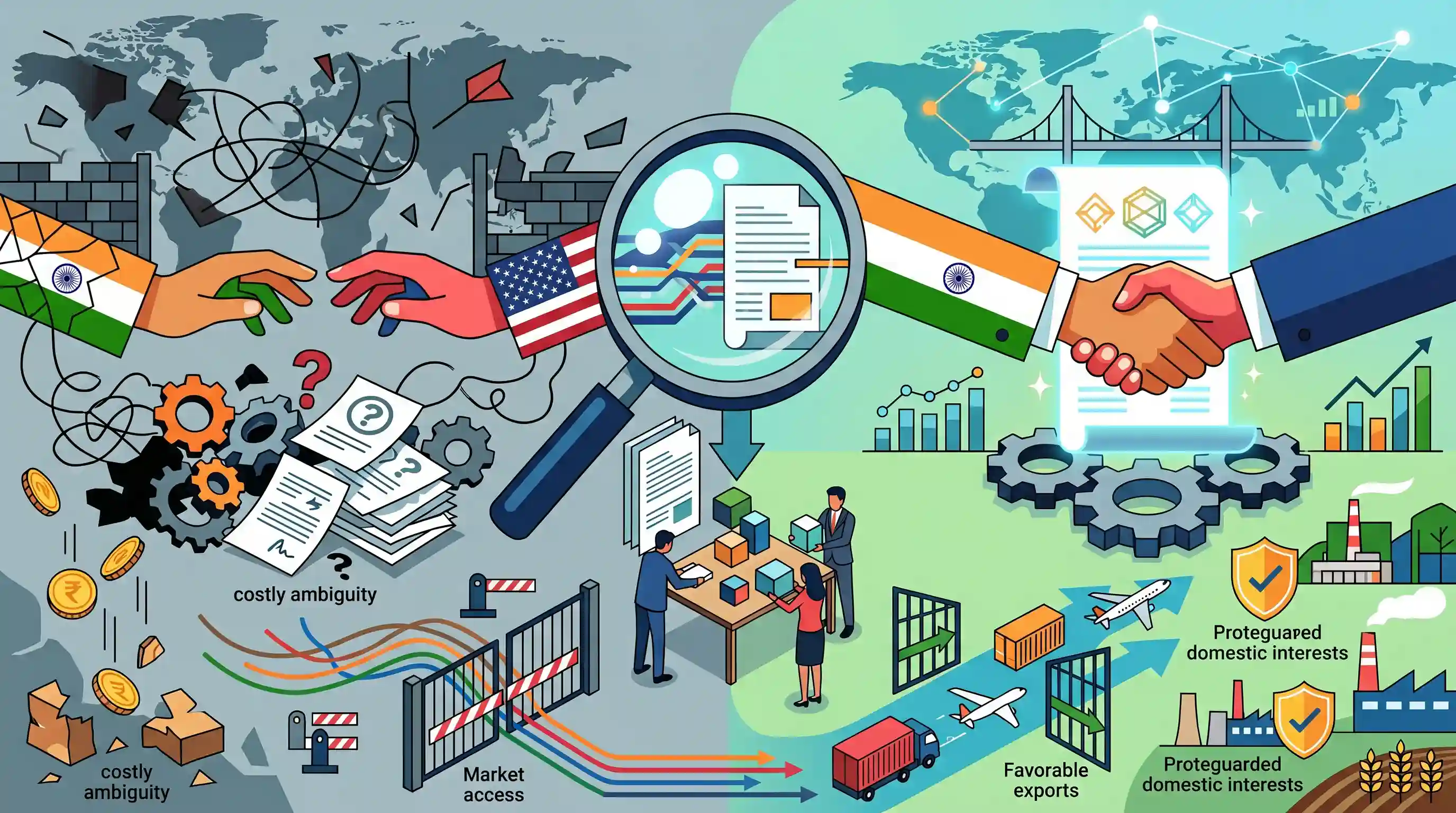
The article highlights the critical need for clarity in the ongoing India-US trade pact negotiations. It warns that any confusion or ambiguity regarding terms of trade, market access, and regulatory frameworks could prove costly for India. By analyzing the complexities of bilateral trade, the piece underscores the importance of a meticulously drafted agreement that safeguards domestic interests while securing favorable export conditions. Furthermore, it argues that a clear, mutually beneficial trade deal is vital for strengthening the strategic partnership between India and the US in an era of growing global protectionism.
Key Points
- Ambiguities and lack of clarity in negotiating an India-US trade pact can lead to significant economic costs and future trade disputes.
- Crucial areas needing precise definitions include market access, tariff reductions, non-tariff barriers, and digital trade regulations.
- India must strategically balance opening its markets with protecting sensitive domestic sectors like agriculture and manufacturing.
- A well-structured trade agreement is essential not only for economic gains but also for reinforcing the broader strategic partnership between the two democracies amidst global trade uncertainties.
Important Terms
India-US Trade Pact (2026)

A 2026 interim agreement where the US reduced tariffs on Indian goods (from 50% to 18%) in exchange for India's commitment to purchase $500 billion in US goods over five years.
UPSC context
GS Paper 2: Bilateral agreements. Tests knowledge of current strategic trade shifts and de-escalation of tariff wars.
Generalized System of Preferences (GSP)
A preferential trade program where developed countries grant duty-free access to products from developing nations to promote their economic growth and export diversification.
UPSC context
GS Paper 3: Indian Economy. Crucial for understanding historical trade barriers and India's export competitiveness in labor-intensive sectors.
Free Trade Agreement (FTA)
A formal treaty between two or more countries to reduce or eliminate import/export barriers (tariffs and quotas) to promote the free exchange of goods and services.
UPSC context
GS Paper 2 & 3. Tests understanding of trade liberalisation, 'Rules of Origin', and India's shift toward strategic trade partnerships.
Economic Diplomacy
The use of a state's economic resources and foreign policy to promote its national interest and influence international policy and regulatory decisions.
UPSC context
GS Paper 2: International Relations. Essential for analyzing how India leverages its market size for strategic and geopolitical gains.
Most Favoured Nation (MFN)
A fundamental WTO principle requiring a country to provide the same trade concessions to all member nations, ensuring non-discrimination in global commerce.
UPSC context
GS Paper 2: International Institutions. Tests understanding of rules-based trade and legal constraints on bilateral "pacts".
World Trade Organization (WTO)
The only global international organization dealing with the rules of trade between nations, providing a framework for negotiations and a dispute settlement mechanism.
UPSC context
GS Paper 2: Important International institutions. Focuses on the mandate, structure, and current challenges (e.g., Appellate Body crisis).
Prelims Trap
India and the US currently trade under the reciprocal Generalized System of Preferences (GSP).
The US GSP is a unilateral, non-reciprocal system, not a mutual FTA. Furthermore, the US revoked India's GSP status in 2019, a frequent chronological trap in UPSC.
Static Concepts Connected
What is the WTO Agreement on Sanitary and Phytosanitary (SPS) Measures?
- Primary Purpose: Allows member nations to set their own food safety and animal/plant health standards, often acting as Non-Tariff Barriers (NTBs).
- Scientific Basis: Measures cannot be arbitrary; they must be based on scientific principles and applied only to the extent necessary.
- Non-discrimination: Members cannot unjustifiably discriminate between countries where identical or similar safety conditions prevail.
How does the Generalized System of Preferences (GSP) differ from an FTA?
- Nature of Concession: GSP is a unilateral, non-reciprocal tariff preference granted by developed nations to developing ones to promote economic growth.
- Reciprocity in FTAs: Free Trade Agreements (FTAs) are bilateral or multilateral treaties demanding mutual (reciprocal) tariff reductions and market access.
- WTO Exception: GSP operates under the WTO's 'Enabling Clause', which is a formal exception to the Most-Favored-Nation (MFN) principle.
Cross-Topic Patterns
Digital Trade & Critical Tech Diplomacy
Bilateral trade now transcends physical goods. Strategic tech access, specifically computing capacity (GPUs) and data localization norms, increasingly form the core of modern diplomatic negotiations.
Agri-protectionism vs Bilateral FTAs
US demands for market access in dairy and poultry clash directly with India's need to protect domestic rural livelihoods from heavily subsidized developed-world agricultural dumping.

Expect a multi-statement 2026 prelims question linking WTO's SPS measures, 'shadow tariffs', and digital trade components of FTAs.
Linked PYQs · 2
Linked PYQs · 2
- 2018MainsGS2
What are the key areas of reform if the WTO has to survive in the present context of "Trade War', especially keeping in mind the interest of India?
- 2012MainsGS2
Discuss the likely negative impact of the protectionist measures proposed by the US on India's software industry.
