Political Turmoil and Ideological Shift in Bangladesh
Source:Indian Express ↗
Why It Matters
The evolving political and ideological landscape in Bangladesh directly impacts India's Neighborhood First policy, internal security along the porous Eastern border, and the broader geopolitical balance in South Asia.
Summary
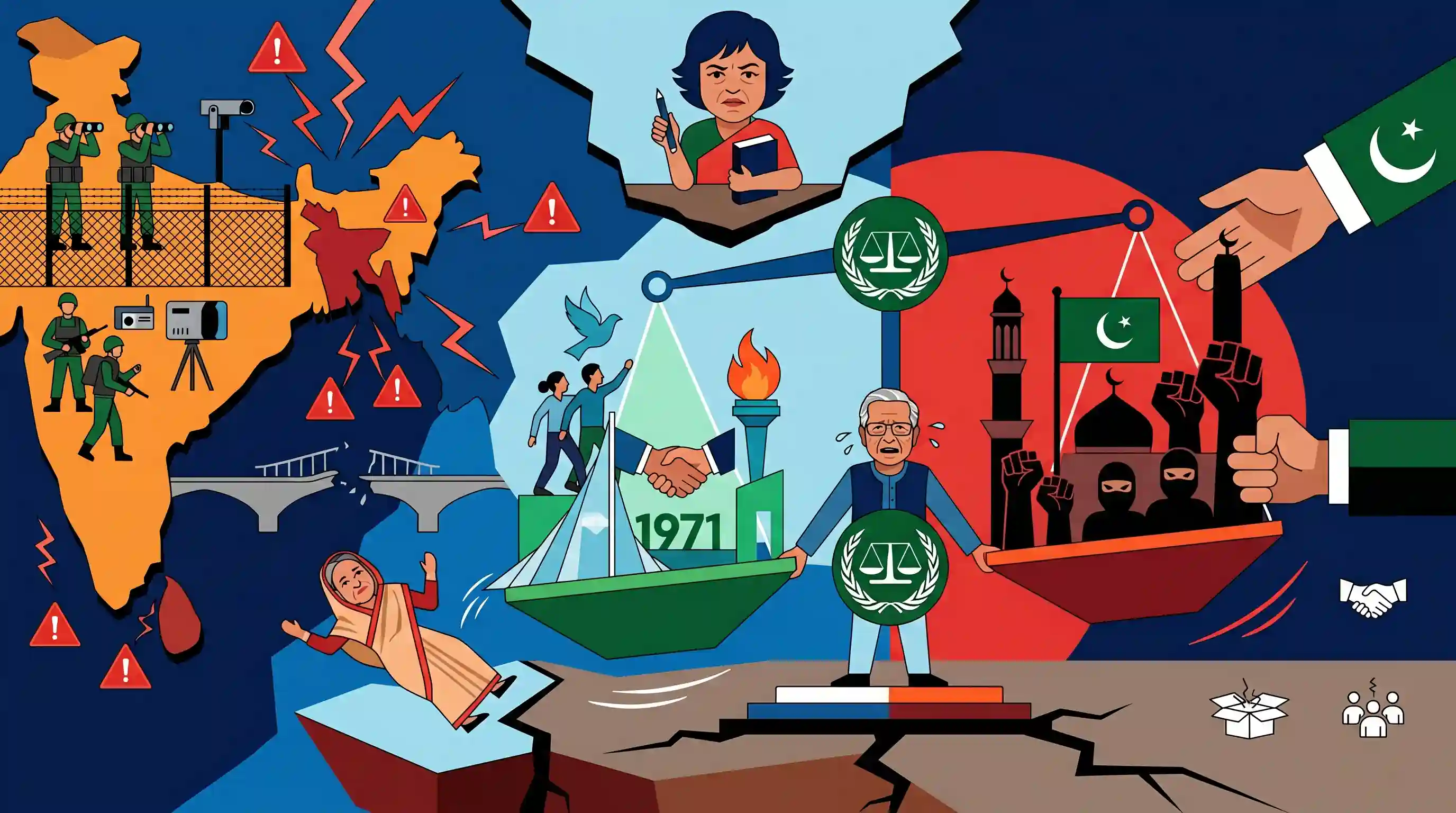
Exiled author Taslima Nasrin observes that the current political unrest in Bangladesh represents a deep-seated ideological battle between secular progressivism and religious fundamentalism. Following the ousting of Sheikh Hasina and the installation of an interim government under Muhammad Yunus, Nasrin notes a concerning pro-Pakistan shift in the nation's political and social fabric. This potential regression towards religious fanaticism challenges the secular ideals of the 1971 Liberation War and carries significant implications for India's neighborhood diplomacy, border security, and regional stability in South Asia.
Key Points
- Author Taslima Nasrin asserts that the ongoing turmoil in Bangladesh is fundamentally an ideological conflict between secularism/rationalism and religious fanaticism/fundamentalism, not just political rivalry.
- There is a noted pro-Pakistan ideological and foreign policy shift in Bangladesh following the ousting of former Prime Minister Sheikh Hasina.
- The interim government led by Muhammad Yunus maintains it pursues a 'balanced foreign policy', yet faces criticism for leaning towards Pakistan and accommodating extremist factions.
- The political instability and potential rise of religious extremism pose serious implications for India's border security and regional stability in South Asia.
Important Terms
Awami League

A secular-nationalist political party in Bangladesh, founded in 1949. It led the 1971 liberation struggle under Sheikh Mujibur Rahman and recently maintained strong strategic and security ties with India under Sheikh Hasina.
UPSC context
GS II: India and its Neighborhood. Tests understanding of bilateral stability and pro-India political factions in the neighborhood.
Bangladesh Nationalist Party (BNP)
A major right-of-centre party founded in 1978 by Ziaur Rahman. It champions 'Bangladeshi Nationalism' and has historically had strained relations with India over security concerns, including the harboring of Northeast insurgents.
UPSC context
GS II: International Relations. Tests knowledge of opposition ideologies affecting regional security and India's 'Neighbourhood First' policy.
Jamaat-e-Islami
Bangladesh's largest Islamist party. Historically opposed to 1971 independence, it seeks an Islamic state. It was banned under the Awami League for 'war crimes' but re-emerged following the 2024 political upheaval.
UPSC context
GS I/II: Secularism & Regional Security. Tests awareness of religious fundamentalism and its impact on minority safety and bilateral ties.
1971 Liberation War
The armed conflict that led to Bangladesh’s independence from Pakistan. India’s military intervention was pivotal, resolving a massive refugee crisis and shifting South Asia's balance of power by partitioning Pakistan.
UPSC context
GS I: Post-Independence Consolidation. Tests understanding of India's role in changing regional geography and humanitarian leadership.
Interim Government (Bangladesh)
An extra-constitutional, temporary administration led by Nobel Laureate Muhammad Yunus. Formed in August 2024 after Sheikh Hasina’s ouster, it is tasked with implementing fundamental reforms and overseeing new democratic elections.
UPSC context
GS II: India and its Neighborhood. Tests knowledge of political transitions in neighbouring countries and the 'Doctrine of Necessity.'
Prelims Trap
The India-Bangladesh border is now completely demarcated and fully fenced following the 100th Constitutional Amendment Act.
While the 100th CAA resolved the enclave disputes, over 1000 km of the border remains unfenced due to difficult riverine and hilly terrain (e.g., Sundarbans, Brahmaputra).
Static Concepts Connected
What are the key transit links connecting mainland India to the Northeast via Bangladesh?
- Port Access: Agreements allow India to use Chattogram (Chittagong) and Mongla ports for transporting transit cargo to the landlocked Northeastern states.
- Inland Waterways: The Protocol on Inland Water Transit and Trade (PIWTT) utilizes the Brahmaputra and Barak river systems for movement of goods.
- Rail Links: Projects like the Akhaura-Agartala and Haldibari-Chilahati cross-border routes were operationalized to bypass the Siliguri Corridor bottleneck.
How does India secure its porous and riverine border with Bangladesh?
- Primary Force: The Border Security Force (BSF), a Central Armed Police Force under the MHA, acts as the primary border guarding entity.
- Tech Integration (CIBMS): The Comprehensive Integrated Border Management System (CIBMS) deploys thermal imagers, radar, and ground sensors in unfenced and vulnerable stretches.
- Riverine Solutions: Project BOLD-QIT (Border Electronically Dominated QRT Interception Technique) secures complex riverine borders, such as the Brahmaputra stretch in Dhubri, Assam.
Cross-Topic Patterns
Regime Change & NE Insurgency
Political vacuums in Bangladesh and Myanmar historically lead to safe havens for Northeast insurgent groups, linking neighborhood diplomatic crises directly to India's internal security matrix.
Secularism as a strategic buffer
Bangladesh's ideological tug-of-war highlights how secular governance in border states acts as a strategic buffer, whereas state-backed fundamentalism creates trans-border security threats and refugee influxes.

Expect a 2026 mains question on how Bangladesh's regime change impacts India's 'Act East' policy and Northeast border security.
Linked PYQs · 4
Linked PYQs · 4
- 2013MainsGS1
Critically examine the compulsions which prompted India to play a decisive role in the emergence of Bangladesh.
- 2019MainsGS1
What are the challenges to our cultural practices in the name of secularism?
- 2020MainsGS3
Analyze internal security threats and transborder crimes along Myanmar, Bangladesh and Pakistan borders including Line of Control (LoC). Also discuss the role played by various security forces in this regard.
- 2016MainsGS2
Increasing cross-border terrorist attacks in India and growing interference in the internal affairs of several member-states by Pakistan are not conducive for the future of SAARC (South Asian Association for Regional Cooperation)." Explain with suitable examples.
