Ebola Outbreak in Congo and Global Health Preparedness
Source:The Hindu ↗
Why It Matters
Ebola outbreaks have severe public health and economic impacts globally (as seen in the 2014-2016 epidemic, previously tested in UPSC). The emergence of a non-Zaire strain in a high-mobility region requires swift epidemiological response and highlights challenges in vaccine coverage, relevant for GS2 Health and GS3 Science & Tech.
Summary
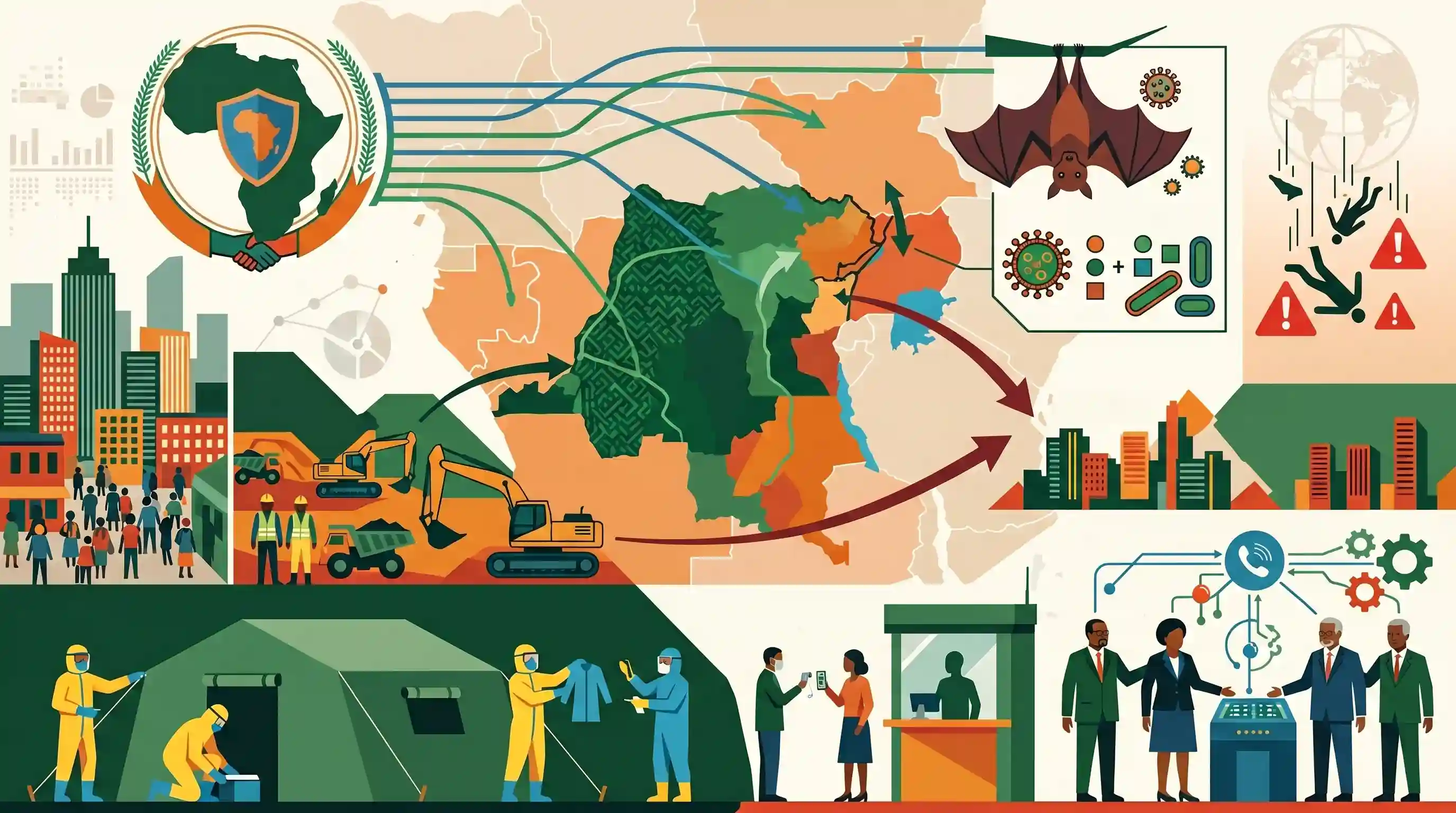
The Africa Centres for Disease Control and Prevention has confirmed a new Ebola outbreak in the Democratic Republic of Congo's Ituri province, marked by a high fatality rate. Initial tests indicate the presence of a 'non-Zaire' strain of the virus. The region's urban density and the high mobility of populations linked to local mining activities pose a significant risk of cross-border transmission into neighboring Uganda and South Sudan, prompting urgent regional coordination for pandemic preparedness.
Key Points
- The Africa CDC confirmed a deadly Ebola outbreak in the Ituri province of the Democratic Republic of Congo (DRC), with 246 suspected cases and 65 deaths.
- Initial findings suggest the pathogen is a 'non-Zaire' strain of the Ebola virus, which raises concerns about the efficacy of current vaccines primarily designed for the Zaire strain.
- The outbreak is concentrated in the Mongwalu and Rwampara health zones, areas characterized by high population mobility due to active mining operations.
- Because of the urban setup (Bunia and Rwampara) and cross-border movements, Africa CDC is convening urgent meetings with health ministers from DRC, Uganda, and South Sudan to prevent regional spread.
Important Terms
Africa Centres for Disease Control and Prevention (Africa CDC)

A specialized technical agency of the African Union established to coordinate disease surveillance, emergency response, and health system strengthening across the 55 member states of Africa.
UPSC context
GS-II (International Institutions) & GS-III (Health). Tests knowledge of regional health governance and institutional responses to pandemics.
Ebola Virus Disease (EVD)
A severe viral hemorrhagic fever caused by ebolaviruses, primarily transmitted from animals to humans and then spreading through direct contact with infected bodily fluids.
UPSC context
GS-III (Science & Technology). Significant for understanding infectious diseases, biosecurity, and the impact of pathogens on public health.
Zoonotic Disease
An infectious disease that jumps from non-human animals (vertebrates) to humans; examples include Ebola, Nipah, and COVID-19.
UPSC context
GS-III (Environment & Health). Crucial for studying epidemic origins, the human-animal interface, and pandemic preparedness.
International Health Regulations (IHR)
A legally binding international legal instrument that requires 196 countries to report specific public health events to the WHO to prevent international disease spread.
UPSC context
GS-II (Global Governance). Tests understanding of international law and global health diplomacy during emergencies.
Sudan Ebolavirus (SUDV)
A distinct species of ebolavirus (non-Zaire) for which current licensed vaccines like Ervebo are not effective, complicating outbreak containment efforts.
UPSC context
GS-III (Science & Tech). Relevant for vaccine development challenges and pathogen-specific research in viral hemorrhagic fevers.
One Health
An integrated, unifying approach that aims to sustainably balance and optimize the health of people, animals, and ecosystems.
UPSC context
GS-III (Environment/Health). Key concept for addressing zoonotic threats and sustainable development goals.
Prelims Trap
"Ebola is an airborne or mosquito-borne viral disease that spreads rapidly in tropical climates."
Ebola is a zoonotic virus naturally hosted by fruit bats. It transmits strictly through direct contact with infected bodily fluids, not via air or mosquitoes.
Static Concepts Connected
What are the key characteristics of the Ebola virus?
- Viral classification: It belongs to the Filoviridae family of RNA viruses and causes severe viral hemorrhagic fever.
- Natural reservoir: Fruit bats of the Pteropodidae family are considered the primary natural hosts.
- Transmission vector: It spreads exclusively via direct contact with blood or bodily fluids of infected humans/animals.
Which nations share land borders with the Democratic Republic of Congo (DRC)?
- Northern borders: Central African Republic and South Sudan.
- Eastern borders: Uganda, Rwanda, Burundi, and Tanzania (across Lake Tanganyika).
- Southern/Western borders: Zambia, Angola, and the Republic of the Congo.
Cross-Topic Patterns
Resource mining & pandemic spread
High mobility around Africa's critical mineral mines complicates contact tracing, bridging economic geography with public health and pandemic preparedness vulnerabilities.
RNA viruses & vaccine specificity
The emergence of a 'non-Zaire' strain mirrors Dengue's serotypes, testing the UPSC concept of how RNA viral mutations can bypass strain-specific vaccines.

Expect a multi-statement Prelims question linking African conflict/mining regions (Ituri) with bordering nations and viral disease vectors.
Linked PYQs · 3
Linked PYQs · 3
- 2015PrelimsGS1
Among the following, which were frequently mentioned in the news for the outbreak of Ebola virus recently?
- 2023PrelimsGS1
Which one of the following is a part of the Congo Basin?
- 2024PrelimsGS1
One of the following regions has the world's largest tropical peatland, which holds about three years worth of global carbon emissions from fossil fuels; and the possible destruction of which can exert detrimental effect on the global climate. Which one of the following denotes that region?
