Confined Field Trials and Regulatory Approvals for GM Maize
Source:The Hindu ↗
Why It Matters
The article highlights the ongoing debate and regulatory complexities surrounding GM crops in India, specifically touching upon the role of the GEAC, state versus central jurisdictions (NOCs), and environmental concerns regarding herbicide (Glyphosate) usage. These are high-yield topics for UPSC GS3 (Agriculture and Environment).
Summary
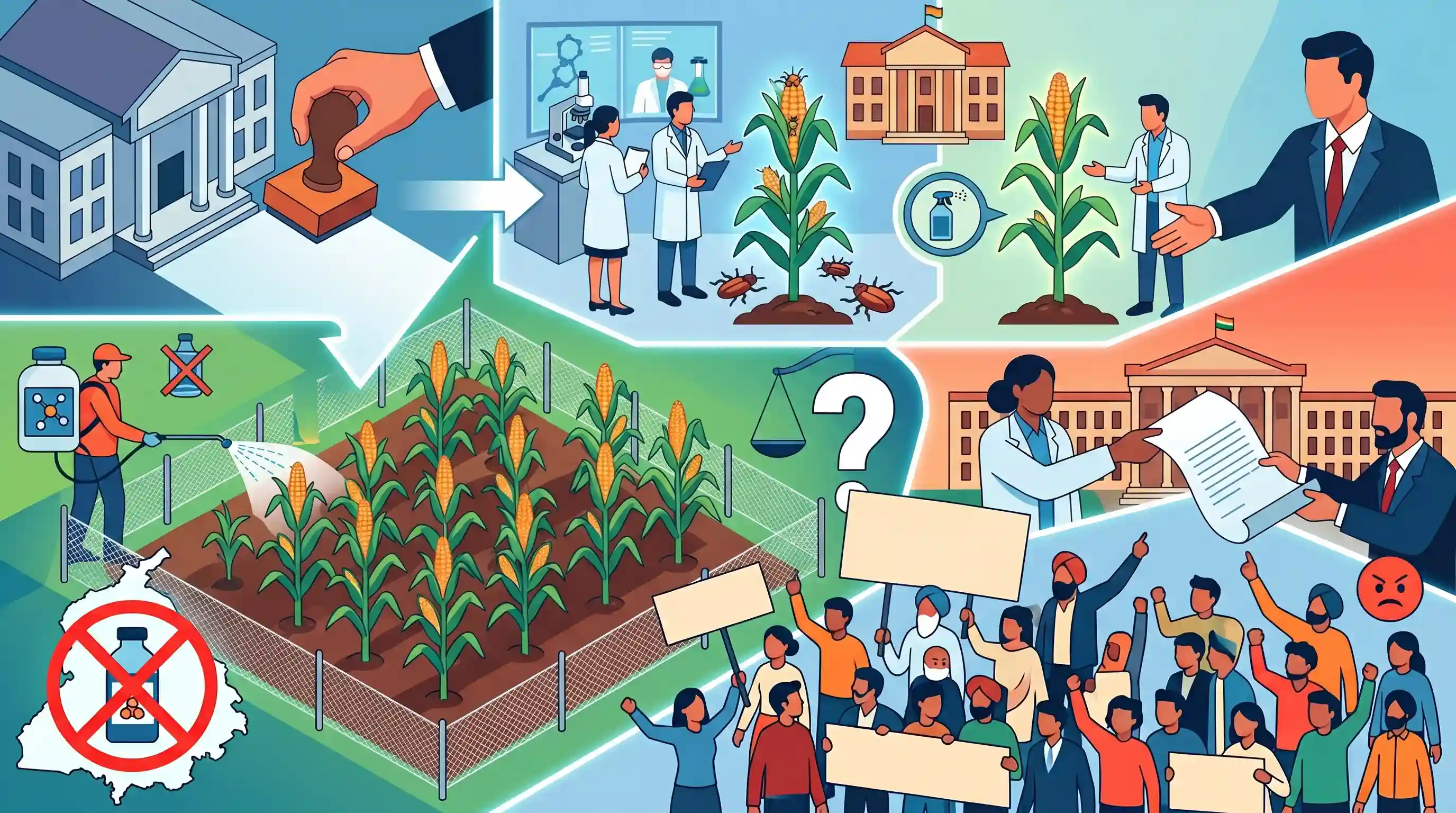
The Genetic Engineering Appraisal Committee (GEAC) has authorized confined field trials for two types of genetically modified (GM) maize—herbicide-tolerant and insect-resistant—at Punjab Agricultural University (PAU). Proposed by Bayer Crop Science, the trials have sparked protests from anti-GM activist groups, who point out a contradiction: the herbicide-tolerant maize is designed to withstand Glyphosate, a herbicide banned for sale in Punjab since 2018. While PAU maintains the trials are strictly for research into weed and pest control efficacy, activists are urging the state government to revoke its No Objection Certificate (NOC).
Key Points
- The Genetic Engineering Appraisal Committee (GEAC) has approved confined field trials for herbicide-tolerant and insect-resistant GM maize at Punjab Agricultural University.
- The trials, proposed by Bayer Crop Science Limited, face opposition from anti-GM activists demanding the withdrawal of the state's No Objection Certificate.
- Activists highlight a contradiction, as the trials involve herbicide-tolerant maize dependent on Glyphosate, a chemical the Punjab government banned the sale of in 2018.
- PAU clarified that the confined trials are strictly for research purposes to evaluate the efficacy of weed control and insect protection.
Important Terms
Genetic Engineering Appraisal Committee (GEAC)

India's apex statutory body under the Ministry of Environment, Forest and Climate Change that regulates the use, manufacture, and release of Genetically Modified Organisms (GMOs).
UPSC context
GS Paper III (Agriculture & Science); tests knowledge of regulatory frameworks for biotechnology and environment protection.
Glyphosate
A broad-spectrum, non-selective herbicide used to kill weeds. It is controversial due to health concerns and its association with herbicide-tolerant genetically modified crops.
UPSC context
GS Paper III (Environment/Agriculture); relevant for issues related to agrochemicals, health impacts, and agricultural regulations.
Confined Field Trials (CFT)
Small-scale, regulated experiments on genetically modified plants conducted in a specified area under strict conditions to assess biosafety and performance before commercial release.
UPSC context
GS Paper III (Science & Tech); essential for understanding the mandatory biosafety protocols for GM crop development.
Herbicide-Tolerant (HT) Crops
Crops genetically engineered to survive the application of certain herbicides, allowing farmers to spray entire fields to kill weeds without harming the crop itself.
UPSC context
GS Paper III (Agriculture); tests understanding of GM traits and their ecological/economic implications.
Punjab Agricultural University (PAU)
A premier state agricultural university in Ludhiana, Punjab, responsible for agricultural research, education, and the scientific evaluation of new crop technologies in the region.
UPSC context
GS Paper III (Agriculture); representative of the role of state-run research institutions in agricultural innovation.
Coalition for a GM-Free India
An informal national network of farmers, scientists, and NGOs advocating for sustainable agriculture and opposing the environmental release of Genetically Modified Organisms.
UPSC context
GS Paper II (NGOs/Pressure Groups); illustrates the role of civil society in environmental policy and public debate.
Prelims Trap
GEAC approval is the final mandatory step for conducting open-field trials of GM crops in India.
Agriculture is a State subject. Even with central GEAC clearance, developers must obtain a No Objection Certificate (NOC) from the respective State Government before any confined field trials can begin.
Static Concepts Connected
What is the mandate and statutory backing of the GEAC?
- Statutory origin: Constituted under the Environment (Protection) Act, 1986, specifically through the 1989 Rules concerning hazardous microorganisms and genetically engineered cells.
- Nodal Ministry: Operates under the Ministry of Environment, Forest and Climate Change (MoEFCC).
- Core mandate: Appraises activities involving the large-scale use or environmental release of genetically engineered organisms, including experimental field trials.
How does Glyphosate function and why is its use restricted in India?
- Mechanism of action: A broad-spectrum, non-selective chemical that kills weeds by blocking EPSP synthase, an enzyme vital for synthesizing amino acids necessary for plant growth.
- Legal restrictions: Due to health and ecological concerns, the Centre restricted its legal application exclusively to tea plantations and their accompanying non-plantation areas.
- HT Crops connection: Herbicide-Tolerant (HT) crops are genetically engineered to withstand Glyphosate, allowing farmers to spray fields to kill surrounding weeds without harming the crop itself.
Cross-Topic Patterns
GM field trials + federalism
The state NOC requirement for GEAC-approved trials underscores the tension between Central environmental regulations and Agriculture being a State List subject, frequently politicizing scientific research in India.
Agrochemical bans vs HT crop viability
Testing Herbicide-Tolerant (HT) maize in a state where its paired herbicide (Glyphosate) is banned exposes contradictory policy landscapes regarding agricultural biotechnology and chemical regulation.

Expect a multi-statement question in 2026 pairing GEAC's statutory powers with the state NOC mandate and Glyphosate's restricted status.
Linked PYQs · 3
Linked PYQs · 3
- 2018PrelimsGS1
With reference to the Genetically Modified mustard (GM mustard) developed in India, consider the following statements: 1. GM mustard has the genes of a soil bacterium that give the plant the property of pest-resistance to a wide variety of pests. 2. GM mustard has the genes that allow the plant cross-pollination and hybridization. 3. GM mustard has been developed jointly by the IARI and Punjab Agricultural University. Which of the statements given above is/are correct?
- 2021PrelimsGS1
Bollgard I and Bollgard II technologies are mentioned in the context of
- 2020PrelimsGS1
If a particular plant species is placed under Schedule VI of The Wildlife Protection Act, 1972, what is the implication?
