Delimitation and Demographic Shifts in Southern States
Source:The Hindu ↗
Why It Matters
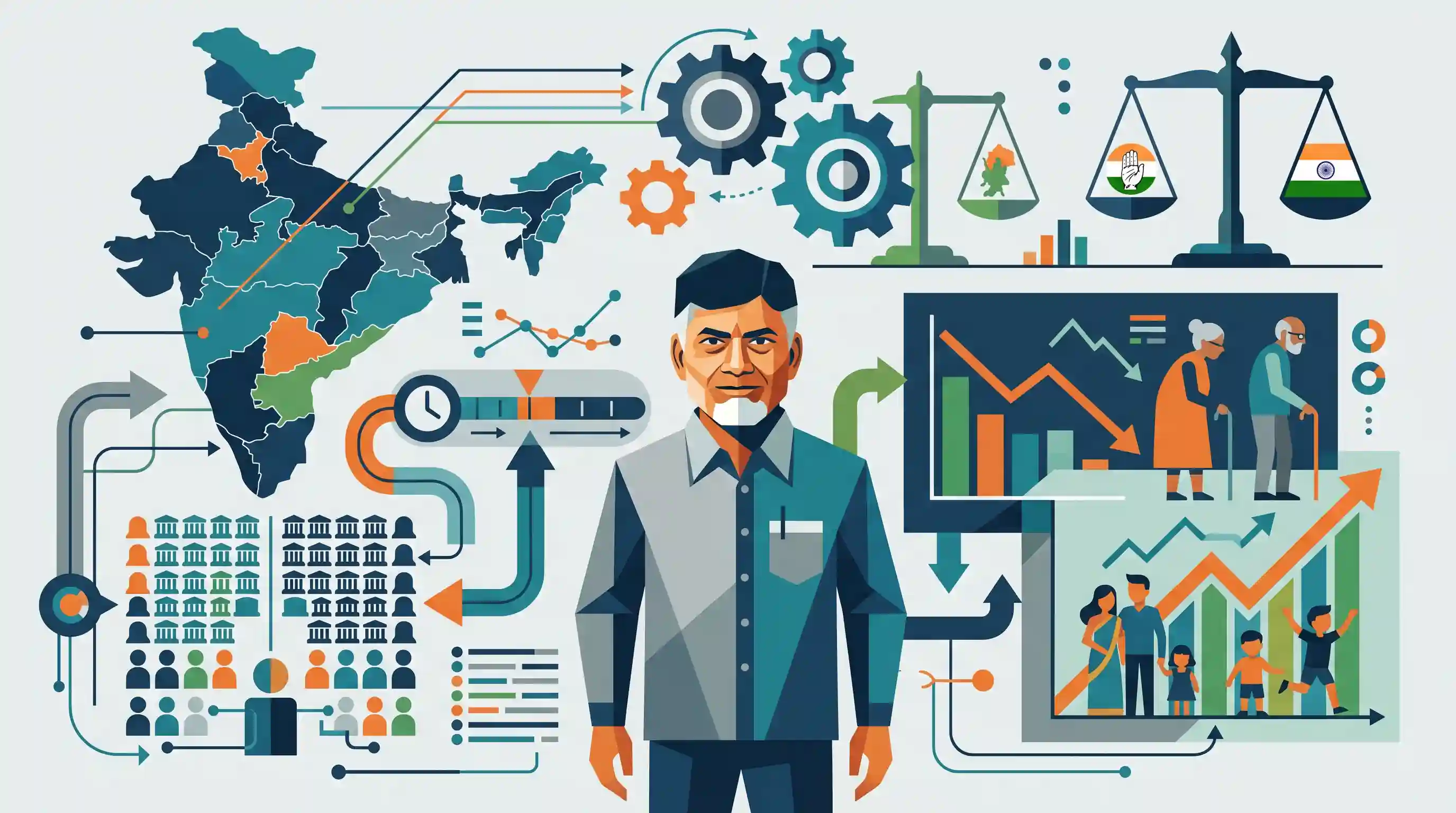
The impending delimitation of Lok Sabha constituencies based on the post-2026 Census threatens to alter the balance of political power in India, heavily impacting Centre-State relations. Additionally, Naidu's comments spotlight a critical pivot in demographic policy—moving from population control to addressing the challenges of an aging population and declining birth rates in specific regions.
Summary
Andhra Pradesh Chief Minister N. Chandrababu Naidu expressed confidence that the upcoming delimitation exercise will be handled equitably, keeping both national interests and the sentiments of Southern states in mind. He recalled the 2001 Constitutional Amendment that delayed the inter-state redistribution of parliamentary seats to prevent penalizing states that effectively controlled their population. Naidu also highlighted a significant demographic shift in South India, pointing out a declining overall population alongside a growing elderly demographic. To counter these challenges, he advocated for a reversal of past population control policies, suggesting that South India must now focus on 'demographic management' to promote population growth.
Key Points
- Andhra Pradesh CM Chandrababu Naidu expressed confidence that PM Modi will address Southern states' concerns over the upcoming delimitation exercise.
- Southern states fear a loss of representation in the Lok Sabha if delimitation is strictly population-based, as they have successfully controlled population growth.
- The 2001 Constitutional Amendment had delayed the inter-state redistribution of parliamentary seats for 25 years (until the first census after 2026).
- Naidu highlighted a shifting demographic trend in South India: a declining population and an increasing elderly population.
- He advocated for 'demographic management' in the South to actively promote population growth, reversing previous population control strategies.
Important Terms
Delimitation

The process of redrawing boundaries of territorial constituencies for the Lok Sabha and State Legislative Assemblies to reflect population changes based on the latest census.
UPSC context
GS Paper II (Polity); essential for understanding electoral reforms, Article 82, and the principle of equal representation.
84th Constitutional Amendment Act, 2001
An amendment that froze the total number of seats in the Lok Sabha and State Assemblies until the first census after 2026 to encourage population control.
UPSC context
GS Paper II (Constitution); critical for debates on federalism and regional imbalances in political representation.
Demographic Management
A strategic policy shift from "population control" to balancing fertility rates and age structures to ensure long-term economic sustainability and prevent population aging.
UPSC context
GS Paper I (Social Issues) & GS Paper III (Economy); relates to human resource development and the aging population crisis.
Demographic Dividend
The economic growth potential resulting from a shift in a population's age structure, specifically when the working-age population is larger than the non-working-age population.
UPSC context
GS Paper III (Economy); key to discussions on labor productivity, economic growth, and India's global competitive advantage.
NITI Aayog
The premier policy think tank of the Government of India, established to foster cooperative federalism by involving State Governments in the national policy-making process.
UPSC context
GS Paper II (Governance); tests knowledge of non-constitutional bodies and the transition from centralized planning to decentralized governance.
Cooperative Federalism
A constitutional concept where the Union and States act as partners to address national concerns, rather than in a hierarchical or competitive relationship.
UPSC context
GS Paper II (Federal Structure); central to questions on Centre-State relations and the functional balance of the Indian federation.
Prelims Trap
The inter-state allocation of Lok Sabha seats is currently frozen based on the 2001 Census data.
The inter-state seat allocation is frozen based on the 1971 Census. The 2001 Census was only used to redraw territorial constituencies within states (87th Amendment), without changing a state's total seats.
Static Concepts Connected
What are the core constitutional and statutory provisions governing Delimitation?
- Article 82: Mandates the Parliament to enact a Delimitation Act after every census to readjust the allocation of Lok Sabha seats.
- Judicial Immunity: The Delimitation Commission is a high-powered statutory body. Its boundary-drawing orders have the force of law and cannot be challenged in any court.
- 84th Amendment (2001): Extended the freeze on inter-state Lok Sabha seat allocation (originally based on the 1971 Census) until the publication of the first census after 2026.
What characterizes the advanced demographic transition in South India?
- Sub-replacement Fertility: The Total Fertility Rate (TFR) drops below the replacement level of 2.1, meaning the population will eventually shrink in absolute terms without inward migration.
- Demographic Winter: An advanced transition stage characterized by accelerated aging, a shrinking working-age population, and increased eldercare burdens, sharply contrasting with North India's current youth bulge.
Cross-Topic Patterns
Finance Commission vs. Delimitation
The 15th Finance Commission mitigated Southern states' 2011 census concerns by introducing a 'Demographic Performance' reward. Delimitation based strictly on population currently lacks a similar constitutional compensatory mechanism.
North-South Demographic Divergence
Creates unique federal tensions: North India requires massive job creation for its youth bulge, while South India shifts focus to eldercare, automation, and pronatalist 'demographic management'.

Expect a multi-statement question on the 84th/87th Amendment differences (1971 vs 2001 census limits) and Delimitation judicial immunity.
Linked PYQs · 3
Linked PYQs · 3
- 2024MainsGS1
What is the concept of a 'demographic winter'? Is the world moving towards such a situation? Elaborate.
- 2024MainsGS2
What changes has the Union Government recently introduced in the domain of Centre-State relations ? Suggest measures to be adopted to build the trust between the Centre and the States and for strengthening federalism.
- 2022MainsGS2
“While the national political parties in India favour centralisation, the regional parties are in favour of State autonomy.” Comment.
