Coastal Ecology Conservation Conference and EIACP Initiative
Source:The Hindu ↗
Why It Matters
Coastal ecology conservation is vital to mitigate climate change effects, preserve marine biodiversity, and sustain the livelihoods of dependent communities. Awareness initiatives like EIACP are crucial for capacity building and promoting sustainable environmental management.
Summary
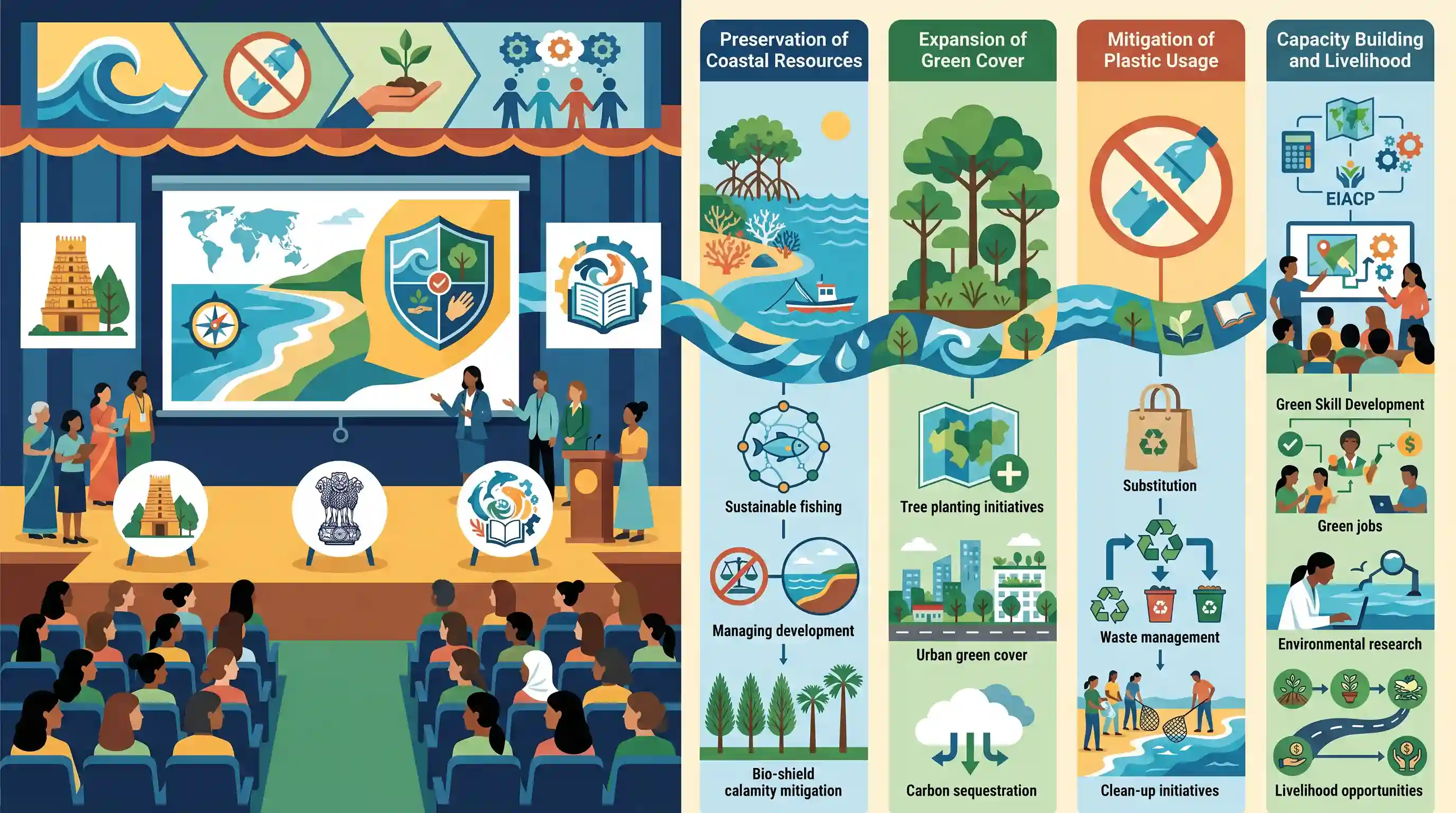
An international conference focused on the conservation of coastal ecology was held at Auxilium College in Vellore. It was co-organized by the Research and Education for Environmental Foundation (REEF) and sponsored by the Ministry of Environment, Forest & Climate Change (MoEF&CC) under its Environmental Information, Awareness, Capacity Building and Livelihood Programme (EIACP), along with the Tamil Nadu Forest Department. The conference aimed to raise awareness regarding the preservation of coastal resources, expansion of green cover, mitigation of plastic usage, and capacity building for environmental sustainability.
Key Points
- An international conference on coastal ecology conservation was organized at Auxilium College in Vellore.
- The event was held in association with the Research and Education for Environmental Foundation (REEF).
- It was sponsored by the Union MoEF&CC under the Environmental Information, Awareness, Capacity Building and Livelihood Programme (EIACP) and the Tamil Nadu Forest Department.
- Discussions highlighted the urgent need to protect marine ecosystems, reduce plastic pollution, and improve environmental awareness and capacity building among stakeholders.
Important Terms
Ministry of Environment, Forest & Climate Change (MoEF&CC)

The nodal ministry of the Indian Government responsible for planning, promoting, and overseeing environmental policies, forest conservation, climate change mitigation, and the implementation of biodiversity-related legislations.
UPSC context
GS Paper 2/3: Essential for understanding India's environmental governance, institutional framework, and legislative enforcement mechanisms.
Environmental Information, Awareness, Capacity Building and Livelihood Programme (EIACP)
A Central Sector sub-scheme (formerly ENVIS) under MoEF&CC that provides a decentralized platform for environmental information, green skilling, and livelihood support in alignment with Mission LiFE.
UPSC context
GS Paper 3: Relevant for government schemes targeting environmental awareness, human resource development, and sustainable livelihood initiatives.
Tamil Nadu Forest Department
The state agency managing forest resources and marine biodiversity; notably implementing the World Bank-funded Tamil Nadu Coastal Restoration Mission (TN-SHORE) to restore mangroves and seagrass.
UPSC context
GS Paper 3: Provides case studies on state-level environmental conservation, coastal resilience, and marine ecosystem management.
Research and Education for Environmental Foundation (REEF)
A non-profit organization dedicated to marine ecosystem conservation, sustainable aquaculture, and community engagement, collaborating with government bodies to promote environmental research and local capacity building.
UPSC context
GS Paper 3: Exemplifies the role of civil society and NGOs in environmental advocacy and grassroots conservation efforts.
Auxilium College
An autonomous educational institution in Vellore that facilitates environmental discourse and academic research, serving as a venue for capacity-building programs sponsored by the MoEF&CC.
UPSC context
GS Paper 2: Represents the involvement of academic institutions in government-sponsored environmental awareness and educational outreach.
Prelims Trap
"EIACP is a Centrally Sponsored Scheme implemented jointly by the Centre and States."
EIACP is a Central Sector sub-scheme under the MoEF&CC (revamping the former ENVIS scheme). It is 100% centrally funded, not a Centrally Sponsored Scheme.
Static Concepts Connected
What is 'Blue Carbon' and which ecosystems act as its primary sinks?
- Definition: Carbon captured and stored by the world's ocean and coastal ecosystems.
- Primary Sinks: Mangroves, tidal salt marshes, and seagrass meadows are the most highly efficient carbon sinks.
- Storage Efficiency: Despite their small global footprint, they sequester carbon at a much faster rate than terrestrial forests and store it for millennia.
How do estuaries and mangroves rank in primary productivity?
- High Productivity: They rank among the highest in primary productivity due to continuous nutrient mixing from rivers and tidal action.
- Compared to Oceans: Despite their massive total area, open oceans have very low productivity per unit area, often referred to as ecological deserts.
Cross-Topic Patterns
Mission LiFE + Green Skilling frameworks
EIACP's focus on green skilling connects environmental conservation with demographic dividend goals, making it a dual-target initiative that merges ecological sustainability with the Skill India framework.
Coastal Protection + Disaster Management
Mangrove expansion is not just an ecological tool; it functions as a vital non-structural disaster mitigation strategy against cyclones and tsunamis under NDMA guidelines.

Expect a Prelims question on EIACP replacing ENVIS, explicitly linking its green-skilling mandate with India's Mission LiFE commitments.
Linked PYQs · 4
Linked PYQs · 4
- 2022MainsGS3
Explain the causes and effects of coastal erosion in India. What are the available coastal management techniques for combating the hazard?
- 2021PrelimsGS1
What is blue carbon?
- 2022PrelimsGS1
"Biorock technology" is talked about in which one of the following situations?
- 2013PrelimsGS1
Which one of the following is the correct sequence of ecosystems in the order of decreasing productivity?
