Decriminalization of Minor Offenses in Drug Regulations
Source:The Hindu ↗
Why It Matters
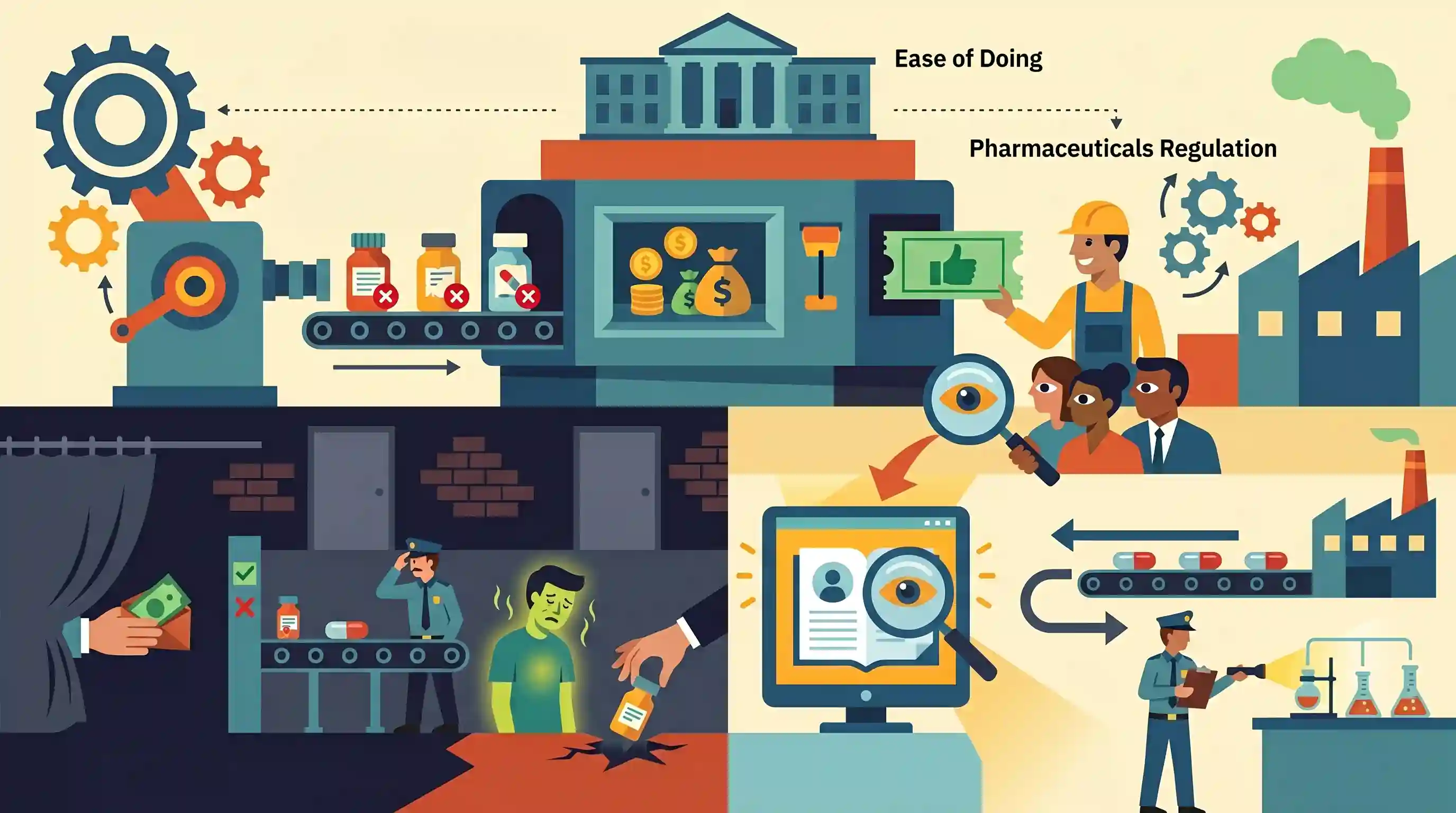
This topic highlights the tension between promoting industrial growth (ease of doing business) and ensuring stringent regulatory oversight in critical sectors like healthcare. It is directly relevant for GS Paper 2 (Health, Regulatory Bodies, and Governance) and GS Paper 3 (Industrial Policy), as it explores the implications of decriminalizing minor offences under the Jan Vishwas Act.
Summary
The article examines the recent guidelines issued by the Central Drugs Standard Control Organization (CDSCO) that enable the compounding of minor drug-related violations, a reform driven by the Jan Vishwas Act. While the decriminalization of technical infractions in the Drugs and Cosmetics Act aims to improve the ease of doing business for the pharmaceutical industry, there are significant concerns regarding regulatory oversight. The author cautions that CDSCO's chronic lack of transparency may lead to a 'pay and pass' culture, inadvertently risking public health. To mitigate these risks, the editorial advocates for greater accountability through the mandatory publication of compounding orders, the inclusion of consumer watchdogs in the regulatory process, and robust enforcement measures like product recalls and follow-up inspections.
Key Points
- The Jan Vishwas Act amended the Drugs and Cosmetics Act, 1940, allowing the Central Drugs Standard Control Organization (CDSCO) to compound minor drug violations to promote the 'ease of doing business'.
- New guidelines permit pharmaceutical firms to resolve technical non-compliance (e.g., minor labeling errors) by paying a fine instead of facing criminal prosecution.
- Critics warn that CDSCO's historical opacity could transform the compounding provision into a corrupt 'pay and pass' scheme, compromising drug quality.
- The current framework lacks a mandate to publicly disclose compounding orders and provides no mechanism for consumer groups or whistle-blowers to intervene.
- To safeguard public health, the editorial stresses the necessity of complementary regulatory actions such as follow-up inspections, mandatory drug recalls, and the publication of safety alerts.
Important Terms
Jan Vishwas (Amendment of Provisions) Act, 2023

Legislation aimed at boosting "ease of doing business" by decriminalizing minor, technical, or procedural defaults across 42 Central Acts, replacing imprisonment with monetary penalties.
UPSC context
GS Papers II & III; tests understanding of regulatory reforms, decriminalization, and government initiatives to improve the business ecosystem.
Drugs and Cosmetics Act, 1940
India's primary legislation regulating the import, manufacture, distribution, and sale of drugs and cosmetics to ensure their safety, efficacy, and quality standards.
UPSC context
GS Paper II (Health/Governance); essential for questions on the legal framework governing public health and pharmaceutical safety.
Central Drugs Standard Control Organization (CDSCO)
India’s National Regulatory Authority (NRA) responsible for drug approvals, clinical trial oversight, and setting standards for pharmaceuticals and medical devices under the Health Ministry.
UPSC context
GS Paper II (Statutory/Regulatory Bodies); critical for understanding the institutional oversight of the pharmaceutical and health sectors.
Compounding of Offences
A legal mechanism allowing an offender to settle minor violations by paying a prescribed fee, thereby avoiding criminal prosecution and lengthy court trials.
UPSC context
GS Paper II (Judiciary/Governance); relates to administrative mechanisms for reducing judicial pendency and rationalizing criminal laws.
Ease of Doing Business (EoDB)
An index and policy goal aimed at simplifying regulations, reducing compliance burdens, and fostering a conducive environment for private investment and entrepreneurship.
UPSC context
GS Paper III (Economy); tests knowledge of structural economic reforms and their impact on India's global competitiveness.
Prelims Trap
The Jan Vishwas Act decriminalizes the manufacturing of spurious drugs to promote ease of doing business.
The Act only decriminalizes minor, technical, or procedural infractions via compounding. The manufacturing of spurious, adulterated, or non-standard quality drugs remains a serious, non-compoundable criminal offence.
Static Concepts Connected
What is the mandate of the Central Drugs Standard Control Organization (CDSCO)?
- Nodal Authority: It is India's apex National Regulatory Authority functioning under the Directorate General of Health Services (Ministry of Health and Family Welfare).
- Statutory Backing: It derives its regulatory powers and statutory backing from the Drugs and Cosmetics Act, 1940.
- Core Functions: It oversees new drug approvals, regulates clinical trials, lays down drug standards, and controls the quality of imported pharmaceuticals.
What does 'compounding of offences' mean in the Indian legal framework?
- Definition: It is a settlement mechanism where the offender pays a financial penalty to avoid a prolonged criminal trial and prosecution.
- Applicability: Usually restricted to minor, non-cognizable offences. It is not available for serious crimes impacting broader public interest or life.
- Legal Outcome: Successful compounding generally results in the acquittal of the accused without an explicit admission of criminal guilt.
Cross-Topic Patterns
Decriminalization vs Regulatory Capture
The tension between ease of doing business (Jan Vishwas Act) and regulatory efficacy mirrors similar debates over the decriminalization of environmental offences under the amended Environment Protection Act.
India as Pharmacy of the World
Opacity in CDSCO’s domestic compounding practices risks impacting India’s global pharmaceutical reputation, which was recently scrutinized following exports of contaminated cough syrups to Africa.

Expect a 2026 GS-2 question analyzing if the Jan Vishwas Act's push for 'ease of doing business' dilutes public health and safety.
Linked PYQs · 3
Linked PYQs · 3
- 2024MainsGS2
In a crucial domain like the public healthcare system the Indian State should play a vital role to contain the adverse impact of marketisation of the system. Suggest some measures through which the State can enhance the reach of public healthcare at the grassroots level.
- 2015MainsGS2
For achieving the desired objectives, it is necessary to ensure that the regulatory institutions remain independent and autonomous. Discuss in the light of the experiences in recent past.
- 2020MainsGS2
In order to enhance the prospects of social development, sound and adequate health care policies are needed particularly in the fields of geriatric and maternal health care. Discuss.
