Emerging Science Technology and Innovation Conclave to Replace ISC
Source:The Hindu ↗
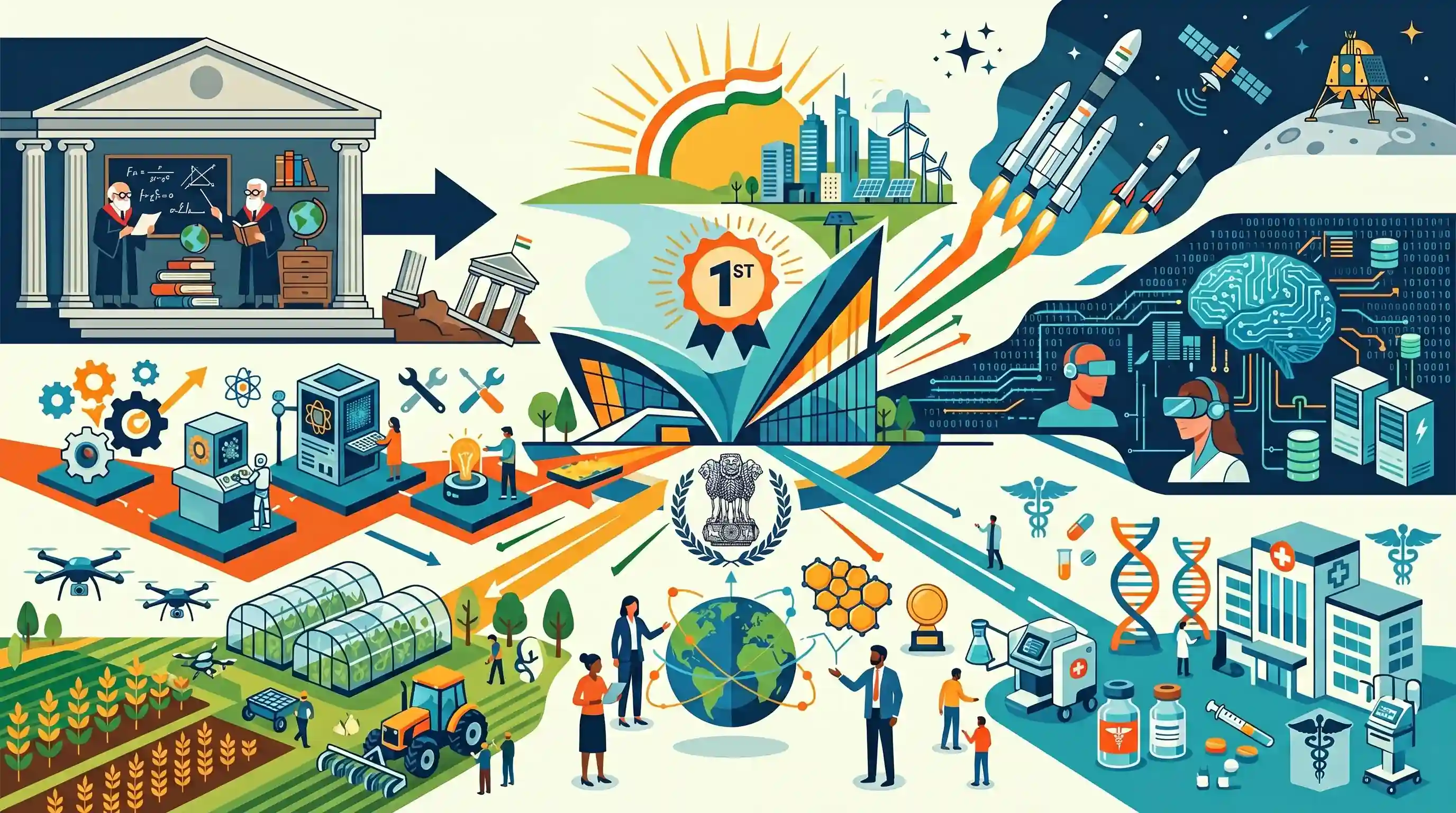
Why It Matters
It marks a significant structural change in India's flagship scientific congregation, replacing the century-old Indian Science Congress. It is highly relevant for GS3 questions concerning the evolution of India's S&T policy, institutional frameworks promoting deep-tech, and the alignment of scientific innovation with national development goals (Viksit Bharat 2047).
Summary
The Government of India is set to host the first-ever Emerging Science, Technology and Innovation Conclave (ESTIC) in November 2025, effectively replacing the historic Indian Science Congress (ISC). Spearheaded by the Department of Science and Technology (DST), the event signifies a shift toward a 'whole-of-government' approach, moving away from purely academic congregations to a platform that highlights India's deep-tech startups, technological achievements, and national S&T goals. Aligned with the vision of Viksit Bharat 2047, the ESTIC will involve cross-sectoral participation from ministries like space, IT, health, and agriculture, and feature prominent international scientists, including Nobel Laureate Andre Geim.
Key Points
- The traditional Indian Science Congress (ISC) has been replaced by the Emerging Science, Technology and Innovation Conclave (ESTIC), scheduled for November 2025 at Bharat Mandapam, New Delhi.
- Organised by the Department of Science and Technology (DST), the ESTIC adopts a whole-of-government approach, involving scientific ministries spanning space, IT, health, agriculture, and more.
- The conclave aims to shift the focus from a traditional academic format to showcasing India's technological evolution, deep-tech start-ups, and alignment with national priorities for Viksit Bharat 2047.
- The event will feature 11 thematic sessions and international participation, including Nobel Laureate Andre Geim and other foreign dignitaries.
Important Terms
Viksit Bharat 2047

India's roadmap to become a developed nation by 2047. It focuses on economic growth ($30-40 trillion GDP), infrastructure, and technological leadership to ensure high per-capita income and global influence.
UPSC context
GS Paper III (Economy/S&T). Tests knowledge of long-term planning, sustainable development, and national goals for India's centennial independence year.
Emerging Science, Technology and Innovation Conclave (ESTIC)
A new flagship annual event (starting Nov 2025) organized by DST. It replaces the Indian Science Congress with a focus on deep-tech startups and cross-ministerial 'whole-of-government' scientific collaboration.
UPSC context
GS Paper III (S&T Institutions). Highlights the shift toward mission-oriented, innovation-driven platforms over traditional academic congregations.
Indian Science Congress (ISC)
Established in 1914, it was India's oldest annual scientific gathering. Historically inaugurated by the Prime Minister, it recently faced suspension of government funding due to disputes over autonomy and scientific quality.
UPSC context
GS Paper III (S&T). Important for understanding the history of scientific institutions and current challenges in the national R&D ecosystem.
Department of Science and Technology (DST)
A nodal department under the Ministry of Science and Technology responsible for formulating S&T policy, promoting R&D, and managing scientific infrastructure and national missions in India.
UPSC context
GS Paper III (S&T Institutions). Essential for identifying the primary executive body managing scientific development and innovation policy.
Indian Science Congress Association (ISCA)
The professional body headquartered in Kolkata that traditionally organized the Indian Science Congress. It is currently at the center of a funding rift with the Union Government.
UPSC context
GS Paper III (S&T Institutions). Relevant for analyzing the relationship between the government and autonomous professional scientific societies.
Prelims Trap
"ESTIC is organized by the historic Indian Science Congress Association (ISCA)."
Aspirants might assume ISCA runs the new conclave. ESTIC is actually spearheaded directly by the Department of Science and Technology (DST) after it withdrew support from ISCA.
Static Concepts Connected
What distinguishes 'Deep-Tech' startups from general technology companies?
- Fundamental R&D: Built on substantial, tangible scientific breakthroughs or advanced engineering challenges (e.g., quantum computing, robotics, advanced materials).
- Long Gestation: Require extended timelines and significant capital investment for research before achieving commercial viability or market entry.
- High IP Value: Rely heavily on hard-to-reproduce patents and intellectual property, unlike tech startups that primarily innovate on business models (e.g., e-commerce).
What is the mandate of the Department of Science and Technology (DST)?
- Policy & Coordination: Acts as the nodal agency for formulating S&T policies and coordinating inter-departmental science initiatives across the government.
- Funding & Promotion: Financially supports basic and applied research, autonomous R&D institutions, and mega-initiatives like the National Quantum Mission.
- International Collaboration: Manages bilateral and multilateral S&T cooperation frameworks and technology transfers on behalf of India.
Cross-Topic Patterns
ESTIC and Anusandhan NRF alignment
The shift towards a centralized, 'whole-of-government' science platform complements the newly operationalized Anusandhan National Research Foundation (NRF), which similarly aims to break academic silos and bridge R&D with industry.
Deep Tech and Atmanirbhar Bharat
Highlighting deep-tech startups at a national conclave converges with self-reliance initiatives like the India Semiconductor Mission and PLI schemes, targeting reduced dependency on foreign critical technologies.

ESTIC's replacement of ISC could appear as a statement within a broader 2026 prelims question on Deep Tech policies and DST's mandates.
Linked PYQs · 3
Linked PYQs · 3
- 2016MainsGS3
Discuss India's achievements in the field of Space Science and Technology. How the application of this technology has helped India in its socio-economic development?
- 2021MainsGS3
What are the present challenges before crop diversification? How do emerging technologies provide an opportunity for crop diversification?
- 2025MainsGS3
India aims to become a semiconductor manufacturing hub. What are the challenges faced by the semiconductor industry in India? Mention the salient features of the India Semiconductor Mission.
