Free Trade Agreement Concessions and Domestic Industry Protection
Source:The Hindu ↗
Why It Matters
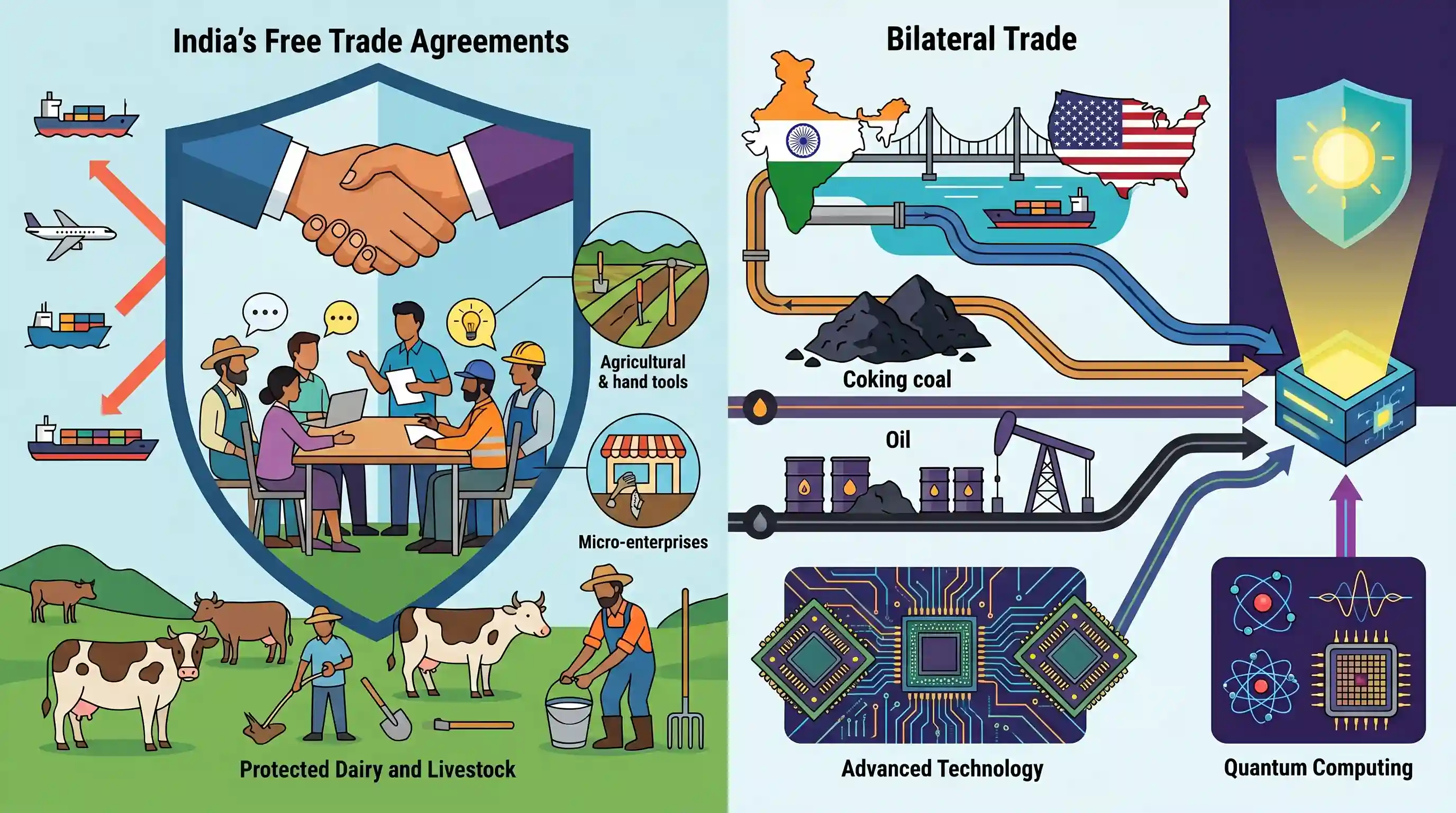
Illustrates India's defensive and offensive interests in international trade negotiations. It provides concrete examples (like protecting dairy while seeking tech and energy from the US) useful for GS3 answers on FTAs, agriculture supply chains, and industrial policy, as well as GS2 answers on India-US bilateral relations.
Summary
Commerce Minister Piyush Goyal stated that concessions in India's Free Trade Agreements (FTAs) are finalized only with the consensus of domestic industry, emphasizing the protection of vulnerable sectors like agriculture, dairy, and MSMEs. He highlighted India's strategic gains from a potential interim trade agreement with the US, focusing on diversification in sourcing critical imports like coking coal, oil, and advanced technologies (GPUs, quantum computing). Notably, the government continues to keep the dairy sector protected from international competition across all FTAs due to the small-scale, non-mechanized nature of Indian dairy farming.
Key Points
- The Indian government ensures domestic industry consensus before finalizing concessions in Free Trade Agreements (FTAs), having executed eight pacts since 2022.
- The dairy sector remains strictly excluded from FTAs to protect India's small and marginal livestock farmers against competition from highly mechanized Western dairies.
- A prospective FTA with the US seeks to strategically diversify India's imports of oil, coking coal, and critical technologies like GPUs and quantum computing equipment.
- India's trade negotiation approach prioritizes safeguarding the interests of vulnerable stakeholders, including MSMEs, farmers, and fisherfolk.
Important Terms
Free Trade Agreements (FTAs)

Pacts between nations to reduce or eliminate tariffs and non-tariff barriers on goods and services, facilitating easier cross-border commerce.
UPSC context
GS Paper-II (International Relations) and GS Paper-III (Economy); essential for understanding India's trade policy and global integration.
MSME
Enterprises classified by investment and turnover limits (e.g., Micro: investment <₹1cr, turnover <₹5cr) under the MSMED Act, 2006.
UPSC context
GS Paper-III (Economy); significant for employment generation, inclusive growth, and their protection in international trade negotiations.
India-U.S. Interim Trade Agreement
A 2026 framework for reciprocal tariff reductions (lowering U.S. tariffs to 18%) and increased market access for Indian textiles and pharmaceuticals.
UPSC context
GS Paper-II (Bilateral Relations); crucial for analyzing India’s strategic partnership and trade balancing with the United States.
Supply Chain Diversification
The strategic process of expanding the number of suppliers and geographic locations for critical imports to mitigate risks and enhance resilience.
UPSC context
GS Paper-III (Economy/Security); vital for energy security and reducing dependence on single sources for critical technology and fuel.
CEPA (Comprehensive Economic Partnership Agreement)
An advanced form of FTA that covers not just goods but also services, investment, intellectual property, and competition.
UPSC context
GS Paper-III (Economy); distinguishes broad-based trade deals like those with UAE and Japan from basic tariff-only agreements.
Dairy Sector (in Trade Context)
A sensitive sector in India consisting of millions of small-scale, non-mechanized farmers, often excluded from FTAs to prevent distress.
UPSC context
GS Paper-III (Agriculture/Economy); relevant for understanding the socio-economic constraints on India's global trade negotiations.
Prelims Trap
Under recent FTAs with developed nations, India has agreed to phase out tariffs on dairy and agricultural products.
Aspirants often assume recent FTAs with Australia or European nations open up dairy trade. India strictly excludes dairy across all FTAs to shield marginal farmers from subsidized Western competition.
Static Concepts Connected
Why does India import coking coal despite having the world's fifth-largest coal reserves?
- High Ash Content: Domestic coal contains high ash (up to 35-45%), making it inefficient for direct use in blast furnaces.
- Poor Caking Properties: Indian coal generally lacks the binding qualities needed to produce metallurgical coke required for steelmaking.
- Import Reliance: India imports over 70% of its coking coal, primarily from Australia, driving efforts to diversify sources to the US and Russia.
How do CECA/CEPA differ from standard Free Trade Agreements (FTAs)?
- Scope of FTA: Focuses primarily on reducing or eliminating customs duties on a positive/negative list of physical goods.
- Comprehensive Nature: CEPAs/CECAs go beyond goods to broadly include trade in services, investments, intellectual property, and mutual recognition agreements (MRAs).
Cross-Topic Patterns
iCET + Strategic Tech Trade
The US-India interim trade focus on GPUs and quantum computing mirrors the goals of the iCET framework, shifting bilateral trade from mere commodities to critical technology supply chains.
Coking Coal + Port-based Steel Plants
India's heavy reliance on imported coking coal explains the geographical shift of new iron and steel plants from raw material pitheads (Jharkhand/Odisha) to coastal locations (Visakhapatnam).
Dairy as Rural Safety Net
The firm stance on keeping dairy out of FTAs aligns with the rural economy's reliance on allied agricultural sectors to double farmer incomes and empower rural women.

Expect a 2026 Prelims question linking India's coking coal import dependency with specific sectoral exclusions (like dairy) in recent FTAs.
Linked PYQs · 4
Linked PYQs · 4
- 2015MainsGS3
Livestock rearing has a big potential for providing non-farm employment and income in rural areas. Discuss suggesting suitable measures to promote this sector in India.
- 2015PrelimsGS1
In India, the steel production industry requires the import of
- 2014MainsGS2
The aim of Information Technology Agreements (ITAs) is to lower all taxes and tariffs on information technology products by signatories to zero. What impact would such agreements have on India's interests?
- 2023MainsGS3
Faster economic growth requires increased share of the manufacturing sector in GDP, particularly of MSMEs. Comment on the present policies of the Government in this regard.
