Railways Announces Reforms for Startups and Claims
Source:Indian Express ↗
Why It Matters
The reforms highlight the government's dual focus on integrating MSME-led innovation into public infrastructure and improving citizen-centric governance through swift grievance redressal in public utilities.
Summary
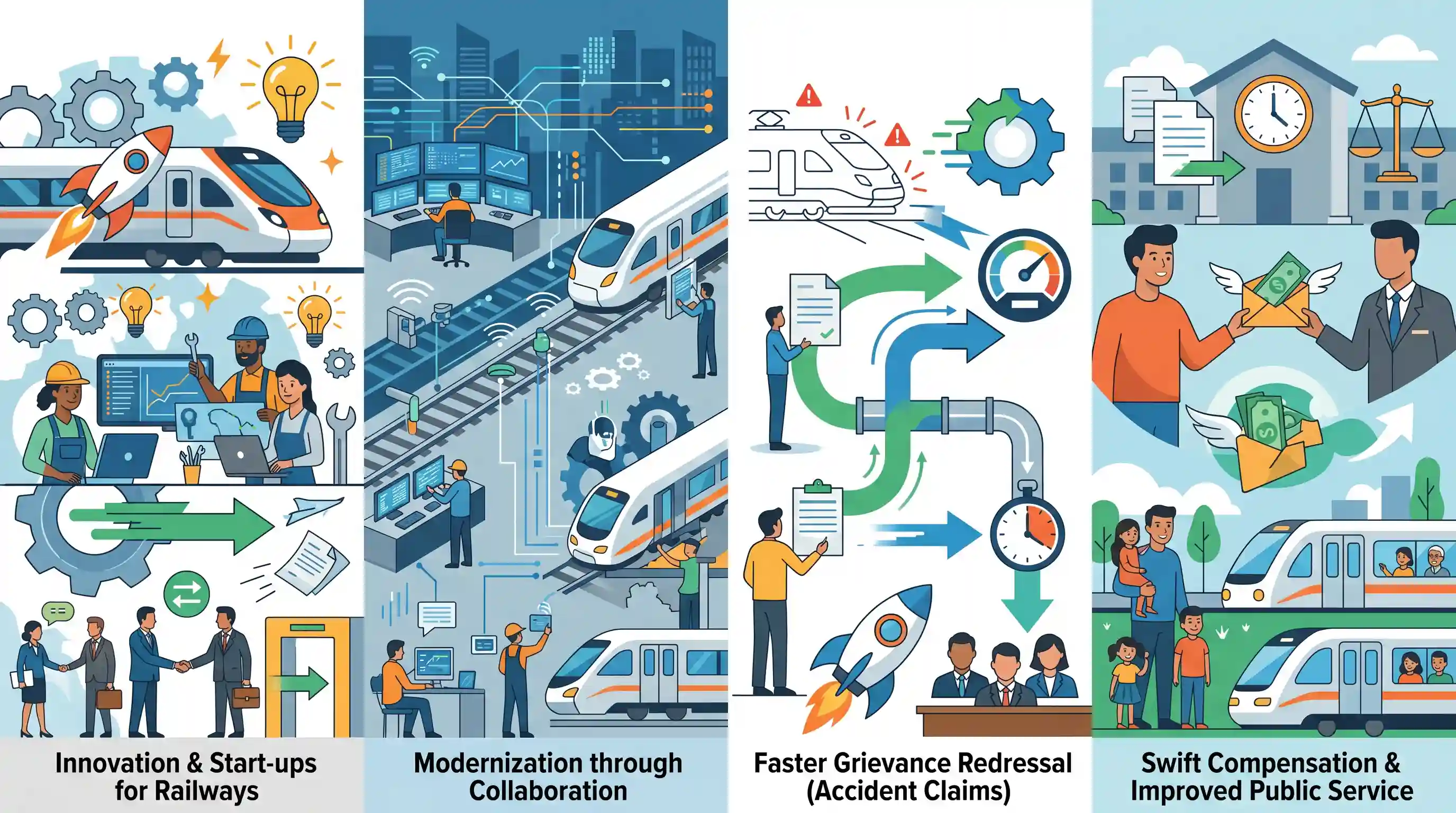
The Ministry of Railways has announced two significant reforms focusing on innovation and citizen-centric governance. To encourage innovation, the Railways has introduced concessions and a simplified system for start-ups, making it easier for MSMEs to collaborate on modernization projects under the 'Start-ups for Railways' initiative. Additionally, to improve public service delivery and grievance redressal, a streamlined process for the faster disposal of accident claims has been introduced, ensuring that victims receive swift compensation through bodies like the Railway Claims Tribunal.
Key Points
- Indian Railways has introduced a simplified system and concessions to encourage start-ups and MSMEs to participate in railway innovation.
- The reform is expected to modernise the railway ecosystem by integrating new technologies and fostering indigenisation.
- A new mechanism for faster disposal of railway accident claims has been announced to ensure quick compensation for victims.
- The move strengthens citizen-centric administration and improves public service delivery by streamlining grievance redressal.
Important Terms
Start-ups for Railways

A dedicated policy initiative launched in 2022 to leverage the expertise of Indian start-ups and MSMEs for improving operational efficiency, safety, and technological modernization in Indian Railways.
UPSC context
GS Paper III: Infrastructure and Economy; tests knowledge of government initiatives for fostering innovation and indigenization in critical sectors.
Railway Claims Tribunal (RCT)
A quasi-judicial body established under the Railway Claims Tribunal Act, 1987, to adjudicate claims related to train accidents, untoward incidents, and loss or damage of goods.
UPSC context
GS Paper II: Governance and Judiciary; relevant for statutory bodies, grievance redressal mechanisms, and judicial reforms.
e-Railway Claims Tribunal (e-RCT) system
A digital transformation of the Railway Claims Tribunal enabling 24x7 online filing (e-filing), real-time case tracking, and end-to-end computerization to ensure faster, transparent disposal of accident claims.
UPSC context
GS Paper II: E-governance and Citizen-centric reforms; focuses on digital service delivery and streamlining legal processes.
Indian Railways Innovation Policy
The overarching framework that allows Indian Railways to provide seed funding (up to ₹1.5 crore) and technical support to innovators while ensuring they retain Intellectual Property Rights (IPR).
UPSC context
GS Paper III: Science and Technology; relates to IPR issues and the development of indigenous technology in the transport sector.
Indian Railways Innovation Portal
A 24x7 digital interface that serves as a single-window platform for start-ups and MSMEs to submit proposals against specific problem statements issued by the Ministry of Railways.
UPSC context
GS Paper II: Governance; tests the role of digital platforms in improving transparency and public-private collaboration.
MSMEs in Railway Modernization
Enterprises defined by the MSME Act, 2006, which are prioritized in the 'Start-ups for Railways' initiative to promote indigenous manufacturing and technological self-reliance (Atmanirbharta).
UPSC context
GS Paper III: Industrial Policy and MSMEs; tests understanding of the role of small businesses in national infrastructure development.
Prelims Trap
Solutions developed under 'Start-Ups for Railways' using government grants surrender their IPR to the Ministry.
Despite receiving a 50% capital grant from the government, the explicit policy allows innovators to retain full Intellectual Property Rights (IPR) to foster private sector growth.
Static Concepts Connected
What is the constitutional and statutory basis of Tribunals like the RCT?
- Constitutional basis: Added by the 42nd Amendment (1976) under Articles 323A (Administrative) and 323B (Other matters).
- Statutory backing: The Railway Claims Tribunal was established specifically under the Railway Claims Tribunal Act, 1987.
- Quasi-judicial powers: It functions as a quasi-judicial body with the powers of a civil court to determine compensation liabilities and adjudicate disputes.
What are the key policies supporting MSMEs in public procurement?
- Mandatory Procurement: Central Ministries and CPSEs must procure a minimum of 25% of their total annual purchases from MSMEs.
- Special Quotas: Within the 25% target, sub-targets exist for SC/ST-owned (4%) and women-owned (3%) MSMEs.
- Condition Exemptions: Start-ups and MSMEs are often exempt from Earnest Money Deposit (EMD) and prior turnover/experience criteria to boost participation.
Cross-Topic Patterns
Digitizing statutory tribunals
The e-RCT system mirrors broader moves like e-Courts and e-Filing in ITAT/NCLT, highlighting a consistent UPSC theme of technology enhancing grievance redressal and justice delivery.
Indigenization in strategic sectors
Similar to the iDEX (Innovations for Defence Excellence) scheme, the Railways start-up policy aims to crowd-in private MSME innovation for strategic public infrastructure while allowing private IPR retention.

Expect a multi-statement question on quasi-judicial bodies linking the Railway Claims Tribunal's statutory backing with e-governance.
Linked PYQs · 4
Linked PYQs · 4
- 2023MainsGS3
Faster economic growth requires increased share of the manufacturing sector in GDP, particularly of MSMEs. Comment on the present policies of the Government in this regard.
- 2022MainsGS3
Why is Public Private Partnership (PPP) required in infrastructural projects ? Examine the role of PPP model in the redevelopment of Railway Stations in India.
- 2024MainsGS2
The Citizens' charter has been a landmark initiative in ensuring citizen-centric administration. But it is yet to reach its full potential. Identify the factors hindering the realisation of its promise and suggest measures to overcome them.
- 2021MainsGS2
Can Civil Society and Non-Governmental Organizations present an alternative model of public service delivery to benefit the common citizen? Discuss the challenges of this alternative model.
