State Government Securities Debt Tenures and Fiscal Sustainability
Source:The Hindu ↗
Why It Matters
Highlights the structural vulnerabilities in state finances, specifically the risks associated with long-term public debt and narrow revenue bases. Important for understanding state-level fiscal management and the macro-economic implications of sovereign bond yields for UPSC GS-3 (Economy) and GS-2 (Federalism).
Summary
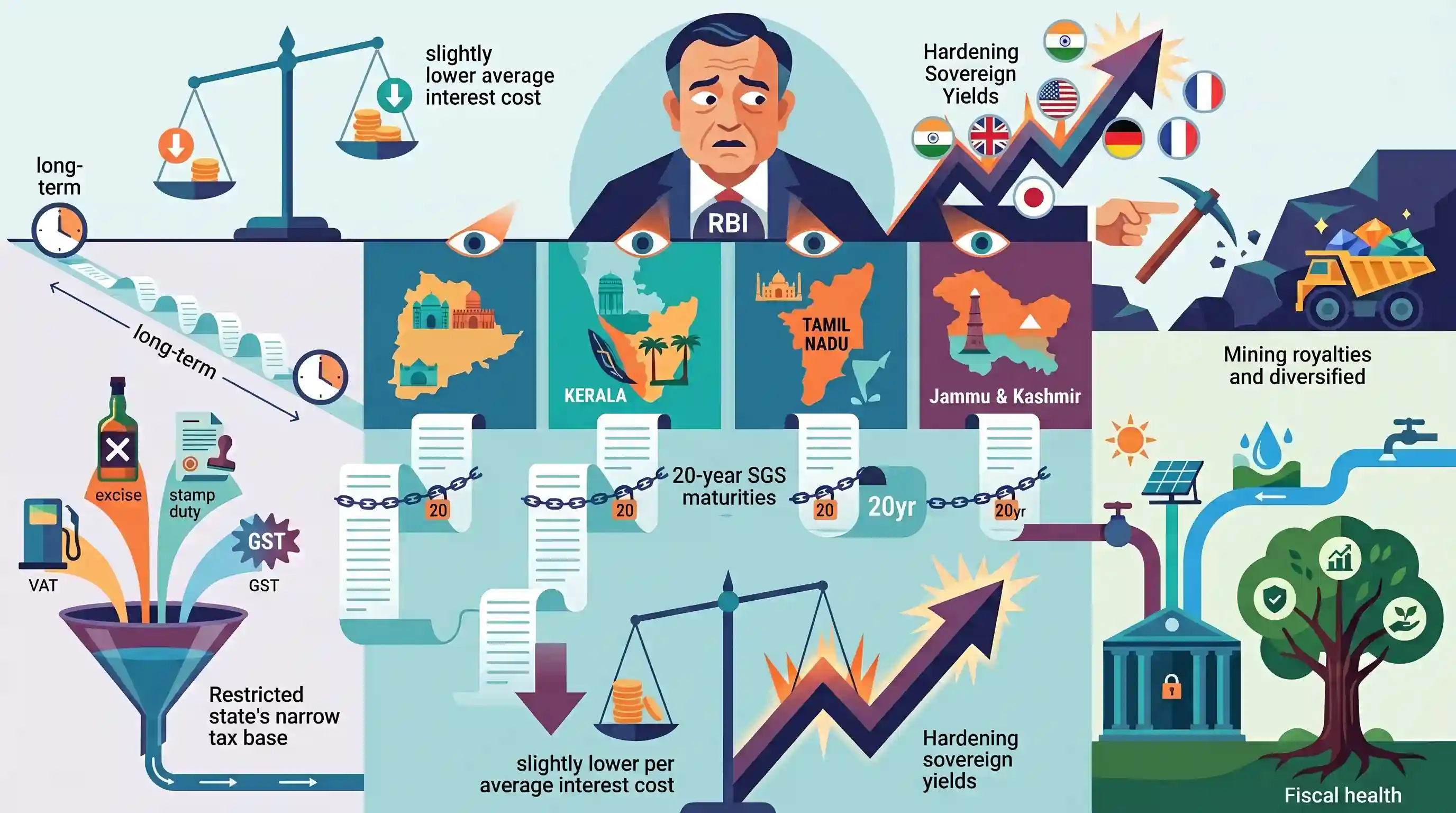
The Reserve Bank of India (RBI) has flagged concerns over the increasing tendency of states, particularly Telangana, Kerala, Tamil Nadu, and Jammu & Kashmir, to issue long-term State Government Securities (SGS) with maturities exceeding 20 years. While this strategy slightly lowers the average interest cost of public debt, it locks states into long-term debt servicing commitments at a time when sovereign yields are hardening. Given that states rely heavily on a narrow tax base—primarily GST, fuel VAT, liquor excise, and stamp duties—the RBI has urged them to diversify and expand their non-tax revenues, such as mining royalties, to ensure long-term fiscal health and debt sustainability.
Key Points
- States are increasingly issuing State Government Securities (SGS) with tenures exceeding 20 years, with Telangana leading at 28.2% of its issuances in this bracket.
- While longer tenures marginally reduce the average interest rate of outstanding debt, they lock states into debt repayment obligations for extended periods amid hardening bond yields.
- State revenues remain highly concentrated in a few tax streams, primarily GST, petroleum VAT, state excise on liquor, and stamp duties on immovable property.
- To ensure debt sustainability, the RBI has advised states to aggressively focus on augmenting non-tax revenues, such as royalties from mining and quarrying.
Important Terms
State Development Loans (SDLs)

Dated securities issued by state governments to fund their fiscal deficits. They are auctioned by the RBI and typically offer slightly higher yields than central government securities.
UPSC context
GS Paper III: Public Finance. Essential for understanding state-level borrowing, fiscal deficits, and the role of the RBI.
Bond Yield
The effective rate of return an investor earns on a bond. 'Hardening' occurs when yields rise (and prices fall), increasing the government's borrowing costs for new debt.
UPSC context
GS Paper III: Indian Economy. Key for analyzing monetary policy transmission, interest rate regimes, and capital market dynamics.
Debt Sustainability
The capacity of a government to service its debt obligations without compromising essential developmental expenditure, resorting to default, or requiring exceptional financial assistance.
UPSC context
GS Paper III: Government Budgeting. Tests knowledge of fiscal discipline, debt-to-GDP ratios, and the FRBM Act.
Non-Tax Revenue
Government income from sources other than compulsory taxes, including administrative fees, fines, dividends from public sector enterprises, and royalties from natural resources like minerals.
UPSC context
GS Paper III: Resource Mobilization. Vital for discussing state fiscal autonomy and diversifying revenue beyond the narrow GST base.
Fiscal Federalism
The system of financial relations and resource allocation between different levels of government (Union and States), governed by constitutional provisions like Articles 270 and 280.
UPSC context
GS Paper II/III: Governance & Economy. Focuses on Centre-State financial relations, tax devolution, and horizontal equity.
Goods and Services Tax (GST)
A comprehensive, multi-stage, destination-based indirect tax levied on the supply of goods and services, replacing multiple central and state taxes to create a unified national market.
UPSC context
GS Paper III: Taxation. Central to discussions on fiscal policy, cooperative federalism, and government revenue structures.
Prelims Trap
State governments can issue both long-term dated securities and short-term Treasury Bills to meet market borrowing needs.
States can issue long-term State Development Loans (SDLs) but cannot issue Treasury Bills. Only the Central government can issue T-Bills for short-term liquidity.
Static Concepts Connected
What are the constitutional limitations on State borrowing under Article 293?
- Domestic constraint: States can only borrow within the territory of India upon the security of the Consolidated Fund of the State.
- Centre's consent: Prior consent of the Central Government is mandatory if any previous loan extended or guaranteed by the Centre remains outstanding.
- External borrowing: State governments cannot directly raise external commercial borrowings or sovereign loans from foreign entities.
What constitute the primary revenue streams for States outside of the GST regime?
- Non-subsumed Taxes: State tax revenues heavily depend on state excise on liquor, VAT on petroleum products, and stamp duty on property registrations.
- Non-Tax Revenues: Includes royalties from mining, irrigation charges, forestry receipts, and dividends from State PSUs, which the RBI emphasizes for debt sustainability.
Cross-Topic Patterns
Fiscal Federalism & Mineral Rights
The push for non-tax revenue like mining royalties directly connects to the recent Supreme Court ruling upholding states' legislative competence to tax mineral rights.
Sovereign Yields & SDL Spreads
Hardening bond yields increase the spread (premium) states must pay over Central G-Secs, significantly straining state finances during periods of monetary tightening.

Expect a 2026 question merging Article 293 borrowing constraints, states' inability to issue T-bills, and post-GST non-tax revenue sources.
Linked PYQs · 3
Linked PYQs · 3
- 2022PrelimsGS1
With reference to the Indian economy, consider the following statements: 1. A share of the household financial savings goes towards government borrowings. 2. Dated securities issued at market-related rates in auctions form a large component of internal debt. Which of the above statements is/are correct?
- 2019MainsGS3
Enumerate the indirect taxes which have been subsumed in the Goods and Services Tax (GST) in India. Also, comment on the revenue implications of the GST introduced in India since July 2017.
- 2025MainsGS3
Explain how the Fiscal Health Index (FHI) can be used as a tool for assessing the fiscal performance of states in India. In what way would it encourage the states to adopt prudent and sustainable fiscal policies?
