Legal position on mandatory voting and uncontested elections
Source:Indian Express ↗
Why It Matters
The debate over compulsory voting and the legal power of NOTA touches on foundational concepts of Indian democracy and electoral laws. Understanding the provisions of the Representation of the People Act, 1951, and Supreme Court rulings on elections is crucial for the GS2 paper.
Summary
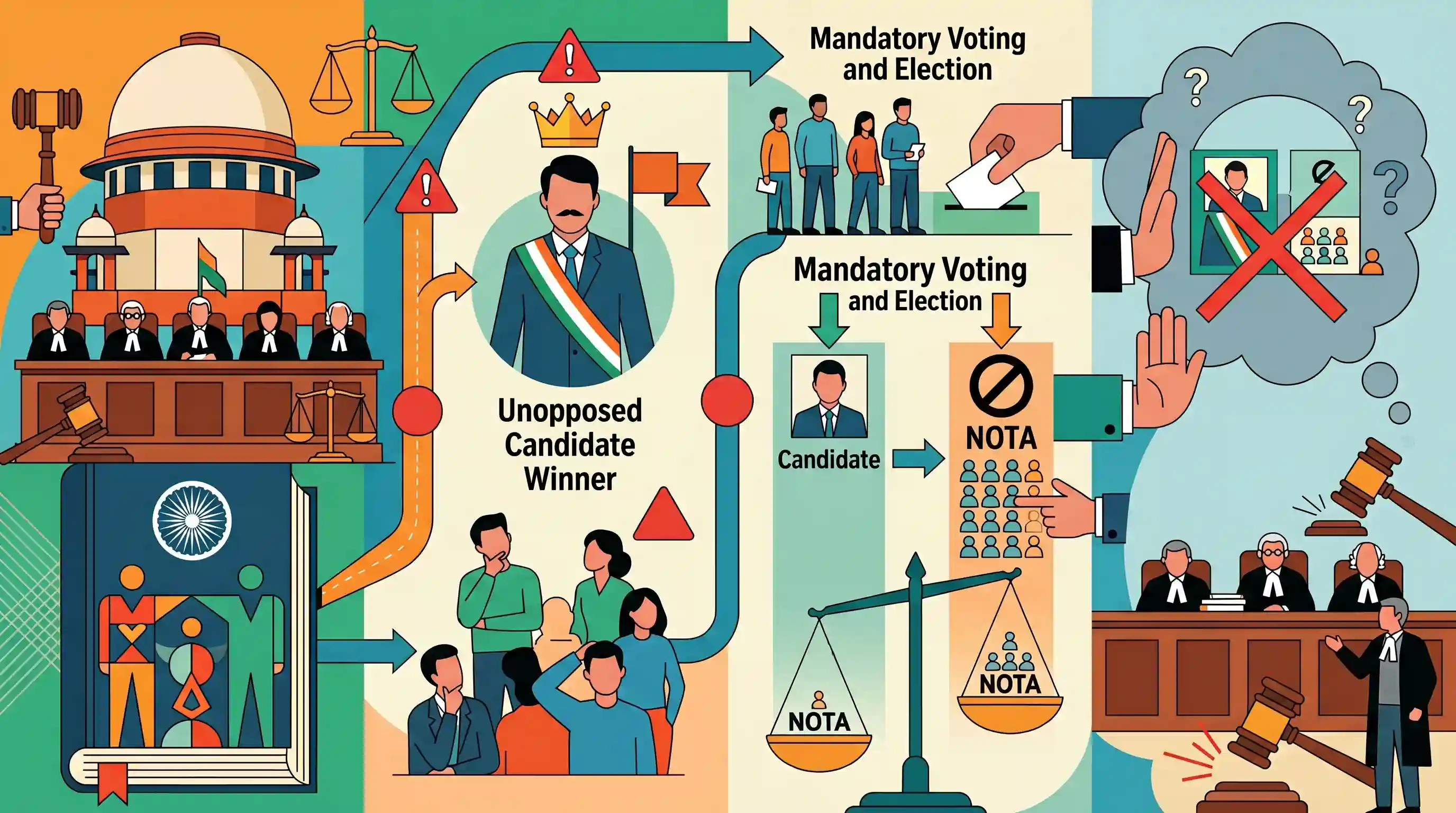
The Supreme Court of India declined to entertain a public interest litigation seeking mandatory voting mechanisms and amendments to electoral laws. The petitioners challenged Section 53(2) of the Representation of the People Act (RPA), 1951, arguing that unopposed candidates should not automatically be declared winners. They contended that elections should still occur to allow voters to choose the 'None of the Above' (NOTA) option, which might secure more votes than the sole candidate. The bench, agreeing with the Attorney General, dismissed the plea as hypothetical.
Key Points
- The Supreme Court dismissed a petition seeking the introduction of a compulsory voting mechanism in India.
- The plea challenged Section 53(2) of the Representation of the People Act, 1951, which allows for a candidate to be declared elected if they are the sole uncontested nominee.
- Petitioners argued that even with a single candidate, elections should be held to allow voters to exercise the None of the Above (NOTA) option, which could hypothetically poll more votes than the candidate.
- Attorney General R Venkataramani opposed the petition, stating the court should not entertain completely hypothetical scenarios regarding uncontested elections and NOTA.
Important Terms
Representation of the People Act 1951

A 1951 parliamentary act governing the actual conduct of elections in India, including the declaration of results, seat allocation, and candidate disqualification. Section 53(2) specifically allows unopposed candidates to be declared winners.
UPSC context
GS Paper II: Polity. Crucial for understanding electoral laws, the Election Commission's powers, and candidate eligibility criteria.
None of the Above (NOTA)
An electoral option introduced in 2013 (PUCL v. Union of India) allowing voters to reject all candidates secretly. It symbolizes the right to dissent under Article 19(1)(a) but currently lacks 'power' to nullify elections.
UPSC context
GS Paper II: Governance/Elections. Tests knowledge of voter rights, democratic expression, and judicial interventions in electoral processes.
Vidhi Centre for Legal Policy
An independent legal think tank that conducts legal research to facilitate better laws and governance. It frequently files Public Interest Litigations (PILs) to seek judicial review of existing legislative provisions.
UPSC context
GS Paper II: Statutory/Regulatory Bodies. Relevant as a non-state actor influencing legal policy and electoral reforms through the judiciary.
Public Interest Litigation (PIL)
A legal mechanism that allows any citizen or group to file a petition in the Supreme Court or High Courts for the protection of 'public interest' or enforcement of fundamental rights.
UPSC context
GS Paper II: Judiciary. Key concept for judicial activism and the protection of constitutional rights for all segments of society.
Article 19(1)(a)
Fundamental right guaranteeing freedom of speech and expression. Petitioners argued that denying NOTA in uncontested elections violates a voter’s right to express their disapproval through the ballot.
UPSC context
GS Paper II: Fundamental Rights. Essential for understanding the constitutional basis of voting as a form of expression.
Prelims Trap
"If NOTA receives the maximum votes in a parliamentary constituency, a re-election is automatically mandated under ECI guidelines."
This is false. For Lok Sabha and Assembly polls, NOTA has no electoral consequence; the candidate with the next highest valid votes is declared the winner.
Static Concepts Connected
What is the constitutional and legal status of the right to vote?
- Constitutional Right: It is a Constitutional Right guaranteed under Article 326, which provides for universal adult suffrage.
- Statutory execution: The right is operationalized and governed by the Representation of the People Act, 1951.
- Freedom of Expression: While voting is constitutional, the right to register a vote of rejection (NOTA) is a Fundamental Right under Article 19(1)(a) (PUCL Case 2013).
What happens when a candidate is uncontested under RPA 1951?
- Section 53(2): Under Section 53(2), if the number of contesting candidates equals the number of seats, the Returning Officer immediately declares them elected.
- No Polling: No polling is conducted, effectively precluding the possibility of voters exercising a NOTA option against the sole candidate.
Cross-Topic Patterns
Constitutional vs. Fundamental Rights
UPSC frequently tests the fine line between constitutional rights (Article 326 voting) and fundamental rights (Article 19(1)(a) right to reject/NOTA) within the context of electoral laws.
Committees on Electoral Reforms
The Dinesh Goswami Committee's rejection of compulsory voting ties into broader electoral reform syllabus topics, such as state funding (Indrajit Gupta Committee) and EVM implementation.

Expect a multi-statement question on RPA 1951 contrasting uncontested elections (Sec 53) with the legal (non)consequences of NOTA.
Linked PYQs · 4
Linked PYQs · 4
- 2024MainsGS2
Examine the need for electoral reforms as suggested by various committees with particular reference to "one nation one election" principle.
- 2019MainsGS2
On what grounds a people's representative can be disqualified under the Representation of Peoples Act, 1951? Also mention the remedies available to such person against his disqualification.
- 2017PrelimsGS1
Right to vote and to be elected in India is a
- 2020PrelimsGS1
Consider the following statements: 1. According to the Constitution of India, a person who is eligible to vote can be made a minister in a State for six months even if he/she is not a member of the Legislature of that State. 2. According to the Representation of People Act, 1951, a person convicted of a criminal offence and sentenced to imprisonment for five years is permanently disqualified from contesting an election even after his release from prison. Which of the statements given above is/are correct?
