US India Trade Deal and Strategic Autonomy Concerns
Source:The Hindu ↗
Why It Matters
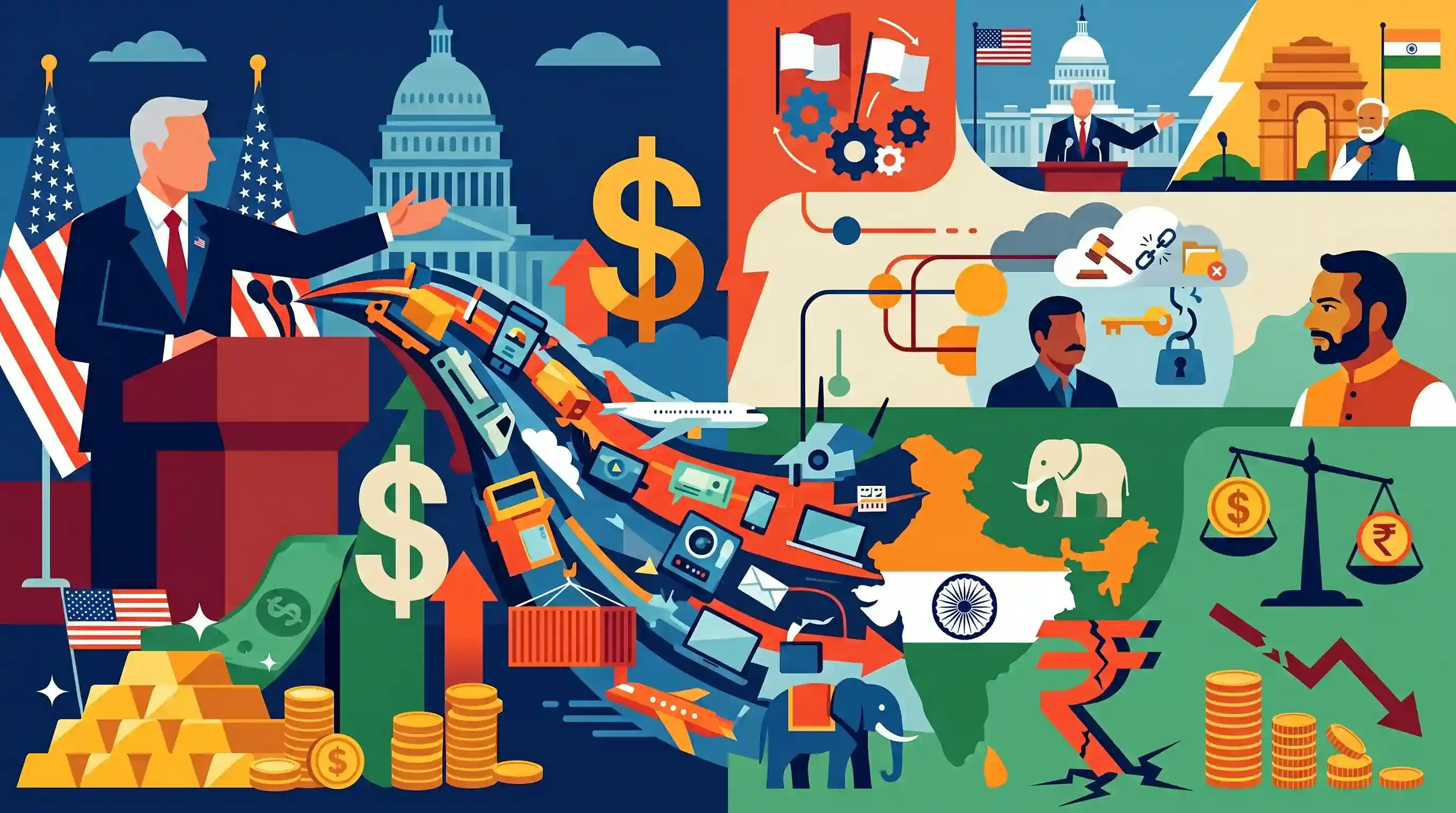
The article highlights the intersection of international diplomacy and macroeconomic stability. The proposed massive trade commitment brings into focus India's balance of trade, foreign exchange management, and currency valuation while simultaneously raising fundamental questions about India's strategic autonomy and sovereign decision-making in its foreign policy.
Summary
Congress leader Jairam Ramesh has strongly criticized Prime Minister Narendra Modi following U.S. Secretary of State Marco Rubio's announcement that India committed to purchasing $500 billion in U.S. goods over the next five years. Ramesh highlighted the severe economic risks of this commitment, arguing it contradicts the government's calls to preserve foreign exchange and would further weaken the Indian Rupee, which has already depreciated 12% against the dollar over the last year. Furthermore, the opposition questioned India's eroding foreign policy autonomy, pointing out that crucial diplomatic developments, including the Operation Sindoor ceasefire, are increasingly being announced in Washington rather than New Delhi. Ramesh also alleged that these geopolitical and economic concessions are linked to the recent dropping of U.S. criminal fraud charges against industrialist Gautam Adani.
Key Points
- U.S. Secretary of State Marco Rubio announced that India committed to importing $500 billion worth of American goods over five years, which would require doubling the current annual import volume of $52.9 billion.
- Congress leader Jairam Ramesh warned that a massive surge in imports would strain foreign exchange reserves and exacerbate the depreciation of the Indian Rupee, which has already lost 12% against the US dollar in the past 12 months.
- The opposition criticized the Modi government's foreign policy sovereignty, questioning why major announcements like the Operation Sindoor ceasefire and the Venezuelan President's proposed visit emanated from Washington instead of New Delhi.
- Congress alleged that the trade deal and geopolitical alignment were compromised concessions to appease the U.S. in exchange for dropping criminal fraud charges against industrialist Gautam Adani.
Important Terms
Operation Sindoor

A 2025 Indian tri-services military operation targeting terror infrastructure in Pakistan following the Pahalgam attack; its kinetic phase ended via a US-mediated ceasefire.
UPSC context
GS Paper II/III (International Relations/Security); tests understanding of India's counter-terrorism doctrine and third-party diplomatic interventions.
Strategic Autonomy
A foreign policy doctrine where a state makes independent decisions based on national interest without being constrained by external alliances or pressures.
UPSC context
GS Paper II (International Relations); central theme in Indian diplomacy regarding non-alignment and managing US-China-Russia relations.
Currency Depreciation
The decline in a currency's value relative to another under market forces; the Rupee recently depreciated significantly against the US Dollar.
UPSC context
GS Paper III (Economy); tests knowledge of exchange rate mechanisms, trade competitiveness, and RBI's market interventions.
Balance of Trade (BoT)
The difference between the monetary value of a country's exports and imports; a massive import commitment can lead to a trade deficit.
UPSC context
GS Paper III (Economy); essential for analyzing current account stability and bilateral trade agreements.
Foreign Exchange (Forex) Reserves
Assets (typically USD, Euro, Gold) held by the RBI to manage exchange rate volatility and ensure external sector resilience.
UPSC context
GS Paper III (Economy); critical for understanding India’s buffer against global financial shocks.
Trump Administration
Refers to the U.S. executive branch (2025-26 context) whose 'America First' approach emphasizes transactional trade deals and active South Asian mediation.
UPSC context
GS Paper II (International Relations); examines the impact of U.S. domestic policy on Indian trade and security.
Prelims Trap
"A binding bilateral import commitment strengthens the domestic currency by signaling robust trade integration."
Massive import surges dramatically increase demand for foreign currency, widening the Current Account Deficit and exerting downward pressure (depreciation) on the domestic currency.
Static Concepts Connected
How does continuous Rupee depreciation affect India's macroeconomic indicators?
- Imported Inflation: Makes imported essentials like crude oil and electronics more expensive, directly driving up domestic retail inflation.
- Export Competitiveness: Temporarily boosts export volumes since Indian goods become cheaper for foreign buyers in dollar terms.
- Debt Burden: Increases the rupee-equivalent repayment cost for domestic corporates holding unhedged External Commercial Borrowings (ECBs).
What differentiates 'Strategic Autonomy' from traditional 'Non-Alignment'?
- Issue-based Partnerships: Focuses on forming proactive alliances with different powers on specific issues to maximize national interest.
- Multi-alignment: Involves deep strategic engagement and interoperability with major powers, moving away from Cold War-era equidistance.
Cross-Topic Patterns
Trade Deficit & RBI's Dilemma
Surging imports to appease trade partners widens the CAD. This forces the RBI to intervene by burning forex reserves to defend a depreciating Rupee, complicating inflation targeting.
Proactive Deterrence vs. Mediation
While Operation Sindoor demonstrated India's shift to proactive conventional military deterrence, Washington announcing the ceasefire highlights the paradox of relying on US diplomatic mediation.

Impact of sudden import surges on CAD and Rupee depreciation will likely feature as a multi-statement macroeconomic question in 2026.
Linked PYQs · 5
Linked PYQs · 5
- 2025MainsGS3
What are the challenges before the Indian economy when the world is moving away from free trade and multilateralism to protectionism and bilateralism? How can these challenges be met?
- 2018MainsGS3
How would the recent phenomena of protectionism and currency manipulations in world trade affect macroeconomic stability of India?
- 2022PrelimsGS1
With reference to the Indian economy, consider the following statements: 1. If the inflation is too high, Reserve Bank of India (RBI) is likely to buy government securities. 2. If the rupee is rapidly depreciating, RBI is likely to sell dollars in the market. 3. If interest rates in the USA or European Union were to fall, that is likely to induce RBI to buy dollars. Which of the statements given above are correct?
- 2019PrelimsGS1
Which one of the following is not the most likely measure the Government/RBI takes to stop the slide of Indian rupee?
- 2021PrelimsGS1
Consider the following statements : The effect of devaluation of a currency is that it necessarily 1. improves the competitiveness of the domestic exports in the foreign markets 2. increases the foreign value of domestic currency 3. improves the trade balance Which of the above statements is/are correct?
