Institutional Anti Ragging Measures and University Governance
Source:Indian Express ↗
Why It Matters
Ensuring safe and ethical environments in higher education institutions is crucial for human resource development and the holistic well-being of the youth. The article highlights the practical administrative, digital, and law-enforcement synergies required to enforce zero-tolerance policies like those mandated by the UGC, serving as a case study for governance in educational institutions.
Summary
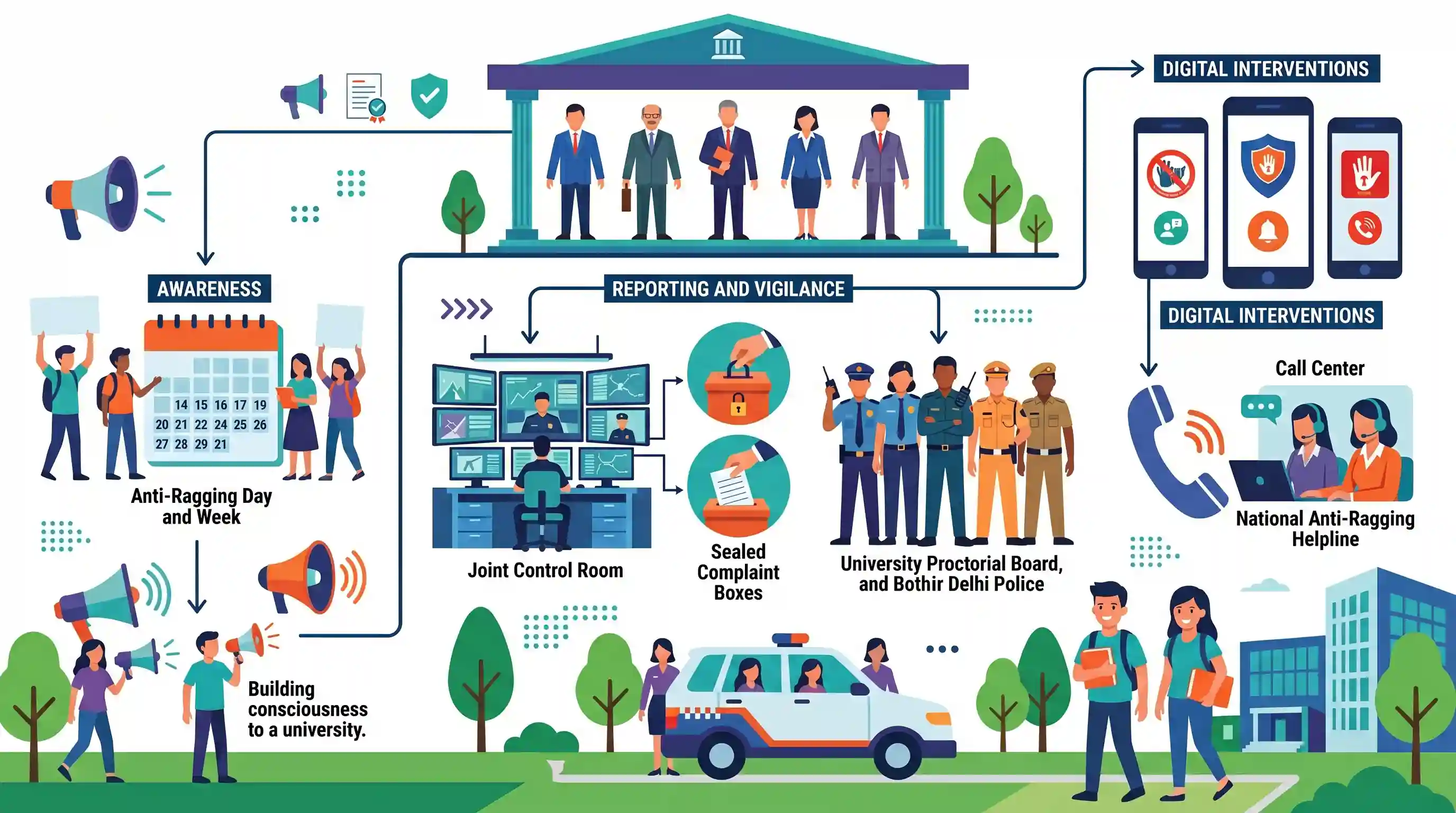
In preparation for the new academic session, Delhi University has implemented a series of stringent anti-ragging measures aligned with University Grants Commission (UGC) guidelines. The initiatives include the establishment of joint control rooms, sealed complaint boxes, and coordinated vigilance squads involving the university's proctorial board and Delhi Police. To improve campus safety and reporting, digital interventions like the National Anti-Ragging Helpline and mobile apps (Anti-Ragging, Himmat) are being promoted, alongside physical patrols like the all-women 'VAMIKA' vehicle. Additionally, DU will observe an Anti-Ragging Day and Week in mid-August to build awareness and ensure a secure, disciplined environment for incoming students.
Key Points
- Delhi University has launched comprehensive anti-ragging measures ahead of the new academic session in accordance with UGC directives.
- The university will observe Anti-Ragging Day on August 12 and Anti-Ragging Week from August 12 to 18 to sensitize students.
- Administrative measures include sealed complaint boxes, joint control rooms for North and South campuses, and mandatory anti-ragging undertakings by students and parents.
- Campus surveillance has been enhanced through police pickets, vigilance squads, and 'VAMIKA', an all-women police patrolling vehicle.
- Digital mechanisms like the Anti-Ragging and Himmat mobile apps, as well as a centralized helpline, are being heavily promoted to facilitate anonymous and prompt reporting.
Important Terms
University Grants Commission (UGC)

A statutory body established under the UGC Act, 1956, responsible for coordinating, determining, and maintaining standards of higher education in India and disbursing funds to universities.
UPSC context
GS Paper II: Statutory/Regulatory bodies; Education policy; mechanisms for maintaining academic standards and student welfare.
UGC Anti-Ragging Regulations (2009)
Mandatory legal guidelines that prohibit ragging in all its forms across Indian higher education institutions, requiring the establishment of institutional anti-ragging committees and squads.
UPSC context
GS Paper II: Government policies and interventions for development; protection of vulnerable sections (students) in educational settings.
National Anti-Ragging Helpline
A 24x7 multi-lingual toll-free service (1800-180-5522) established by the UGC to provide immediate grievance redressal and support for victims of ragging in colleges.
UPSC context
GS Paper II: Social Justice; institutional mechanisms for grievance redressal and protection of student rights.
Himmat Plus App
An emergency safety mobile application launched by the Delhi Police to provide SOS services, distress alerts, and location tracking, primarily aimed at enhancing women's security.
UPSC context
GS Paper II: Governance and Internal Security; role of technology in public safety and gender-based crime prevention.
Anti-Ragging Mobile App
A digital platform launched by the UGC allowing students to file ragging complaints, submit mandatory undertakings, and access the national helpline via smartphones.
UPSC context
GS Paper II: e-Governance; digital interventions for accessible grievance redressal and administrative accountability.
Prelims Trap
Ragging is a statutory offense penalized under a dedicated Central Anti-Ragging Act enacted by Parliament.
India lacks a singular national anti-ragging law. Incidents are addressed via state-specific laws, general penal codes, and UGC administrative regulations (2009).
Static Concepts Connected
What constitutes the regulatory framework against ragging in India?
- Raghavan Committee: A 2007 Supreme Court-appointed committee whose recommendations formed the bedrock of institutional anti-ragging mechanisms.
- UGC Regulations (2009): Mandates institutional anti-ragging squads and helplines. Clause 9.4 allows the UGC to de-recognize or penalize non-compliant institutions.
- Legal Prosecution: In the absence of a central law, perpetrators face action under state laws or general criminal codes for offenses like wrongful restraint.
What are the limitations of emergency e-governance apps like Himmat?
- Low Adoption: Despite strong utility, parliamentary panels note adoption remains limited due to complex user interfaces and regional language barriers.
- Digital Divide: Over-reliance on smartphones and mobile internet connectivity can inadvertently exclude vulnerable populations lacking digital access.
Cross-Topic Patterns
Institutional Ethics (GS4) & Ragging
The persistence of ragging highlights a failure of core societal values like empathy. Formal policing must be paired with value-based education to foster moral accountability in higher education.
Tech solutions for vulnerable sections (GS2)
Apps like Himmat and initiatives like 'VAMIKA' highlight the intersection of e-governance and community policing to secure vulnerable demographics like women students.

Expect a prelims statement on the Raghavan Committee or a trap claiming India has a standalone Central Anti-Ragging Act (it doesn't).
Linked PYQs · 3
Linked PYQs · 3
- 2020MainsGS2
National Education Policy 2020 is in conformity with the Sustainable Development Goal-4 (2030). It intends to restructure and reorient education system in India. Critically examine the statement.
- 2015MainsGS2
The quality of higher education in India requires major improvements to make it internationally competitive. Do you think that the entry of foreign educational institutions would help improve the quality of higher and technical education in the country? Discuss.
- 2024MainsGS4
“Ethics encompasses several key dimensions that are crucial in guiding individuals and organizations towards morally responsible behaviour.” Explain the key dimensions of ethics that influence human actions. Discuss how these dimensions shape ethical decision-making in the professional context.
