Separation of Powers in India and United States
Source:The Hindu ↗
Why It Matters
Provides highly relevant analytical content for GS2 Mains questions that require comparing the Indian constitutional scheme with the US Constitution, particularly concerning the judiciary's role, administrative overreach, and the separation of powers.
Summary
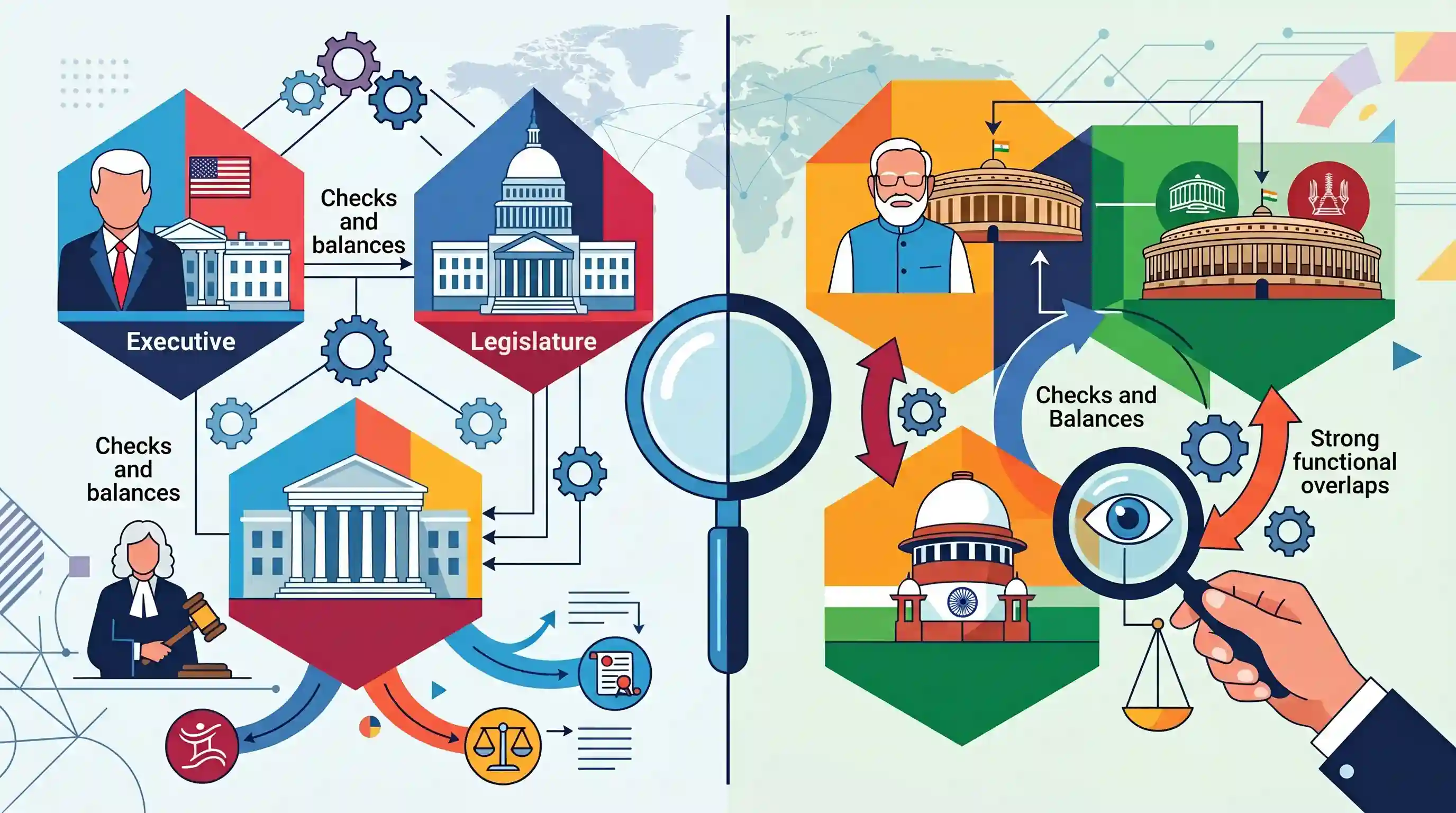
A comparative analysis of the 'separation of powers' doctrine in India and the United States, viewed through the lens of recent US Supreme Court (SCOTUS) judgments. The article contrasts the relatively rigid American structural separation with the Indian constitutional framework, which relies heavily on functional overlaps, judicial review, and checks and balances among the executive, legislature, and judiciary.
Key Points
- Analyzes recent United States Supreme Court (SCOTUS) rulings to understand evolving interpretations of the separation of powers doctrine.
- Compares the relatively strict, textual separation of powers in the US system with India's model of functional overlap and checks and balances.
- Highlights differences in how the judiciary in each country reviews executive actions and administrative law, revealing distinct jurisprudential philosophies.
- Examines the balance of power between the executive, legislative, and judicial branches and how structural constraints are managed in both democracies.
Important Terms
Separation of Powers

Constitutional principle dividing government into Legislative, Executive, and Judicial branches to prevent power concentration and ensure liberty through distinct spheres of authority.
UPSC context
GS Paper II: Fundamental to comparing Indian constitutional schemes with other countries like the US and UK.
Checks and Balances
A system allowing each branch of government to limit the powers of the others, ensuring no single organ becomes absolute or tyrannical in its functions.
UPSC context
GS Paper II: Tests understanding of dispute redressal mechanisms and inter-organ relationships.
Judicial Review
The judiciary's power to review and potentially invalidate laws or executive actions that violate the Constitution; a cornerstone of constitutionalism in both India and the US.
UPSC context
GS Paper II: Essential for topics on judicial activism and the structure of the judiciary.
Chevron Deference
A US legal doctrine requiring courts to defer to agency interpretations of ambiguous laws; recently overturned by SCOTUS, shifting power back to the judiciary.
UPSC context
GS Paper II: Relevant for comparative constitutional law and recent global judicial trends.
Basic Structure Doctrine
An Indian judicial innovation stating that Parliament cannot amend certain fundamental features of the Constitution, such as secularism and judicial review.
UPSC context
GS Paper II: High-frequency topic regarding constitutional amendments and judicial limits on the legislature.
Functional Overlap
The Indian constitutional model where branches share certain duties (e.g., Executive participating in legislation), unlike the rigid personnel separation seen in the US.
UPSC context
GS Paper II: Key concept for distinguishing between parliamentary (India) and presidential (US) systems.
Prelims Trap
The US Constitution explicitly outlines Judicial Review, whereas the Indian Constitution only implies it.
This is reversed. Judicial review is implied in the US (Marbury v. Madison) but explicitly codified in the Indian Constitution (Articles 13, 32, and 226).
Static Concepts Connected
How does Separation of Powers functionally differ between India and the US?
- US Strict Separation: Articles I, II, and III vest powers rigidly. The executive is entirely separate from the legislature (presidential system).
- Indian Functional Overlap: India follows a parliamentary system where the executive (Council of Ministers) is drawn directly from, and is accountable to, the legislature.
- Article 50 Mandate: The Indian Constitution does not have a strict textual separation but explicitly directs separating the judiciary from the executive under Article 50 (DPSP).
What is the status of Judicial Review in both constitutional schemes?
- Constitutional Basis: India explicitly grants judicial review (Arts 13, 32, 226). The US framework implies it, as established by the 1803 Marbury v. Madison Supreme Court case.
- Scope of Review: The US operates strictly on 'due process of law'. India adopted 'procedure established by law', though it functionally evolved into due process post-Maneka Gandhi (1978).
Cross-Topic Patterns
Delegated Legislation & Executive Overreach
SCOTUS limiting excessive legislative delegation (tariffs) parallels India's administrative law principle that 'essential legislative functions' cannot be delegated to the executive.
Due Process vs Procedure by Law
Constitutional comparisons frequently focus on how India’s 'procedure established by law' functionally merged with the American 'due process' doctrine following the 1978 Maneka Gandhi judgment.

Expect a GS-2 Mains question contrasting the US and Indian approaches to limits on delegated legislation and executive overreach.
Linked PYQs · 4
Linked PYQs · 4
- 2020MainsGS2
Judicial Legislation is antithetical to the doctrine of separation of powers as envisaged in the Indian Constitution. In this context justify the filing of large number of public interest petitions praying for issuing guidelines to executive authorities.
- 2024MainsGS2
Discuss India as a secular state and compare with the secular principles of the US constitution.
- 2021MainsGS2
Analyze the distinguishing features of the notion of Right to Equality in the Constitutions of the USA and India.
- 2017PrelimsGS1
In India, Judicial Review implies
