Comparative Constitutional Jurisprudence on Separation of Powers
Source:The Hindu ↗
Why It Matters
The 'Separation of Powers' and 'Comparison of Constitutional Schemes' are core topics in UPSC GS Paper 2. Understanding how landmark international rulings reflect differing constitutional philosophies provides candidates with critical analytical depth for Mains answers on judicial review, executive overreach, and constitutional checks and balances.
Summary
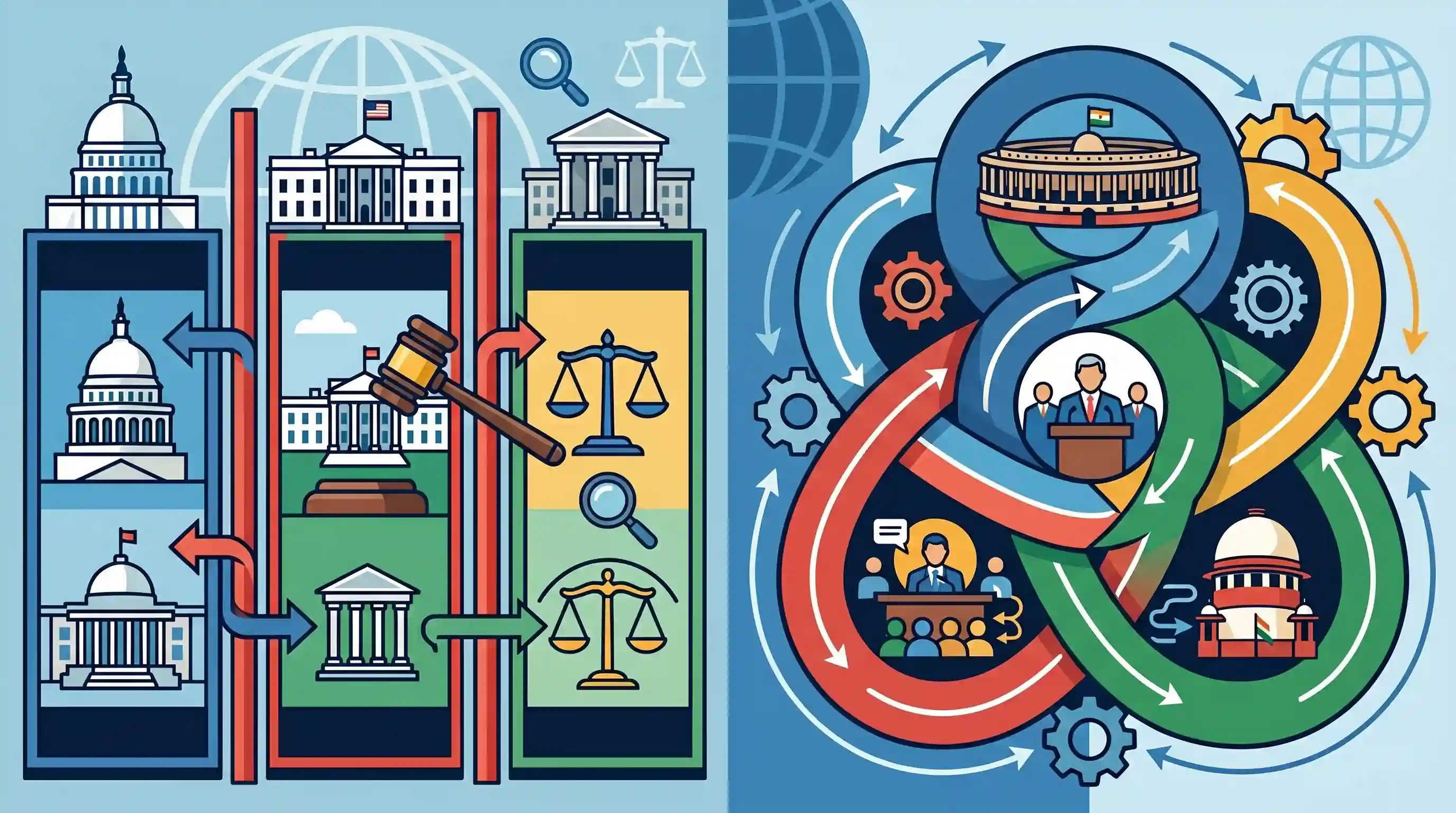
The article provides a comparative analysis of the separation of powers in India and the United States, contextualized by recent rulings from the U.S. Supreme Court (SCOTUS). It contrasts the rigid, structural separation of powers established by the U.S. Constitution with India's fluid model of 'checks and balances' under a parliamentary democracy. Recent SCOTUS judgments underscore a strict boundary-setting exercise among the executive, legislative, and judicial branches, while the Indian system allows for more functional overlap, specifically highlighting how differences in constitutional design shape judicial review and executive accountability in both nations.
Key Points
- The U.S. Constitution mandates a strict structural separation of powers across its legislative, executive, and judicial branches, whereas India relies on a functional system of checks and balances.
- Recent SCOTUS rulings (like the reversal of Chevron deference or presidential immunity decisions) reflect a rigid, textualist reinforcement of separation of powers.
- India's parliamentary democracy inherently fuses the executive and the legislature, making absolute separation impossible, though Article 50 specifically mandates separating the judiciary from the executive.
- Comparative constitutional analysis shows the Indian judiciary often adopts a more proactive role in reviewing executive actions, contrasting with the evolving U.S. approach to agency deference and executive power.
Important Terms
Separation of Powers

The constitutional model dividing government into executive, legislative, and judicial branches to prevent power concentration. The U.S. follows a rigid structural model, while India follows a functional, overlapping one.
UPSC context
GS Paper II: Essential for topics on 'Separation of powers between various organs' and comparative constitutional analysis.
Checks and Balances
A system allowing each branch of government to amend or veto acts of another branch to prevent any one from becoming too powerful. India uses this to moderate its 'fusion of powers.'
UPSC context
GS Paper II: Tests understanding of how Indian parliamentary democracy maintains accountability despite overlapping branch functions.
Loper Bright Enterprises v. Raimondo
A 2024 U.S. Supreme Court ruling that overturned the 'Chevron doctrine,' ending the requirement for courts to defer to administrative agencies' interpretations of ambiguous laws.
UPSC context
GS Paper II: Recent international legal development impacting administrative law and judicial review standards globally.
Chevron Deference
A defunct U.S. legal principle where courts deferred to executive agencies' 'reasonable' interpretations of ambiguous statutes. Its removal marks a shift toward stricter judicial boundary-setting.
UPSC context
GS Paper II: Comparative law; used to contrast executive-judicial relations in the U.S. versus India.
Basic Structure Doctrine
A judicial principle established in Kesavananda Bharati (1973) stating that Parliament cannot amend the Indian Constitution's core features, including the separation of powers.
UPSC context
GS Paper II: Critical for questions on judicial activism and the limits of the legislature's amending power.
Judicial Review
The power of courts to examine and invalidate legislative or executive actions that violate the Constitution. In the U.S., it is more rigid; in India, it includes 'judicial activism.'
UPSC context
GS Paper II: Core topic on the 'Structure, organization and functioning of the Judiciary.'
Prelims Trap
"The Indian Constitution explicitly mandates a strict separation of powers between the executive, legislative, and judicial branches."
India follows a 'fusion of powers' (parliamentary system) where the executive is drawn from the legislature. The Constitution does not explicitly mandate rigid structural separation.
Static Concepts Connected
How does the Indian Constitution structurally ensure checks and balances between organs?
- Article 50 (DPSP): Directs the State to separate the judiciary from the executive in public services.
- Article 75(3): The Council of Ministers (executive) is collectively responsible to the House of the People (legislature).
- Articles 121 & 211: Parliament and State Legislatures cannot discuss the conduct of Supreme Court or High Court judges.
- Articles 122 & 212: Courts are prohibited from inquiring into the validity of proceedings of Parliament and State Legislatures.
What are the limitations on 'Delegated Legislation' in India?
- Essential Functions: Legislatures cannot delegate their 'essential legislative functions', such as laying down the core policy of a law.
- Judicial Review: Courts can strike down rules made by the executive if they exceed the scope of the parent Act (Ultra Vires).
Cross-Topic Patterns
Judicial Review vs Parliamentary Sovereignty
Contrasting UK's parliamentary sovereignty, US's judicial supremacy, and India's synthesis model is a recurring GS2 Mains theme.
Tribunalisation vs Judicial Independence
The debate over executive overreach in Indian tribunals parallels the US SCOTUS pulling interpretive authority back from federal agencies.

Expect a GS2 Mains question comparing India's checks and balances with the US model, citing the SCOTUS reversal of Chevron deference.
Linked PYQs · 4
Linked PYQs · 4
- 2019MainsGS2
Do you think that Constitution of India does not accept principle of strict separation of powers rather it is based on the principle of 'checks and balance'? Explain.
- 2018MainsGS2
India and USA are two large democracies. Examine the basic tenets on which the two political systems are based.
- 2025MainsGS2
Compare and contrast the President's power to pardon in India and in the USA. Are there any limits to it in both the countries? What are 'preemptive pardons'?
- 2025MainsGS2
Discuss the evolution of collegium system in India. Critically examine the advantages and disadvantages of the system of appointment of the Judges of the Supreme Court of India and that of the USA.
