Opposition questions credentials of company in major Bihar MoU
Source:The Hindu ↗
Why It Matters
Highlights the mechanisms and preliminary nature of Memorandums of Understanding (MoUs) in state investment summits. It emphasizes the need for robust corporate governance and due diligence to prevent potential misuse of state subsidies and public land.
Summary
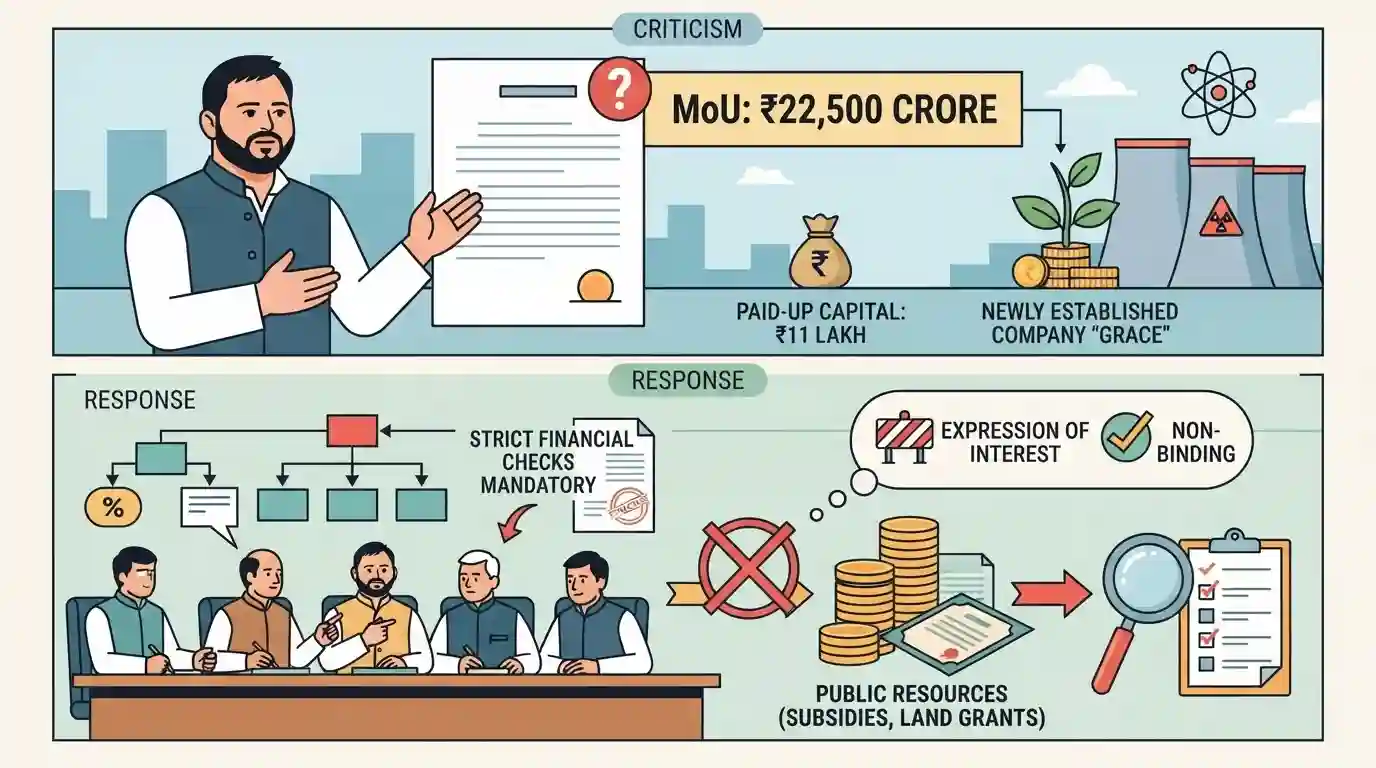
Opposition leader Tejashwi Yadav criticized the Bihar government for signing a ₹22,500 crore MoU with a recently established company, GRACE, which has a paid-up capital of just ₹11 lakh. The MoU, aimed at the nuclear energy sector, was signed during the Bihar Business Connect-2024. Yadav raised concerns about potential misuse of public funds through subsidies and land grants. In response, state officials clarified that MoUs are non-binding expressions of interest and that strict financial and credibility checks are mandatory before any public resources are committed.
Key Points
- The Bihar government signed a ₹22,500 crore MoU with GRACE during the Bihar Business Connect-2024 for investments in the nuclear energy sector.
- RJD leader Tejashwi Yadav alleged that the company has a paid-up capital of only ₹11 lakh and was formed just five months ago, raising concerns about corporate credibility.
- Yadav claimed that the state government might grant subsidies of up to 30% (approx. ₹6,750 crore) and provide land to the newly established firm.
- Government officials clarified that an MoU is merely a preliminary expression of interest, and rigorous scrutiny of land, finances, and track record is conducted before any actual project approval or subsidy dispersal.
Important Terms
Bihar Business Connect-2024

An investor summit organized by the Government of Bihar to attract domestic and international investments in key sectors like textiles, energy, and infrastructure to foster economic growth.
UPSC context
GS Paper 3: State Economy. Tests knowledge of state-level initiatives for industrialization, investment promotion, and job creation.
Memorandum of Understanding (MoU)
A preliminary, non-binding agreement outlining the broad terms and intentions of cooperation between two or more parties before a formal, legally enforceable contract is established.
UPSC context
GS Paper 2: Governance. Crucial for understanding public-private partnerships, administrative procedures, and the legal weight of initial government agreements.
Global Renewable Advanced Clean Energy Private Limited (GRACE)
A private firm incorporated in 2026 that signed a ₹22,500 crore MoU for Bihar’s nuclear energy sector, sparking controversy due to its ₹11 lakh paid-up capital.
UPSC context
GS Paper 3: Corporate Governance. Highlights the need for rigorous financial vetting and due diligence in government investment deals.
Rashtriya Janata Dal (RJD)
A regional political party in India, primarily based in Bihar, advocating for social justice. It currently serves as the principal opposition party in the state assembly.
UPSC context
GS Paper 2: Indian Polity. Relevant for topics on regional political parties, state legislature dynamics, and the role of the opposition.
Government of Bihar
The sub-national administrative authority of the Indian state of Bihar, responsible for governance, public policy implementation, and driving state-level economic development through industrial initiatives.
UPSC context
GS Paper 2: State Government. Relevant for understanding federalism, state-level executive accountability, and regional economic policy implementation.
Prelims Trap
Private enterprises can independently set up and operate civil nuclear power stations in India.
The Atomic Energy Act restricts nuclear power generation to government companies. Private firms can only supply equipment, construction services, or participate in non-core areas, not operate plants.
Static Concepts Connected
What is the difference between Authorized Capital and Paid-up Capital?
- Authorized Capital: The maximum value of shares a company is legally permitted to issue, as outlined in its Memorandum of Association.
- Paid-up Capital: The actual amount of money a company has received from shareholders in exchange for issued shares.
- Regulatory Scrutiny: A massive investment MoU from a firm with minimal paid-up capital often triggers Ministry of Corporate Affairs scrutiny for shell company traits.
What are the rules for private participation in India's nuclear sector?
- State Monopoly: Under the Atomic Energy Act of 1962, operating civil nuclear power plants is restricted to government-owned entities like NPCIL and BHAVINI.
- Private Role: Private players are restricted to providing components, EPC (Engineering, Procurement, and Construction) services, and non-core technological support.
- FDI Prohibition: Foreign Direct Investment (FDI) is completely prohibited in India's nuclear power generation sector.
Cross-Topic Patterns
Investment Summits & State Fiscal Health
Mega-MoUs at state summits often lack financial backing. UPSC connects such industrial incentives and capital subsidies to state fiscal deficits, RBI warnings on state debt, and Article 293 borrowing limits.
Nuclear Capacity Goals vs Legal Monopolies
India's push for 100 GW nuclear capacity by 2047 requires massive private capital for EPC and equipment, creating tension with the Atomic Energy Act's strict state-monopoly provisions.

Expect a Prelims statement testing the prohibition of FDI and independent private operations in India's civil nuclear energy sector.
Linked PYQs · 3
Linked PYQs · 3
- 2024-EBPSC_PRELIMSGS1
When did Bihar State introduce the Green Budget for the first time?
- 2022BPSC_PRELIMSGS1
In the recent Union Budget, the FM has increased the Foreign Direct Investment (FDI) limit in the insurance sector from the existing one to
- 2024-IBPSC_PRELIMSGS1
Renewable Energy means 1. Electricity produced from solar 2. Electricity produced from thermal plants 3. Electricity produced from coal 4. Electricity produced from wind Choose the correct answer from the options given below:
