Karnataka High Court Stays Executive Withdrawal of Criminal Cases
Source:Indian Express ↗
Why It Matters
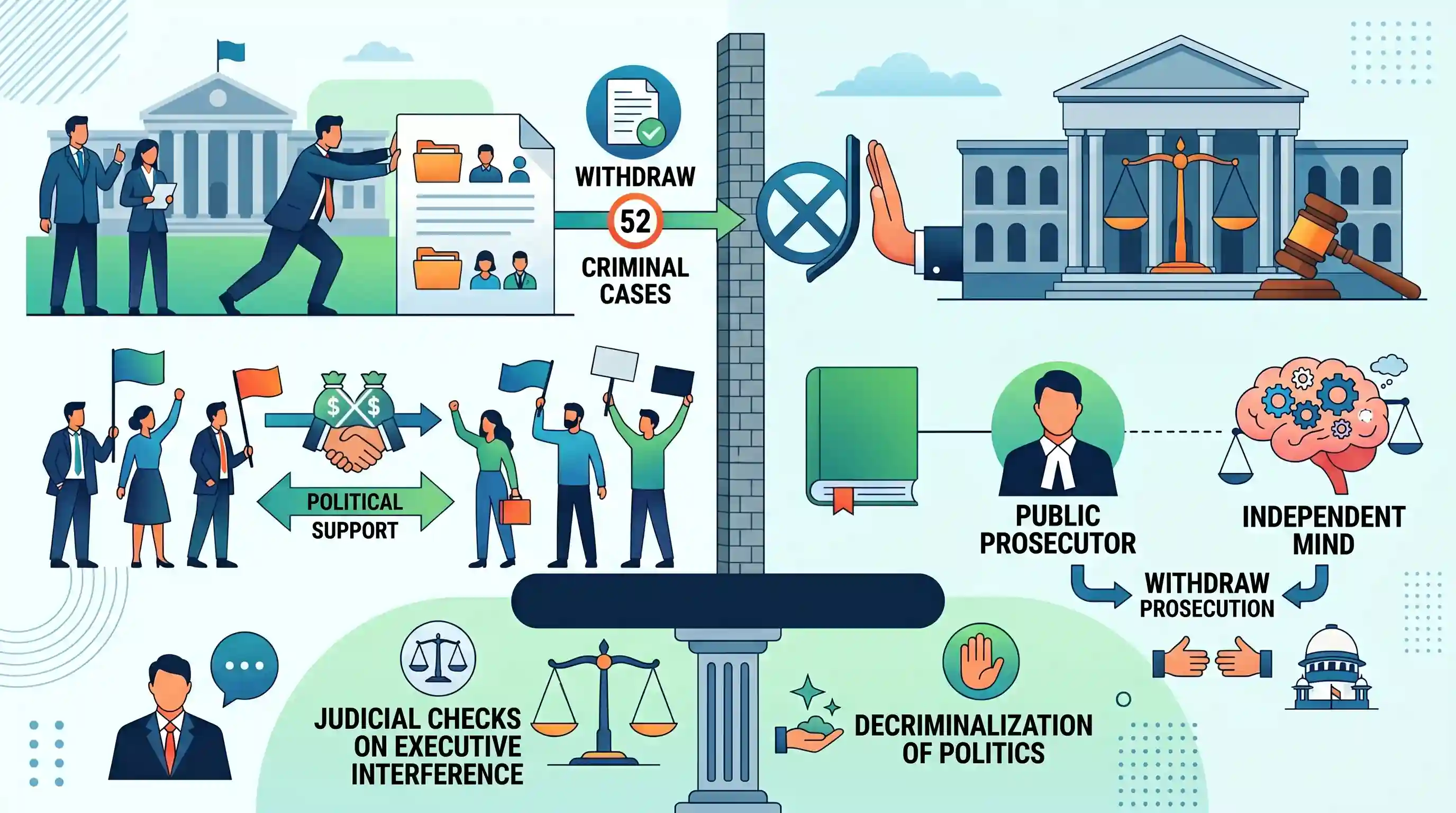
The article provides an excellent real-world case study on the boundaries of executive discretion versus judicial independence, the role of the Public Prosecutor as an independent officer of the court under Section 321 of CrPC (now BNSS equivalents), and judicial measures to prevent the politicization of the criminal justice system and criminalization of politics.
Summary
The Karnataka High Court stayed a state government executive order to withdraw 52 criminal cases. Successive governments in Karnataka have historically dropped cases against their political support bases, involving issues from communal violence to linguistic protests. The High Court ruled that under Section 321 of the CrPC, the authority to withdraw prosecution belongs strictly to the Public Prosecutor, who must apply an independent mind, rather than the executive making politically motivated policy decisions. The article underscores judicial checks on executive interference in the criminal justice system and the significance of the SC's Ashwani Kumar Upadhyay (2021) judgment.
Key Points
- The Karnataka High Court stayed the state government's order to withdraw 52 criminal cases, reiterating that selective prosecution cannot be halted arbitrarily by executive decree.
- Under Section 321 of the Code of Criminal Procedure (CrPC), the statutory power to withdraw from prosecution is vested in the individual Public Prosecutor, who must act independently as an officer of the court and not as a mere agent of the government.
- The High Court observed that state cabinet-driven case withdrawals often 'smack of political nature' and strip public prosecutors of their discretionary room to apply an independent mind.
- Successive political regimes (both Congress and BJP) in Karnataka have routinely used cabinet decisions to drop hundreds of criminal cases (including those involving communal violence, rioting, regional activism, and farm protests) to appease their electoral and ideological support bases.
- The Supreme Court's landmark ruling in Ashwani Kumar Upadhyay v. Union of India (2021) acts as an essential check, stipulating that state governments cannot withdraw criminal cases against sitting or former MPs and MLAs without obtaining prior clearance from the respective High Court.
Important Terms
Code of Criminal Procedure (CrPC) Section 321

A legal provision in India's old procedural code that empowers a Public Prosecutor to withdraw from a prosecution with the court's consent, provided it is done in public interest and not under political influence.
UPSC context
GS Paper II (Polity). Tests separation of powers, executive overreach, and the independence of public prosecutors.
Bharatiya Nagarik Suraksha Sanhita (BNSS)
The statutory framework that replaced the CrPC in India. Its Section 360 (replacing CrPC Section 321) mandates that courts must hear the victim before permitting withdrawal of prosecution.
UPSC context
GS Paper II (Judicial Reforms). Key for testing legal updates, criminal law reforms, and victim rights.
Popular Front of India (PFI)
An Islamist political organization banned by India's Ministry of Home Affairs for five years in 2022 under the Unlawful Activities (Prevention) Act (UAPA) for alleged terror links and subversive activities.
UPSC context
GS Paper III (Internal Security). Tests challenges to internal security, state response to extremism, and UAPA's implementation.
Karnataka High Court
The apex judicial body of Karnataka state. It plays a crucial constitutional role in exercising judicial review, protecting the rule of law, and checking arbitrary executive decisions.
UPSC context
GS Paper II (Judiciary). Tests federal judicial structures, High Court jurisdiction, and checks on state executive decisions.
Decriminalization of Politics
A reformative process aimed at preventing individuals with criminal backgrounds or pending criminal cases from contesting elections and holding public office, ensuring ethical and clean governance.
UPSC context
GS Paper II (Electoral Reforms). Crucial for evaluating the criminal-political nexus and Supreme Court transparency directives.
Prelims Trap
The state cabinet/executive holds the statutory authority to directly withdraw criminal prosecutions from courts.
Under Section 321 of the CrPC (now Section 360 of the BNSS), the executive branch (Cabinet) cannot directly withdraw a prosecution; it can only request the Public Prosecutor to apply to the court, which retains the final veto.
Static Concepts Connected
What is the statutory framework and role of the Public Prosecutor in case withdrawal?
- Statutory Custodian: Under Section 321 CrPC (Section 360 BNSS), the power to withdraw prosecution is vested solely in the Public Prosecutor, not the executive cabinet.
- Judicial Officer: The Supreme Court has ruled that the Public Prosecutor is an 'officer of the court' and must exercise independent, bona fide discretion in public interest.
- Judicial Consent Required: No prosecution can be withdrawn without the explicit consent of the court, which acts as a supervisory check against arbitrary executive influence.
What are the key safeguards under the Ashwani Kumar Upadhyay (2021) judgment?
- Prior HC Permission: State governments cannot withdraw criminal cases against sitting or former MPs and MLAs without prior permission from the respective High Court.
- Suo Motu Monitoring: High Courts must institute suo motu writ petitions to continuously monitor and supervise the progress of trials against elected representatives.
Cross-Topic Patterns
Executive Overreach vs Criminal Justice Reforms
Explores how political regimes attempt to bypass the judicial process to appease voter bases, conflicting directly with Article 50 and the independence of public prosecution.
Decriminalization of Politics and Judicial Activism
The Supreme Court’s guidelines in Ashwani Kumar Upadhyay (2021) demonstrate active judicial monitoring to prevent politicians from dropping charges against themselves.

Judicial limits on executive case withdrawals and the transition to BNSS Section 360 are highly likely GS-2 Separation of Powers fodder.
Linked PYQs · 3
Linked PYQs · 3
- 2021PrelimsGS1
Which one of the following factors constitutes the best safeguard of liberty in a liberal democracy?
- 2023MainsGS2
“Constitutionally guaranteed judicial independence is a prerequisite of democracy.” Comment.
- 2020MainsGS2
Judicial Legislation is antithetical to the doctrine of separation of powers as envisaged in the Indian Constitution. In this context justify the filing of large number of public interest petitions praying for issuing guidelines to executive authorities.
