Jaipur Hosts Commonwealth Peace Mediation Conference Judicial Reforms
Source:scc-online ↗
Why It Matters
The event is highly relevant for RPSC Prelims as it combines Rajasthan-specific current affairs (hosting an international Commonwealth event) with significant state-level judicial reforms, notably the 'Nyayan' software and paperless district courts. It also highlights the growing institutional emphasis on mediation and NALSA's role in ADR.
Summary
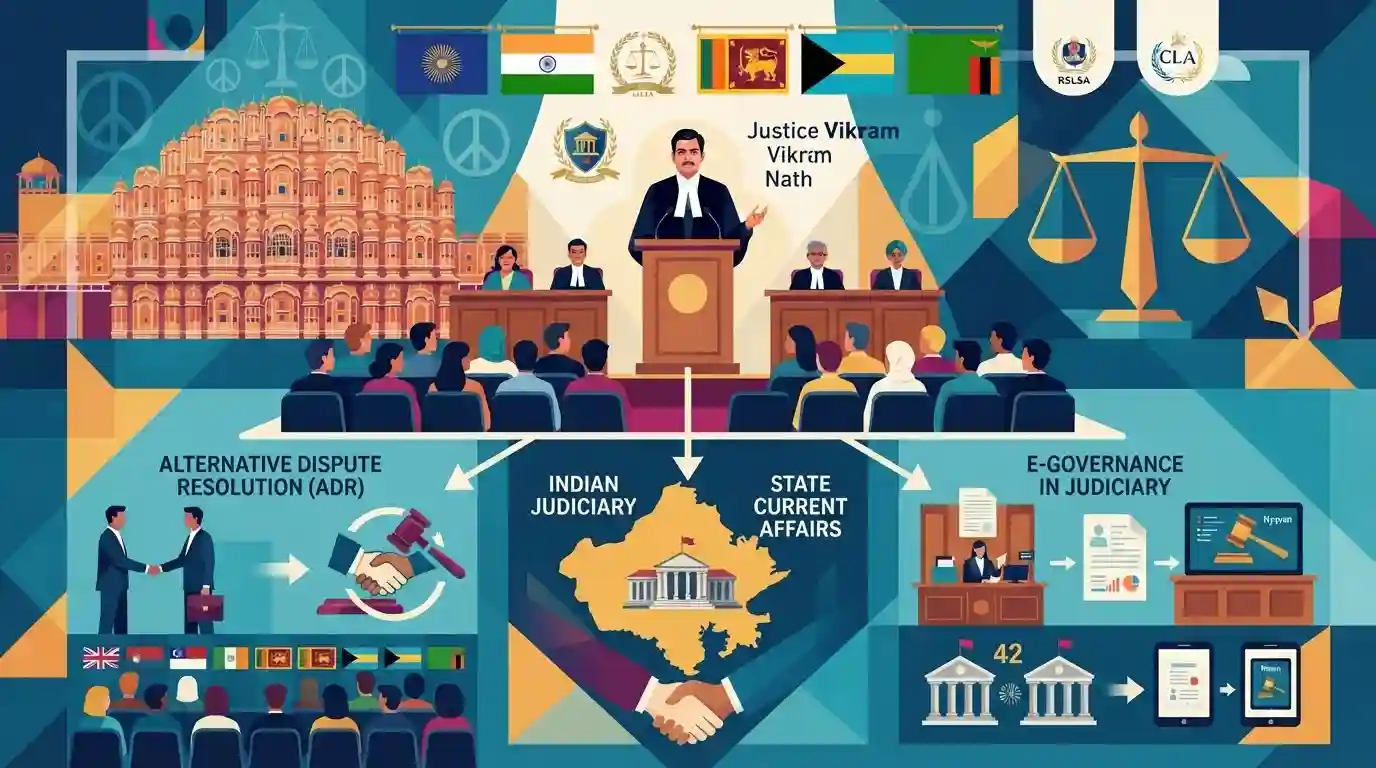
Justice Vikram Nath addressed the valedictory session of the Commonwealth Peace Mediation Conference held in Jaipur in August 2026. The conference, jointly organized by the Rajasthan State Legal Services Authority (RSLSA), Commonwealth Lawyers Association (CLA), SCBA, and Nivaaran, focused on the transformative role of mediation in dispute resolution. International judges from Sri Lanka, Bahamas, and Zambia participated, reflecting a global consensus on Alternative Dispute Resolution (ADR). Alongside the discussions, the Rajasthan High Court announced significant e-governance initiatives, including the paperless operation of 42 district courts and the launch of a new judicial software, 'Nyayan'.
Key Points
- The Commonwealth Peace Mediation Conference was held in Jaipur, Rajasthan in August 2026.
- The valedictory session was addressed by Justice Vikram Nath, Supreme Court Judge and Executive Chairman of NALSA.
- The event was organized by RSLSA, Rajasthan High Court, Commonwealth Lawyers Association, SCBA, and Nivaaran.
- Dignitaries from Bahamas, Sri Lanka, and Zambia attended, with Bahamas and Sri Lanka offering to host the next conference.
- Rajasthan High Court announced the paperless functioning of 42 district courts and introduced a new software called 'Nyayan' to enhance judicial efficiency.
- The conference emphasized mediation and Alternative Dispute Resolution (ADR) as critical tools for resolving family, commercial, and climate disputes.
Important Terms
Nyayan Software

A judicial administration software launched by the Rajasthan High Court in August 2026 to facilitate and manage the paperless operation of district courts.
UPSC context
GS Paper 2 (E-Governance). Relevant for judicial reforms, highlighting the digital transformation of India's lower courts to enhance efficiency.
Nivaaran
An institutional body of mediators from the Supreme Court of India dedicated to advancing the amicable settlement of disputes through Alternative Dispute Resolution and peace mediation.
UPSC context
GS Paper 2 (Dispute Redressal Mechanisms). Important for topics on reducing judicial pendency through institutionalized mediation and conciliation efforts.
Commonwealth Lawyers Association (CLA)
An international organization of legal professionals from Commonwealth nations working to uphold the rule of law, promote human rights, and advance peace mediation practices globally.
UPSC context
GS Paper 2 (International Institutions). Tests awareness of international legal collaborations and forums shaping global justice and ADR frameworks.
National Legal Services Authority (NALSA)
The statutory body established under the Legal Services Authorities Act, 1987, to provide free legal services to marginalized sections and organize Lok Adalats in India.
UPSC context
GS Paper 2 (Statutory Bodies / Judiciary). Essential for evaluating mechanisms that ensure equitable access to justice for vulnerable populations.
Rajasthan State Legal Services Authority (RSLSA)
The state-level statutory body in Rajasthan responsible for executing legal aid programs, organizing alternative dispute resolution forums, and promoting awareness about legal rights.
UPSC context
GS Paper 2 (State Legal Mechanisms). Highlights the decentralized administration of legal aid, free legal services, and justice delivery.
Prelims Trap
The Chief Justice of India serves as the Executive Chairman of NALSA.
The CJI is actually the Patron-in-Chief of NALSA. The second senior-most judge of the Supreme Court serves as the Executive Chairman.
Static Concepts Connected
How does NALSA function under the Legal Services Authorities Act, 1987?
- Constitutional Basis: Implements Article 39A (DPSP) to provide free legal aid to weaker sections and ensure justice is accessible.
- Statutory Role: Created under the Legal Services Authorities Act, 1987 to oversee legal aid programs and organize Lok Adalats.
- Award Finality: Lok Adalat awards are deemed civil court decrees; they are final, binding, and unappealable in any court.
What is the statutory backing for ADR in Indian civil law?
- Section 89 CPC: Empowers civil courts to refer pending disputes for Alternative Dispute Resolution (ADR) if elements of settlement exist.
- Recognized Methods: Explicitly covers arbitration, conciliation, judicial settlement (including Lok Adalats), and mediation.
Cross-Topic Patterns
E-Governance and Judicial Pendency
State-level software like 'Nyayan' aligns with the national e-Courts Project Phase III, leveraging digital infrastructure to tackle the massive backlog of over 4 crore pending cases.
Legal Diplomacy via Commonwealth
Hosting intra-Commonwealth legal summits highlights India's judicial soft power, utilizing shared common law traditions to build consensus on global commercial and climate disputes.

Expect a 2026 multi-statement Prelims question mixing NALSA's leadership structure, Section 89 of CPC, and Lok Adalat award finality.
Linked PYQs · 2
Linked PYQs · 2
- 2023RPSC_PRELIMSGS1
According to Article 217 (1) of the Constitution, the President shall make the appointment of a judge of the Rajasthan High Court (other than the Chief Justice) after consultation with whom?
- 2023RPSC_PRELIMSGS1
The 9th Commonwealth Parliamentary Association (CPA) India Region Conference was held in which city?
