ISRO Committee to Probe Systemic Failures of PSLV Rocket
Source:The Hindu ↗
Why It Matters
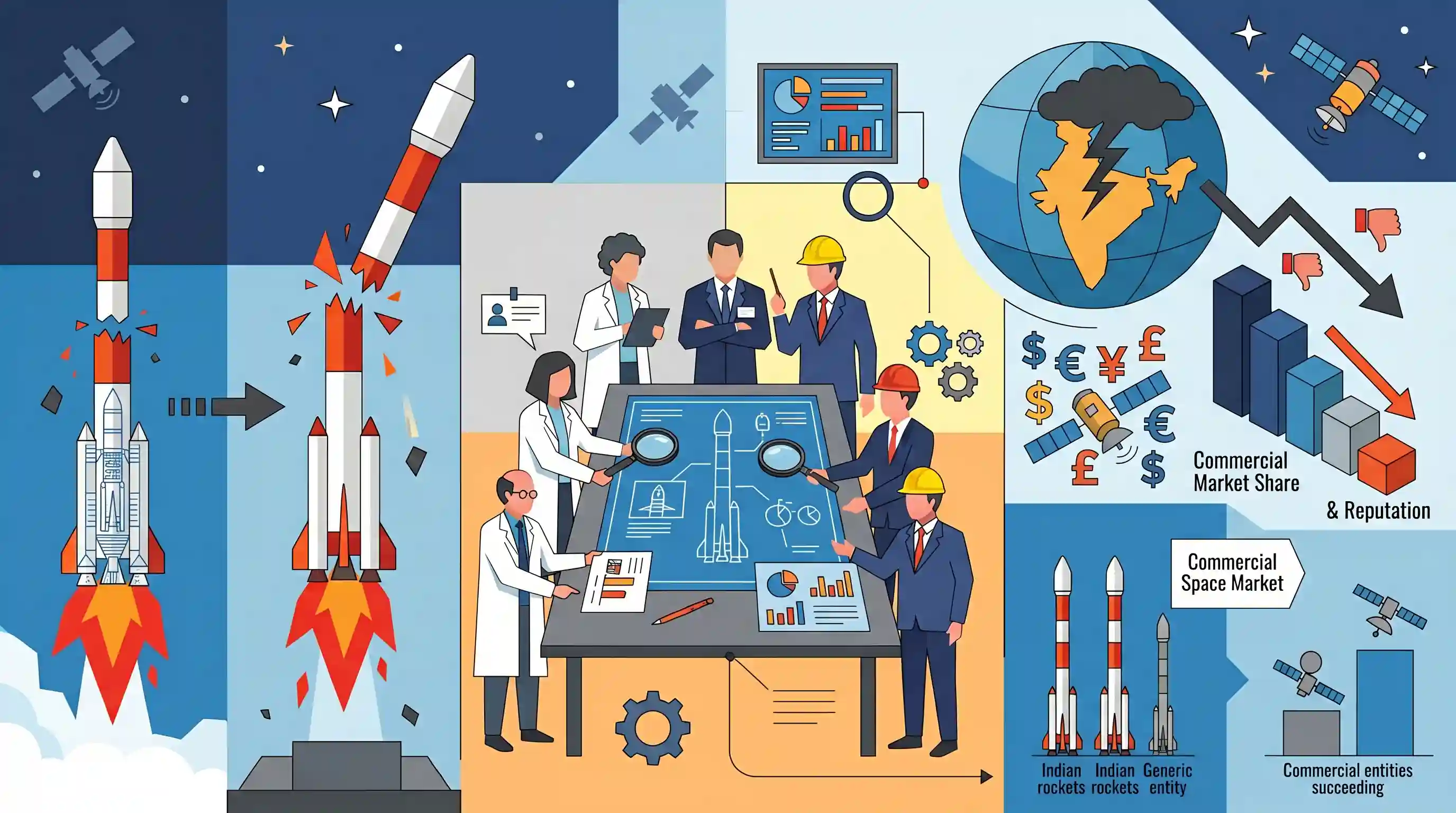
The PSLV is traditionally India's most reliable launch vehicle and the backbone of its commercial space efforts. Repeated failures undermine ISRO's credibility in the global commercial launch market and pose severe risks to the expanding domestic private space ecosystem that depends on these launch services. Understanding ISRO's institutional mechanisms for addressing such failures is important for questions on S&T achievements and governance.
Summary
ISRO has formed a high-level committee, including K. VijayRaghavan and S. Somanath, to investigate systemic and organisational flaws following the back-to-back failures of the PSLV-C61 and PSLV-C62 missions. The repeated malfunctioning of India's historically reliable workhorse rocket raises serious concerns over accountability and procedural lapses, threatening the country's reputation and commercial viability in the growing global and domestic space market.
Key Points
- ISRO has constituted a committee to probe the systemic and organisational issues responsible for the repeated failures of its PSLV rockets.
- The committee features prominent figures, including former Principal Scientific Advisor K. VijayRaghavan and former ISRO Chairman S. Somanath.
- The PSLV-C62 mission failed on January 12, 2026, when its third stage failed to ignite, resulting in the loss of 16 satellites.
- This follows a previous failure on May 18, 2025, when PSLV-C61 failed and destroyed the EOS-09 satellite.
- The recurring anomalies highlight the need for systemic reforms and accountability, especially given the rising involvement of private companies and foreign commercial launches.
Important Terms
Polar Satellite Launch Vehicle (PSLV)

India's "workhorse" launch vehicle, a four-stage rocket alternating between solid and liquid fuel. It is primarily used to place Earth-observation satellites into Sun-Synchronous Polar Orbits.
UPSC context
GS Paper III: Science and Technology. Tests knowledge of launch vehicle architecture and technological self-reliance.
Indian Space Research Organisation (ISRO)
India's primary space agency under the Department of Space, mandated to develop space technology and its application for national needs like communication, navigation, and research.
UPSC context
GS Paper III: Achievements of Indians in science & technology; indigenization of technology.
NewSpace India Limited (NSIL)
The commercial arm of ISRO (est. 2019) responsible for productionising launch vehicles (PSLV/SSLV) through Indian industry and marketing space-based services to global customers.
UPSC context
GS Paper III: Effects of liberalization on the economy; Space commercialisation.
Geosynchronous Satellite Launch Vehicle (GSLV)
A three-stage heavy-lift rocket featuring an indigenous cryogenic upper stage. It is designed to launch communication and weather satellites into higher Geosynchronous Transfer Orbits (GTO).
UPSC context
GS Paper III: Science and Technology. Essential for understanding India's heavy-lift capabilities and cryogenic tech.
Sun-Synchronous Orbit (SSO)
A near-polar orbit where a satellite passes over any point at the same local solar time. This constant illumination is vital for Earth-mapping and surveillance satellites.
UPSC context
GS Paper III: Space technology; awareness in the fields of IT, Space, Computers.
IN-SPACe
An autonomous nodal agency that facilitates and regulates private sector participation in the Indian space program, acting as a "single-window" interface for non-government entities.
UPSC context
GS Paper II/III: Government policies and interventions; Space sector reforms.
Prelims Trap
PSLV is a purely solid-propellant launch vehicle, unlike the GSLV which uses cryogenic engines.
PSLV is actually a four-stage launch vehicle that alternates between solid (1st and 3rd stages) and liquid (2nd and 4th stages) propulsion.
Static Concepts Connected
What is the four-stage propulsion configuration of the PSLV?
- First Stage: Solid propellant motor (HTPB based), often augmented by strap-on boosters in certain variants.
- Second Stage: Earth-storable liquid propulsion system utilizing the indigenous Vikas engine.
- Third Stage: High-performance solid rocket motor (the specific stage implicated in the recent C62 mission failure).
- Fourth Stage: Liquid stage equipped with twin engines for precise final orbital insertion of payloads.
How do the mandates of NSIL and IN-SPACe differ in India's space ecosystem?
- NSIL: The commercial arm of ISRO (a CPSE), focused on executing satellite launch contracts and commercialising ISRO's R&D globally.
- IN-SPACe: An independent, single-window nodal agency meant to authorize, regulate, and facilitate non-governmental/private sector participation in space.
Cross-Topic Patterns
PSLV reliability and forex earnings
PSLV failures threaten NSIL's capacity to secure foreign commercial launch contracts, jeopardizing a crucial stream of high-tech export revenue and global market share.
Space tech + public accountability
The VijayRaghavan committee marks a shift toward stringent public-sector accountability in ISRO, essential for retaining investor confidence as private start-ups enter the ecosystem.

Expect a multi-statement 2026 Prelims question comparing the propellant stages of PSLV, GSLV, and LVM3, alongside NSIL's mandate.
Linked PYQs · 3
Linked PYQs · 3
- 2018PrelimsGS1
With reference to India's satellite launch vehicles, consider the following statements: 1. PSLVs launch the satellites useful for Earth resources monitoring whereas GSLVs are designed mainly to launch communication satellites. 2. Satellites launched by PSLV appear to remain permanently fixed in the same position in the sky, as viewed from a particular location on Earth. 3. GSLV Mk III is a four-staged launch vehicle with the first and third stages using solid rocket motors; and the second and fourth stages using liquid rocket engines. Which of the statements given above is/are correct?
- 2016MainsGS3
Discuss India's achievements in the field of Space Science and Technology. How the application of this technology has helped India in its socio-economic development?
- 2019MainsGS3
What is India's plan to have its own space station and how will it benefit our space programme?
