Expert Committee to Probe Systemic Failures of PSLV Rocket
Source:The Hindu ↗
Why It Matters
Highlights a significant governance shift in India's premier space agency, moving from internal technical reviews to external systemic audits. This is crucial for UPSC candidates studying the evolution of India's space sector, the privatization of space activities, and the need for institutional accountability in science and technology.
Summary
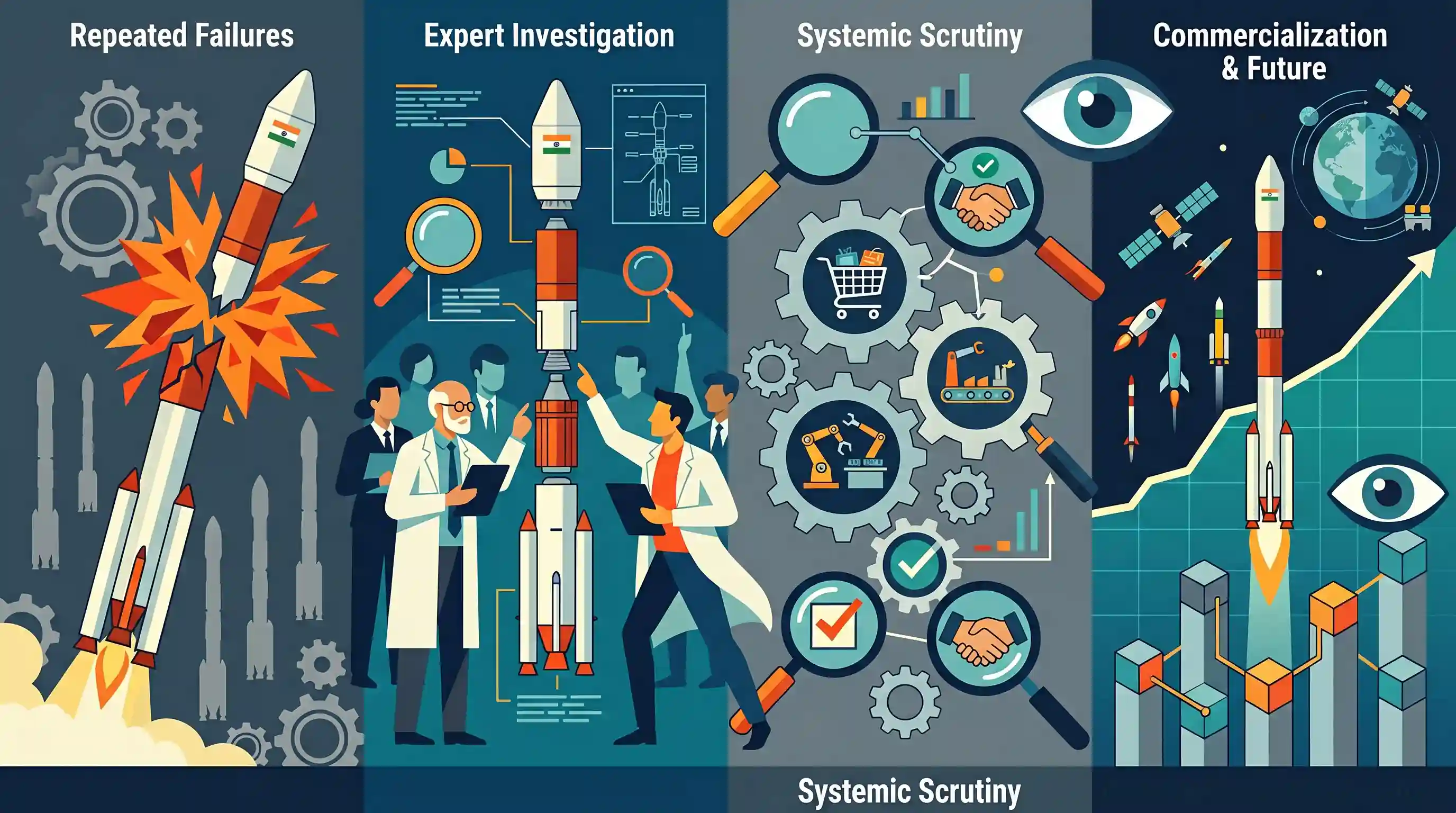
The Union government has constituted a national-level expert committee to investigate systemic and organizational issues behind recent repeated failures of ISRO's Polar Satellite Launch Vehicle (PSLV). Prominent scientists, including K. VijayRaghavan and S. Somanath, will lead the probe following the back-to-back failures of the PSLV-C61 and PSLV-C62 missions, which suffered third-stage ignition anomalies. Going beyond standard internal technical reviews, the committee will scrutinize broader institutional practices such as procurement, manufacturing, assembly, and accountability. This external scrutiny is seen as crucial to restoring faith in India's space program and ensuring robust standards as private companies increasingly participate in the country's growing space ecosystem.
Key Points
- An external expert committee, including former PSA K. VijayRaghavan and former ISRO chief S. Somanath, has been set up to probe the recent repeated failures of ISRO's PSLV rockets.
- The probe marks a shift from ISRO's traditional internal Failure Analysis Committee reviews, focusing instead on broader systemic and organizational issues.
- Recent missions PSLV-C61 and PSLV-C62 failed because the third stage failed to ignite, denting the PSLV's historically high success rate of over 90%.
- The committee will investigate processes spanning procurement, manufacturing, assembling, and organizational accountability.
- The thorough external review is deemed necessary to maintain confidence in India's space systems, especially as the space ecosystem expands with increased private sector participation.
Important Terms
PSLV (Polar Satellite Launch Vehicle)

India's third-generation four-stage launch vehicle, using liquid and solid propulsion. Known as ISRO's 'workhorse' for its high reliability in placing satellites into Polar and Sun-Synchronous Orbits.
UPSC context
GS Paper III: Space Technology. Critical for understanding India's launch capabilities, commercial space success, and recent technical challenges.
ISRO (Indian Space Research Organisation)
India's premier space agency under the Department of Space, responsible for space research, planetary exploration, and the development of indigenous space technologies and launch vehicles.
UPSC context
GS Paper III: Scientific Developments. Central to all topics involving Indian space missions, institutional governance, and self-reliance in technology.
Failure Analysis Committee (FAC)
An internal technical body constituted by ISRO after mission failures to perform root-cause analysis. It focuses on engineering anomalies, telemetry data, and recommending specific technical rectifications.
UPSC context
GS Paper III: Technology and Disaster Management. Tests knowledge of institutional response mechanisms and accountability in high-technology sectors.
Space Commission
The apex body responsible for formulating India's space policies and overseeing the Department of Space. It is typically chaired by the Secretary, Department of Space (ISRO Chairman).
UPSC context
GS Paper II: Governance/Executive Bodies. Important for understanding the administrative structure and policy oversight of India's strategic space sector.
PSLV-C61 & PSLV-C62 Missions
The 63rd and 64th flights of the PSLV (2025-2026) that ended in failure due to third-stage (PS3) anomalies, leading to the loss of strategic Earth observation satellites.
UPSC context
GS Paper III: Internal Security/Space. Highlights the vulnerability of strategic surveillance assets and the impact of technical setbacks on national security.
National-level Expert Committee (K. VijayRaghavan Committee)
A high-level external panel formed in 2026 to investigate institutional lapses in procurement, manufacturing, and quality control following repeated launch failures, signaling a shift toward external accountability.
UPSC context
GS Paper II: Governance & GS III: Science. Tests understanding of systemic reforms, external audits, and governance in scientific organizations.
Prelims Trap
"The PSLV's third stage uses a liquid propellant engine to enable precise orbital insertions."
PSLV uses an alternating solid-liquid architecture. The first and third stages are solid, while the second and fourth are liquid. The recent failures occurred in the solid third stage.
Static Concepts Connected
What is the stage-wise propulsion architecture of the Polar Satellite Launch Vehicle (PSLV)?
- Stage 1 & 3: Uses solid propellants like HTPB. The recent PSLV-C61 and C62 anomalies occurred in the third stage (PS3), which is a solid rocket motor.
- Stage 2 & 4: The second stage uses the Vikas engine (Earth storable liquid), and the fourth uses dual liquid engines (MMH and MON-3).
How does the Indian Space Policy 2023 separate institutional roles in the space sector?
- ISRO (R&D): Transitions away from routine manufacturing to focus primarily on advanced research, deep space missions, and developing new technologies.
- IN-SPACe (Regulator): Acts as the single-window autonomous agency for authorizing, promoting, and regulating private sector space activities (NGEs).
- NSIL (Commercial): The commercial arm responsible for manufacturing, leasing, and marketing space technologies, including operationalizing launch vehicles like the PSLV.
Cross-Topic Patterns
Space commercialization & accountability
With the 2023 Space Policy allowing private entities end-to-end access, transparent external failure probes are critical to reassuring foreign clients and private investors about India's launch reliability.
Internal vs External audits in Science
Shifting from ISRO's internal Failure Analysis Committee to an external national-level panel highlights a crucial GS-2 governance theme: the need for independent accountability mechanisms in strategic scientific sectors.

Expect a 2026 Prelims question mixing PSLV's alternating solid/liquid stages with IN-SPACe's regulatory mandate under the 2023 Space Policy.
Linked PYQs · 4
Linked PYQs · 4
- 2016MainsGS3
Discuss India's achievements in the field of Space Science and Technology. How the application of this technology has helped India in its socio-economic development?
- 2019MainsGS3
What is India's plan to have its own space station and how will it benefit our space programme?
- 2023MainsGS3
What is the main task of India's third moon mission which could not be achieved in its earlier mission? List the countries that have achieved this task. Introduce the subsystems in the spacecraft launched and explain the role of the Virtual Launch Control Centre' at the Vikram Sarabhai Space Centre which contributed to the successful launch from Sriharikota.
- 2018PrelimsGS1
With reference to India's satellite launch vehicles, consider the following statements: 1. PSLVs launch the satellites useful for Earth resources monitoring whereas GSLVs are designed mainly to launch communication satellites. 2. Satellites launched by PSLV appear to remain permanently fixed in the same position in the sky, as viewed from a particular location on Earth. 3. GSLV Mk III is a four-staged launch vehicle with the first and third stages using solid rocket motors; and the second and fourth stages using liquid rocket engines. Which of the statements given above is/are correct?
