India Nordic Summit Upgrades Strategic Green Technology Partnership
Source:The Hindu ↗
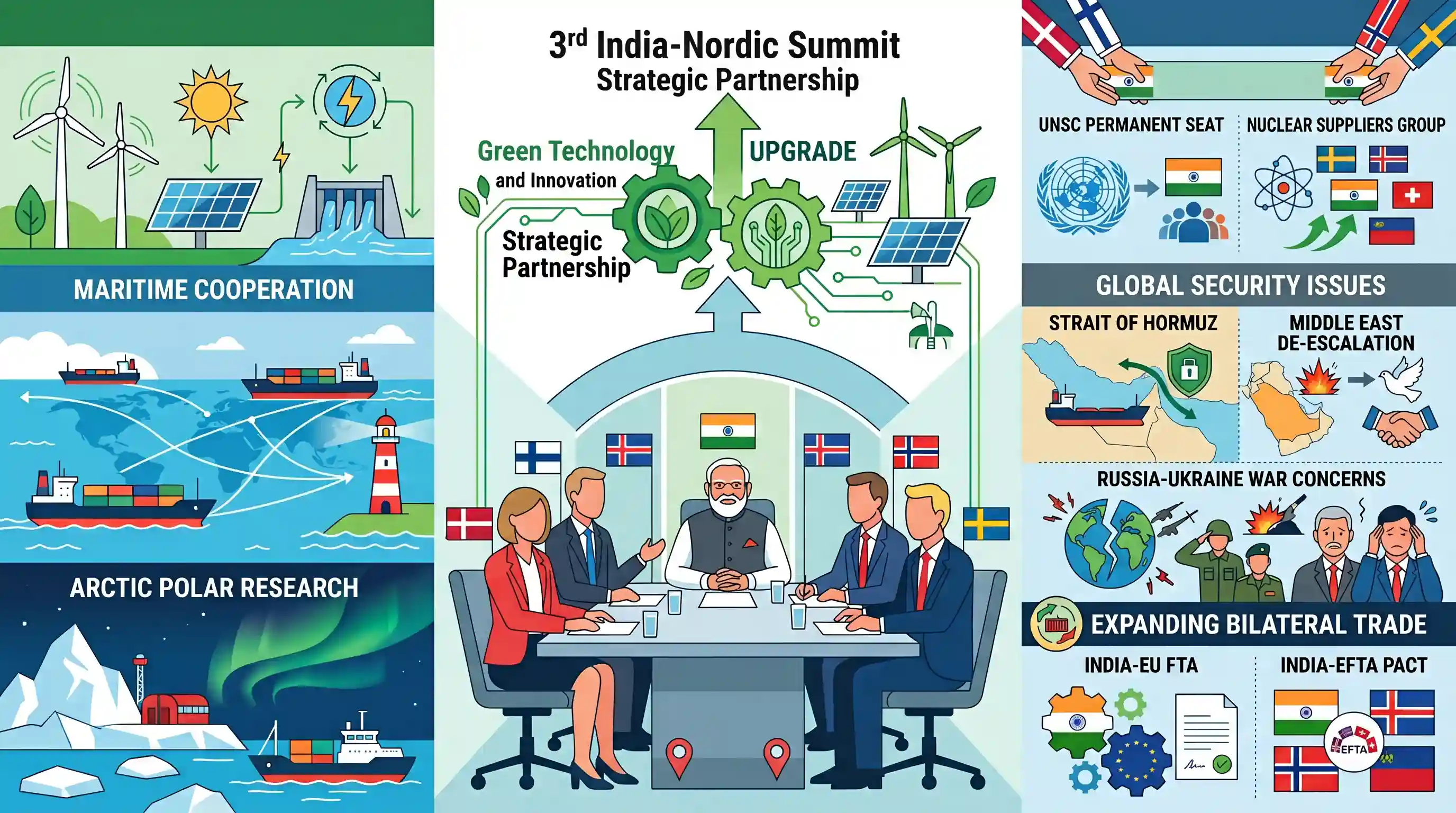
Why It Matters
The India-Nordic Summit highlights India's strategic push to engage with technologically advanced 'middle powers' in Europe. For UPSC aspirants, this illustrates the broadening scope of India's multi-alignment strategy, encompassing green transitions, Arctic geopolitics, UN reforms, and critical trade partnerships (EFTA/EU).
Summary
Prime Minister Narendra Modi attended the Third India-Nordic Summit in Oslo, Norway, where India and the Nordic nations (Denmark, Finland, Iceland, Norway, and Sweden) upgraded their relationship to a 'Green Technology and Innovation Strategic Partnership.' The summit placed a strong emphasis on sustainable energy, maritime cooperation, and Arctic polar research. On the diplomatic front, the Nordic nations threw their weight behind India's quest for a permanent UN Security Council seat and membership in the Nuclear Suppliers Group. The leaders also addressed pressing global security issues, calling for freedom of navigation in the Strait of Hormuz, de-escalation in the Middle East, and expressing concerns over the Russia-Ukraine war, while prioritizing the expansion of bilateral trade frameworks like the India-EU FTA and the EFTA pact.
Key Points
- India and the five Nordic countries (Denmark, Finland, Iceland, Norway, Sweden) elevated their ties to a 'Green Technology and Innovation Strategic Partnership' at the Third India-Nordic Summit in Oslo.
- The leaders agreed to deepen cooperation in sustainable energy, maritime security, and polar research in the Arctic region.
- Nordic leaders reaffirmed their support for India's bid for a permanent seat in a reformed UN Security Council and entry into the Nuclear Suppliers Group (NSG).
- The summit emphasized growing trade partnerships, contextualized by the ongoing India-EU FTA negotiations and the recently signed India-EFTA trade agreement.
- The joint statement condemned terrorism and addressed global geopolitical friction points, urging de-escalation in the Middle East and ensuring freedom of navigation through the Strait of Hormuz.
Important Terms
Green Technology and Innovation Strategic Partnership

An upgraded bilateral framework between India and the five Nordic nations launched in 2026. It focuses on clean energy transition, blue economy, and sustainable development by merging Nordic technological expertise with India's talent and scale.
UPSC context
GS Paper II: International Relations; bilateral and regional groupings; India’s leadership in global climate technology and sustainable development goals.
India-EFTA Trade and Economic Partnership Agreement (TEPA)
A landmark trade pact between India and EFTA states (Iceland, Liechtenstein, Norway, Switzerland) effective from October 2025. It includes an unprecedented $100 billion investment commitment to India and targets for one million jobs.
UPSC context
GS Paper II & III: International Relations and Economy; trade agreements with developed nations; FDI and domestic manufacturing impact.
India-European Union Free Trade Agreement (EU FTA)
A major trade agreement concluded in early 2026 designed to eliminate tariffs on most goods and open service subsectors between India and the EU's 27 member states, enhancing professional mobility and supply chain resilience.
UPSC context
GS Paper II & III: International Relations and Economy; trade liberalization; strategic economic integration with India's largest trading bloc.
Nuclear Suppliers Group (NSG)
A 48-member elite group that controls global nuclear exports to prevent proliferation. India seeks membership to gain full access to advanced nuclear technology and integrate into mainstream global nuclear commerce.
UPSC context
GS Paper II: International Relations; global export control regimes; nuclear diplomacy and India’s strategic autonomy.
UN Security Council (UNSC)
The 15-member United Nations body responsible for international peace and security. India's quest for a permanent seat seeks to reform global governance to reflect contemporary geopolitical realities and democratic representation.
UPSC context
GS Paper II: International Relations; important international institutions; reforms in global governance and India's permanent seat bid.
European Free Trade Association (EFTA)
An intergovernmental organization comprising Iceland, Liechtenstein, Norway, and Switzerland. It promotes free trade and economic integration outside the European Union and recently partnered with India through the TEPA.
UPSC context
GS Paper II: International Relations; regional groupings affecting India’s interests; distinguishing between EU and non-EU European trade blocs.
Prelims Trap
All Nordic nations are part of the EFTA bloc, allowing India to trade seamlessly with them through the new TEPA.
EFTA includes only two Nordic countries (Iceland and Norway) along with Switzerland and Liechtenstein. Denmark, Finland, and Sweden are EU members, which require a separate India-EU FTA.
Static Concepts Connected
What is India's status and institutional footprint in the Arctic region?
- Observer Status: India is not a full member but has maintained an Observer status in the eight-member intergovernmental Arctic Council since 2013.
- Research Infrastructure: India operates the 'Himadri' research station in Svalbard, Norway, and the 'IndARC' underwater moored observatory in Kongsfjorden.
- Monsoon Teleconnections: Indian polar research primarily focuses on understanding the cryosphere, climate change, and their direct impact on the Indian monsoon system.
Why is the Strait of Hormuz geopolitically critical to India?
- Geographic Location: A vital maritime chokepoint connecting the oil-rich Persian Gulf to the Gulf of Oman and the Arabian Sea.
- Bordering Nations: It physically separates Iran to the north from Oman (Musandam Peninsula) and the United Arab Emirates to the south.
- Energy Security: It facilitates a massive share of the world's seaborne oil trade, making freedom of navigation here a core pillar of Indian energy security.
Cross-Topic Patterns
Arctic melt & Indian Monsoons
India's polar partnerships with Nordic countries are driven heavily by climate geography. Studies increasingly link rapid Arctic sea-ice melt to extremes in Indian monsoon variations (teleconnections).
EFTA vs EU Trade Dynamics
The India-EFTA TEPA ($100B investment commitment) accelerates the geopolitical pressure on the stalled India-EU FTA. UPSC often tests structural differences between EFTA, Eurozone, and the EU.

Map-based questions distinguishing European blocs (EFTA vs EU vs Nordic) and Arctic Council observer mechanisms are highly probable in 2026.
Linked PYQs · 3
Linked PYQs · 3
- 2023MainsGS2
‘The expansion and strengthening of NATO and a stronger US-Europe strategic partnership works well for India.’ What is your opinion about this statement ? Give reasons and examples to support your answer.
- 2022PrelimsGS1
Which one of the following statements best describes the 'Polar Code'?
- 2015MainsGS2
Discuss the impediments India is facing in its pursuit of a permanent seat in UN Security Council.
