Pollution control vessel commissioning and maritime self-reliance
Source:The Hindu ↗
Why It Matters
This development is crucial for UPSC as it sits at the intersection of GS-3 topics: indigenisation of defence, maritime security, and marine pollution response. Furthermore, it serves as a strong case study for women's empowerment (GS-1/GS-2) in frontline defense roles.
Summary
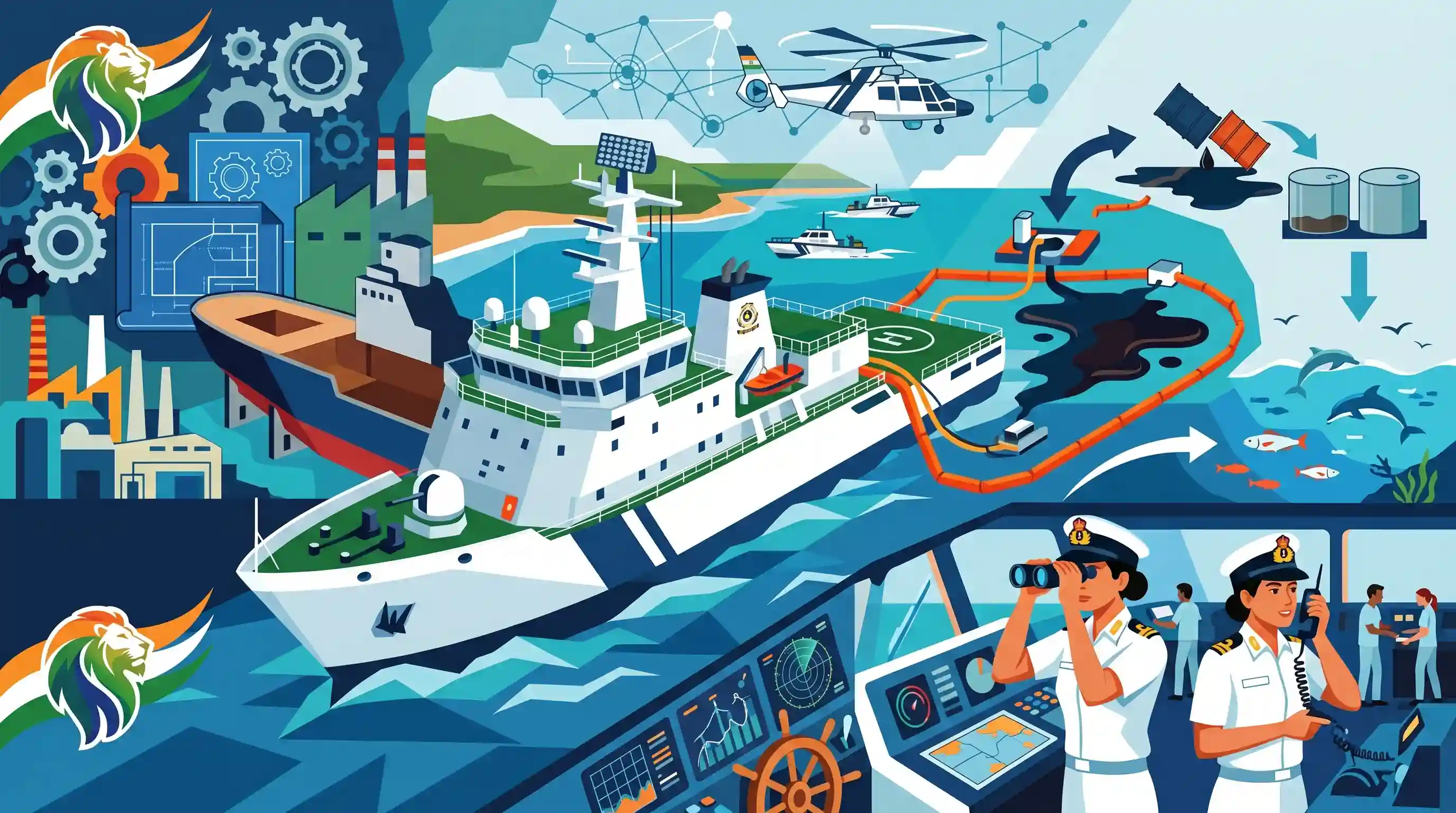
The Indian Coast Guard has commissioned the ICGS Samudra Pratap, marking India's first indigenously designed Pollution Control Vessel (PCV). Built by Goa Shipyard Limited, the vessel emphasizes self-reliance ('Aatmanirbhar Bharat') in defence manufacturing. Equipped with advanced pollution response and detection systems, it enhances India's capacity to address marine environmental challenges and oil spills. Additionally, the deployment of two women officers onboard highlights growing gender inclusion in frontline maritime defense operations.
Key Points
- The Indian Coast Guard commissioned ICGS Samudra Pratap, India's first indigenously designed Pollution Control Vessel (PCV).
- The vessel was built by Goa Shipyard Limited (GSL) and commissioned by Defence Minister Rajnath Singh.
- It strengthens India's maritime security apparatus and marine environmental sustainability, advancing the 'Aatmanirbhar Bharat' vision.
- Equipped with advanced pollution detection systems, specialized response boats, and aviation facilities (helicopter hangar).
- Sets a precedent for gender inclusion by deploying two women officers in frontline maritime operations.
Important Terms
Indian Coast Guard (ICG)

A multi-mission armed force under the Ministry of Defence that serves as India’s maritime law enforcement agency and the Central Coordinating Authority for oil spill response.
UPSC context
GS Paper 3: Internal Security/Environment; tests knowledge of maritime security architecture and oil-spill response mandates.
Pollution Control Vessel (PCV)
Specialized maritime platforms (e.g., ICGS Samudra Pratap) equipped with side-sweeping arms and oil skimmers to contain, recover, and analyze marine pollutants and oil spills.
UPSC context
GS Paper 3: Environment/Security; relevant for marine pollution response and technological advancements in maritime safety.
Indigenisation of Defence
The capability of designing, developing, and manufacturing military equipment domestically to achieve strategic autonomy and reduce reliance on foreign imports.
UPSC context
GS Paper 3: S&T/Security; central to Aatmanirbhar Bharat and tests understanding of defense manufacturing ecosystems.
Goa Shipyard Limited (GSL)
A premier Defence Public Sector Undertaking (DPSU) under the Ministry of Defence, responsible for the indigenous design and construction of sophisticated warships and specialized vessels.
UPSC context
GS Paper 3: Economy/Security; highlights the role of DPSUs in supporting the domestic defense industrial base.
Aatmanirbhar Bharat
The 'Self-reliant India' mission aimed at making India a global manufacturing hub and reducing import dependence in strategic sectors like defense and technology.
UPSC context
GS Paper 3: Economy/Security; foundational theme for industrial policy, strategic self-sufficiency, and indigenous production.
National Oil Spill Disaster Contingency Plan (NOSDCP)
The primary administrative framework established in 1993 for mobilizing resources and coordinating various agencies to respond to oil spill disasters in Indian waters.
UPSC context
GS Paper 3: Disaster Management; tests knowledge of specific protocols for handling marine environmental crises.
Prelims Trap
"The Indian Coast Guard operates as a Central Armed Police Force (CAPF) under the Ministry of Home Affairs."
Unlike CAPFs (BSF, CISF) which manage border and internal security under MHA, the Indian Coast Guard is an independent Armed Force under the Ministry of Defence.
Static Concepts Connected
What is the statutory mandate of the Indian Coast Guard?
- Nodal Agency: Acts as the Central Coordinating Authority for marine oil spill response in India's maritime zones.
- Jurisdiction: Enforces maritime law and protects national interests across India's Territorial Waters, Contiguous Zone, and EEZ.
- Protection Duties: Tasks include protecting artificial islands, offshore terminals, fishermen, and preserving marine ecology.
How does bioremediation mitigate marine oil spills?
- Oilzapper: A consortium of five bacteria species (developed by TERI) that degrades crude oil and hydrocarbon waste into CO2 and water.
- Biostimulation: Adding nutrients (nitrogen, phosphorus) to marine environments to stimulate the growth of indigenous oil-degrading bacteria like Alcanivorax.
- Bioaugmentation: Introducing specific external oil-degrading microorganisms directly to the polluted site to accelerate the cleanup process.
Cross-Topic Patterns
Defense indigenisation meets marine ecology
The shift of defense PSUs like Goa Shipyard from purely kinetic platforms to ecological ones (PCVs) bridges Defense Indigenisation (GS3) with Environmental Conservation (GS3) and disaster response.
Breaking the glass ceiling in maritime roles
Deploying women officers on PCVs aligns with recent moves allowing women on frontline warships and in specialized units, making gender inclusion in armed forces a prime GS1/GS2 essay theme.

Expect a 2026 prelims question merging the statutory role of the Indian Coast Guard in oil spills with bioremediation tech like Oilzapper.
Linked PYQs · 4
Linked PYQs · 4
- 2025MainsGS3
Why is maritime security vital to protect India's sea trade? Discuss maritime and coastal security challenges and the way forward.
- 2022MainsGS3
What are the maritime security challenges in India ? Discuss the organisational, technical and procedural initiatives taken to improve the maritime security.
- 2023MainsGS3
What is oil pollution? What are its impacts on the marine ecosystem? In what way is oil pollution particularly harmful for a country like India?
- 2024MainsGS1
Distinguish between gender equality, gender equity and women's empowerment. Why is it important to take gender concerns into account in programme design and implementation?
